
Huawei has launched the OSTA O1 Pro, the first smartphone under its new OSTA brand, targeting technology enthusiasts and younger premium consumers with advanced artificial intelligence (AI), personalized digital experiences, improved imaging and extended battery life. Starting at RMB 5,699, the smartphone represents Huawei’s strategy to expand its premium market presence and strengthen competition against Apple, Oppo, Xiaomi and vivo in China.
According to Counterpoint Research, Huawei is positioning OSTA as an AI-first smartphone brand, creating an additional growth opportunity beyond its established Mate, Pura and nova product families.
The launch comes as Huawei faces intensifying competition in China’s premium smartphone market, where consumers are becoming increasingly selective about spending on new devices amid rising component costs and longer replacement cycles.
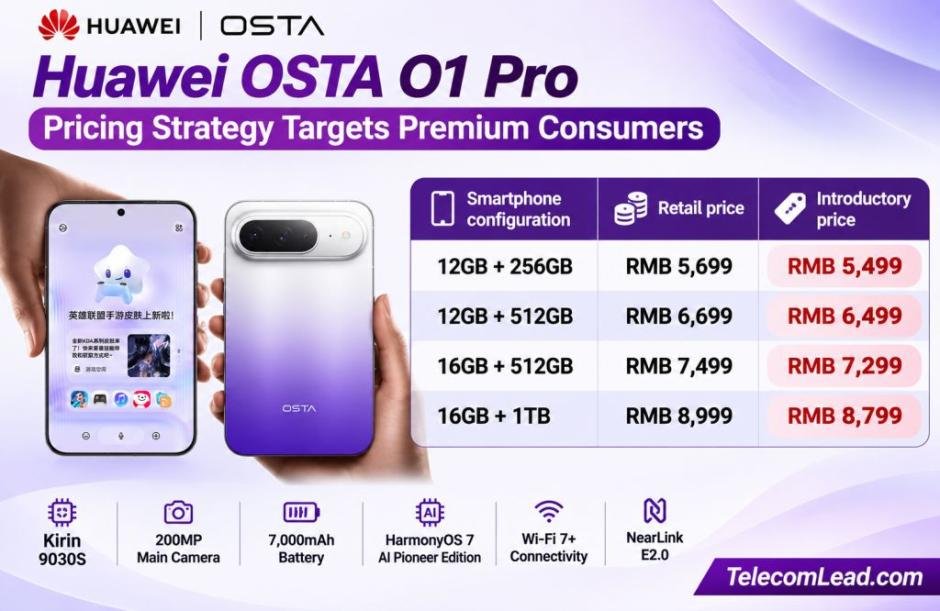
Huawei OSTA O1 Pro Pricing Strategy Targets Premium Consumers
Huawei has introduced four configurations of the OSTA O1 Pro, offering consumers different memory and storage options. The smartphone went on sale in China on November 20, 2026, with introductory discounts of RMB 200 across all variants.
Huawei’s pricing strategy indicates that OSTA is not intended to compete primarily through affordability. Instead, Huawei is targeting consumers willing to pay more for advanced AI capabilities, higher memory configurations and premium hardware.
Consumers upgrading from the entry-level 256GB model to the 1TB configuration must spend an additional RMB 3,300, representing a price difference of nearly 58 percent.
Increasing storage from 256GB to 512GB costs consumers an additional RMB 1,000, while upgrading from 12GB to 16GB RAM in the 512GB configuration costs RMB 800.
The pricing structure provides Huawei with opportunities to increase average selling prices by encouraging consumers to purchase higher-memory variants, particularly as AI applications become more demanding.
Huawei Targets Consumers Seeking AI, Photography and Battery Performance
Huawei is differentiating the OSTA O1 Pro through a combination of AI software and premium hardware rather than relying exclusively on processor performance.
The smartphone features a Kirin 9030S processor, a 6.39-inch 1.5K flat display, a 200MP main camera with RYYB technology, a 50MP periscope telephoto camera and second-generation Red Maple imaging technology.
The 7,000mAh battery, 66W wired charging, wireless charging and Kunlun Glass protection are designed to address consumer requirements around battery endurance, charging convenience and device durability.
Huawei is also targeting consumers seeking improved connectivity through its proprietary Wi-Fi 7+ and NearLink E2.0 technologies.
Huawei’s laboratory tests indicate that Wi-Fi speeds under weak-signal conditions can improve by up to 100 percent, while latency can decline by up to 80 percent when using compatible Huawei networking equipment.
NearLink E2.0 supports connectivity with compatible accessories, gaming devices, audio products and device-finding services, creating additional opportunities for Huawei to expand consumer spending across its hardware ecosystem.
HarmonyOS 7 AI Strategy Focuses on Consumer Personalization
The OSTA O1 Pro is Huawei’s first smartphone featuring HarmonyOS 7 AI Pioneer Edition, reflecting the company’s strategy to make AI a central component of the smartphone experience.
Huawei’s Xiaoyi AI assistant is designed to understand user preferences, retain information across interactions and deliver personalized recommendations.
According to Xinhua, Huawei’s AI platform integrates more than 300 system-data interfaces, over 2,100 system skills and more than 500 ecosystem application capabilities.
Huawei claims that its AI companion achieves long-cycle memory accuracy exceeding 92 percent in laboratory testing.
Consumers can use Xiaoyi to remember restaurants, movies, travel destinations, personal interests and everyday preferences. Huawei is attempting to differentiate its smartphones by making AI more proactive and context-aware rather than limiting functionality to conventional chatbot interactions.
However, consumer adoption will depend on AI accuracy, practical usefulness, personal data protection and the availability of compatible applications.
Strong Initial Demand for Higher-Priced OSTA Smartphones
The 16GB RAM configurations reportedly sold out across online and offline sales channels on launch day, prompting Huawei to adjust production and availability.
The initial consumer response suggests that buyers interested in AI smartphones may prioritize higher memory capacity despite significant price differences.
For Huawei, demand for the more expensive configurations could support higher average selling prices and premium brand positioning. However, launch-day sellouts do not establish sustained consumer demand, particularly because initial inventory and actual sales volumes have not been disclosed in the supplied reports.
Huawei’s Strategy Behind the New OSTA Smartphone Brand
Huawei has reportedly spent approximately three years developing OSTA, which stands for Original, Smart, Technology and Accessible.
The company’s initial strategy is to spend one to two years establishing brand recognition, developing a dedicated consumer base and experimenting with emerging technologies rather than aggressively pursuing shipment volumes.
OSTA allows Huawei to introduce experimental AI features and new smartphone experiences without significantly changing the positioning of its established Mate and Pura flagship brands.
The strategy shares similarities with Oppo’s approach to OnePlus, where a differentiated brand identity targets specific consumer segments while benefiting from the parent company’s technology and supply-chain infrastructure.
OSTA will leverage Huawei’s Kirin processors, HarmonyOS operating system, imaging technologies and nationwide service network of more than 2,600 outlets in China.
Huawei’s strategic partnership with JD.com also carries a three-year sales target of RMB 70 billion, although this represents the broader partnership’s ambition rather than an exclusive OSTA revenue target.
Huawei Faces Growing Competition from Apple in China’s Premium Smartphone Market
Huawei’s OSTA launch comes as Apple strengthens its position in China’s premium smartphone segment, defined by Counterpoint Research as devices with wholesale prices above $600.
Apple increased its premium smartphone market share from 50 percent in Q3 2025 to 54 percent in Q3 2026, while Huawei’s share declined from 31 percent to 26 percent.
Oppo increased its share from 2 percent to 5 percent, while Xiaomi declined from 8 percent to 6 percent. Vivo accounted for 5 percent and Honor held 2 percent in Q3 2026.
China’s premium smartphone segment recorded 6 percent growth, demonstrating continued demand for higher-priced devices despite weakness in the broader smartphone market.
According to Counterpoint Research’s Double 11 smartphone sales report, China’s smartphone sales declined 17 percent year-on-year between October 12 and November 13, 2026.
Huawei was the only major smartphone manufacturer to achieve growth during the period, with sales increasing 29 percent, supported by the Enjoy 90 Pro Max, Pura X View and Enjoy 100 series.
Huawei’s HarmonyOS Ecosystem Supports Premium Pricing Strategy
Huawei is increasingly relying on its proprietary software ecosystem to strengthen consumer loyalty, encourage repeat purchases and differentiate its smartphones from Android and Apple devices.
According to RTHK, devices running HarmonyOS 5, 6 and 7 surpassed 100 million across smartphones, tablets and PCs. The ecosystem supports more than 460,000 applications and services and 12 million registered developers.
For Huawei, OSTA creates another channel to expand HarmonyOS adoption, generate premium smartphone revenue and encourage consumers to purchase compatible connected devices.
The success of Huawei’s OSTA strategy will ultimately depend on whether consumers consider its AI capabilities, photography, battery performance and ecosystem integration sufficiently valuable to justify prices approaching RMB 9,000. Huawei must also establish a distinct identity for OSTA without cannibalizing sales of its existing premium smartphones.
FASNA SHABEER