
TIM Brazil reported 5.3 percent growth in service revenue to R$ 6.88 billion in the third quarter of 2026, supported by higher mobile average revenue per user (ARPU), expanding fiber broadband subscriptions and stronger enterprise digital services revenue.
The Brazilian telecom operator is accelerating its strategy around mobile monetization, fiber broadband, 5G-enabled enterprise connectivity, cloud computing and artificial intelligence (AI), while maintaining its 2026 capital expenditure (Capex) guidance of R$ 4.4 billion to R$ 4.6 billion.
TIM Brazil Revenue Growth Driven by Mobile, Fiber and Enterprise Services
TIM Brazil’s net service revenue increased to R$ 6.882 billion in Q3 2026 from R$ 6.534 billion a year earlier.
Mobile service revenue rose 4 percent to R$ 6.451 billion from R$ 6.203 billion, reflecting ARPU growth, postpaid subscriber growth and improving prepaid revenue trends.
Fixed service revenue increased 30.1 percent to R$ 430 million from R$ 331 million.
During the first nine months of 2026, total service revenue grew 5.8 percent, mobile revenue increased 4.7 percent and fixed revenue expanded 26.7 percent.
TIM’s enterprise business recorded strong growth, with B2B service revenue increasing 19.3 percent to R$ 1.827 billion on a last-12-month basis, compared with R$ 1.532 billion in the corresponding previous period.
B2B services represented 6.8 percent of total service revenue, while new business lines, including Network-as-a-Service, data partnerships and IoT, accounted for 24 percent of B2B revenue.
TIM Brazil Capex Strategy Focuses on Network Investment and Digital Expansion
TIM Brazil reported nominal Capex of R$ 3.3 billion during the first nine months of 2026.
The company maintained its full-year Capex guidance of R$ 4.4 billion to R$ 4.6 billion.
TIM’s investment strategy supports mobile network development, fiber broadband expansion, enterprise connectivity and digital service capabilities.
The operator is also extending its enterprise portfolio through dedicated 5G networks, cloud infrastructure and AI-based network operations.
The Q3 2026 presentation does not provide a separate breakdown of Capex for 5G, fiber broadband or AI infrastructure.
TIM Brazil Mobile ARPU Rises 5% as Postpaid Subscriber Growth Accelerates
TIM Brazil’s mobile ARPU increased 5 percent year-on-year to R$ 34.8 per month in Q3 2026.
The operator added 292,000 postpaid subscribers excluding machine-to-machine (M2M) connections during the quarter, compared with 247,000 in Q2 2026 and 188,000 in Q1 2026.
Postpaid churn declined to 0.8 percent, improving by 0.1 percentage point sequentially.
TIM also reported a 12 percent year-on-year increase in its loyal postpaid and control customer base, reflecting greater adoption of plans with customer retention commitments.
In prepaid services, revenue declined 4.2 percent year-on-year in Q3 2026, compared with declines of 6.9 percent in Q2 and 6.5 percent in Q1.
TIM introduced a new R$ 40 prepaid offer in selected regions to encourage higher-value recharges and improve prepaid ARPU.
The operator’s mobile strategy emphasizes subscriber value, customer retention and higher revenue per connection rather than subscriber additions alone.
TIM Ultrafibra Subscribers Increase 13.2% to 931,000
TIM Brazil’s fiber broadband business continued expanding during Q3 2026, with TIM Ultrafibra subscribers reaching 931,000, representing 13.2 percent year-on-year growth.
The fiber subscriber base increased from 880,000 in Q1 2026 to 899,000 in Q2 and 931,000 in Q3.
TIM Ultrafibra revenue increased 12.7 percent year-on-year to R$ 257 million in Q3 2026, compared with R$ 247 million in Q2 and R$ 243 million in Q1.
For the first nine months of 2026, TIM Ultrafibra revenue grew 11.2 percent.
Fiber broadband gross subscriber additions increased 10 percent year-on-year.
TIM also reported an 8.1 percentage-point year-on-year increase in the proportion of broadband customers who also subscribe to its mobile services.
The company’s fixed-mobile convergence strategy includes TIM Black Família VIP, combining 600 Mbps fiber broadband with a 200 GB mobile data allowance at R$ 314.99.
The package accounted for 54.7 percent of convergence activations.
TIM has also launched its full UltraCombo portfolio to strengthen fixed-mobile convergence and increase revenue from existing customer relationships.
TIM Brazil Expands 5G Coverage for Enterprises, Industry and Smart Cities
TIM Brazil is expanding its 5G strategy beyond consumer mobile broadband into enterprise connectivity, industrial applications and smart-city infrastructure.
The operator reported coverage of approximately 31 million hectares of agricultural land through its 4G network, representing 32 percent year-on-year growth.
Its logistics connectivity network covered 13,776 kilometers of highways, an increase of 81 percent year-on-year.
TIM is strengthening its automotive connectivity business through partnerships with BYD, Fiat, Jeep and Ram.
Under its BYD partnership, TIM expects to provide embedded connectivity for 200,000 vehicles over the next 24 months.
TIM is also providing dedicated 5G and 4G connectivity covering 4.6 square kilometers of BYD’s industrial operation, including indoor and outdoor environments.
In Rio de Janeiro, TIM is supporting a public-safety connectivity project involving more than 12,000 cameras using 5G network slicing.
The company also highlighted the deployment of Brazil’s first 5G port with a private network.
TIM’s presentation did not disclose its nationwide 5G population coverage percentage or total 5G subscriber base for Q3 2026.
TIM Brazil Digital Strategy Expands Cloud, AI and Enterprise Revenue
TIM Brazil is expanding its digital business through V8.TECH, cloud services, enterprise AI and cybersecurity.
The company launched TIM Cloud AI by V8.TECH, combining Oracle Cloud Infrastructure (OCI), GPU capacity and managed services in a unified enterprise offering.
V8.TECH is positioned as Oracle’s first cloud managed services provider in Latin America and serves more than 100 enterprise customers.
TIM is also expanding its enterprise cybersecurity portfolio through Google Security Operations, integrating security information and event management (SIEM), security orchestration and automated response (SOAR), threat intelligence and agentic AI capabilities.
TIM’s B2B business already serves more than 120 large companies through its cybersecurity portfolio.
The operator is also strengthening digital customer engagement through TIM Play, TIM BetaCreator, PicPay and its UltraCombo fixed-mobile offering.
TIM BetaCreator combines a 50 GB mobile plan with unlimited TikTok usage, targeting digital content creators.
The company’s PicPay partnership supports financial services integration and cross-selling.
TIM Brazil Uses AI to Improve Customer Service and Network Availability
Artificial intelligence is becoming a major component of TIM Brazil’s customer service and network management strategy.
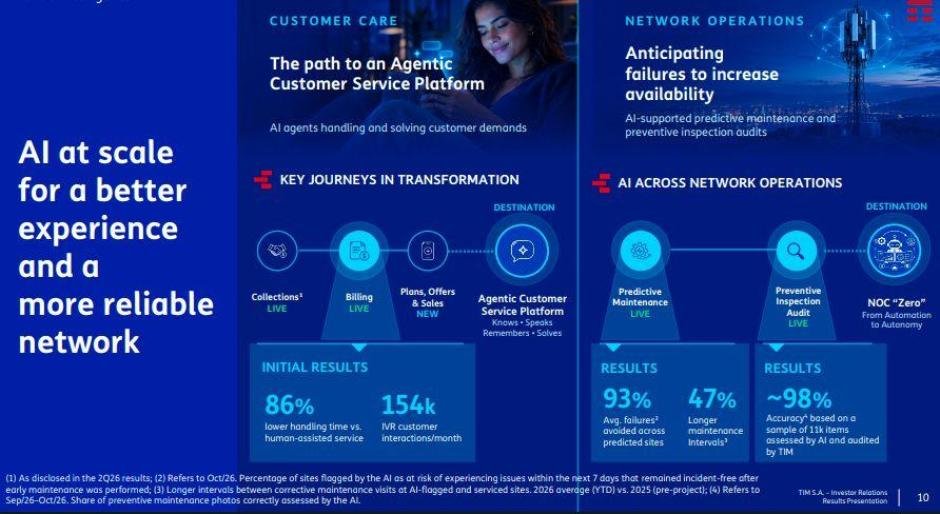
The company is deploying AI agents across customer service processes, including collections, billing, plans, offers and sales.
AI-based collections and billing applications are already operational, while additional customer interactions are being integrated into an agentic customer service platform.
TIM reported that AI-assisted customer service reduced handling time by 86 percent compared with human-assisted service.
Its AI-enabled interactive voice response platform handles approximately 154,000 customer interactions per month.
In network operations, TIM is using AI-supported predictive maintenance and preventive inspection systems to improve network availability.
The operator reported that early maintenance prevented failures at 93 percent of AI-flagged sites identified as at risk in October 2026.
TIM also recorded 47 percent longer intervals between corrective maintenance visits at AI-flagged and serviced sites compared with its 2025 pre-project average.
AI-based preventive inspection achieved approximately 98 percent accuracy in assessing network maintenance images.
TIM’s longer-term objective is to move toward increasingly autonomous network operations through its NOC Zero strategy.
TIM Brazil’s 2026 Strategy Prioritizes ARPU, Fiber Growth, 5G and AI
TIM Brazil’s Q3 2026 performance reflects a strategy centered on improving mobile ARPU, expanding fiber broadband subscriptions, reducing postpaid churn and increasing enterprise digital revenue.
The company is maintaining its R$ 4.4 billion to R$ 4.6 billion annual Capex guidance while extending 5G applications into automotive connectivity, industrial networks, public safety and enterprise services.
TIM’s expansion through V8.TECH, Oracle Cloud Infrastructure and AI-enabled network operations represents a broader shift toward cloud, cybersecurity, AI and managed enterprise connectivity.
The operator’s revenue growth, improving postpaid subscriber additions and expanding fiber customer base provide the main indicators of progress in its telecom and digital services strategy.
BABURAJAN KIZHAKEDATH