Reliance Jio delivered the fastest mobile download speeds in Gujarat’s Kachchh region, while Bharti Airtel demonstrated strong voice network reliability and upload performance, according to the latest drive test conducted by the Telecom Regulatory Authority of India (TRAI). BSNL recorded the highest call drop rates and significant coverage gaps, particularly along the Bhuj–Bhachau highway.
TRAI’s mobile network quality assessment, released on October 29, 2026, evaluated the performance of Reliance Jio, Bharti Airtel, Vodafone Idea and BSNL across Gandhidham, Bhuj and the Bhuj–Bhachau highway.
The tests were conducted between September 8 and September 11, 2026, covering 245.2 kilometres of urban routes, 75.7 kilometres of highway and nine hotspot locations.
Reliance Jio Leads Mobile Download Speeds in Gandhidham and Bhuj
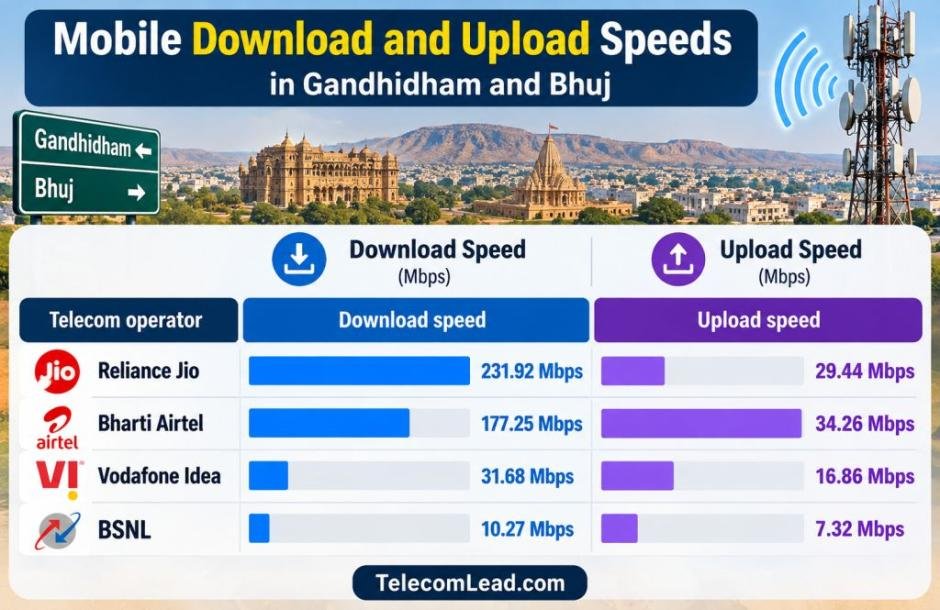
Reliance Jio achieved the highest mobile download speed of 231.92 Mbps across the Kachchh urban test routes, outperforming Airtel, Vodafone Idea and BSNL.
Airtel secured second position with an average download speed of 177.25 Mbps.
Vodafone Idea recorded 31.68 Mbps, while BSNL delivered 10.27 Mbps.
Reliance Jio’s average download speed was approximately 31 percent higher than Airtel’s performance.
Jio delivered download speeds approximately 7.3 times faster than Vodafone Idea and 22.6 times faster than BSNL.
The results highlight the substantial differences in mobile broadband performance among India’s leading telecom operators.
However, the comparison includes different network technologies. Jio and Airtel were tested across 5G and 4G networks, while BSNL’s results covered 4G, 3G and 2G services.
Airtel emerged as the leader in mobile upload performance, delivering an average speed of 34.26 Mbps.
Reliance Jio followed with 29.44 Mbps, while Vodafone Idea achieved 16.86 Mbps.
BSNL recorded the lowest upload speed at 7.32 Mbps.
Airtel’s upload performance was approximately 16 percent higher than Reliance Jio’s.
Reliance Jio Achieves 241 Mbps Download Speed on Bhuj–Bhachau Highway
Reliance Jio strengthened its lead in mobile broadband performance along the Bhuj–Bhachau highway.
Jio achieved an average download speed of 241.22 Mbps, compared with Airtel’s 139.15 Mbps.
Vodafone Idea delivered 22.97 Mbps, while BSNL recorded 10.66 Mbps.
Reliance Jio’s highway download speed was approximately 73 percent higher than Airtel’s.
Jio’s download performance was approximately 10.5 times that of Vodafone Idea and 22.6 times that of BSNL.
Mobile Network Speed Comparison on Bhuj–Bhachau Highway
| Telecom operator | Download speed | Upload speed |
| Reliance Jio | 241.22 Mbps | 19.41 Mbps |
| Bharti Airtel | 139.15 Mbps | 17.68 Mbps |
| Vodafone Idea | 22.97 Mbps | 13.80 Mbps |
| BSNL | 10.66 Mbps | 3.80 Mbps |
Reliance Jio also led highway upload performance with 19.41 Mbps.
Airtel followed closely with 17.68 Mbps, while Vodafone Idea recorded 13.80 Mbps.
BSNL achieved an average upload speed of just 3.80 Mbps.
The highway results indicate that Reliance Jio maintained a significant mobile broadband advantage across the tested route.
However, Jio’s upload speed declined from 29.44 Mbps in urban areas to 19.41 Mbps on the highway.
Airtel’s upload speed decreased from 34.26 Mbps to 17.68 Mbps.
Vodafone Idea’s upload performance declined from 16.86 Mbps to 13.80 Mbps.
These differences illustrate how mobile broadband performance can vary between urban environments and highway corridors.
Airtel and Vodafone Idea Record Zero Call Drops in Urban Tests
Voice network reliability was another important component of TRAI’s assessment.
Airtel and Vodafone Idea recorded zero dropped calls across the urban test routes covering Gandhidham, Bhuj and surrounding locations.
Airtel successfully established 496 calls without recording any dropped calls.
Vodafone Idea established 499 calls and also reported zero dropped calls.
Reliance Jio recorded three dropped calls from 495 successfully established calls.
BSNL recorded 10 dropped calls from 496 established calls.
Call Drop Performance in Gandhidham and Bhuj
| Operator | Established calls | Dropped calls | Calculated drop rate |
| Airtel | 496 | 0 | 0 percent |
| Vodafone Idea | 499 | 0 | 0 percent |
| Reliance Jio | 495 | 3 | 0.61 percent |
| BSNL | 496 | 10 | 2.02 percent |
Airtel and Vodafone Idea demonstrated the strongest voice call continuity during the urban tests.
Reliance Jio maintained a relatively low call drop rate of 0.61 percent.
BSNL’s 2.02 percent call drop rate was the highest among the four operators.
The results suggest that mobile download speed leadership does not necessarily translate into the strongest voice call reliability.
BSNL Records 12.5 Percent Call Drop Rate on Highway
The performance gap became more pronounced along the Bhuj–Bhachau highway.
BSNL recorded seven dropped calls from 56 successfully established calls, representing a call drop rate of 12.5 percent.
Airtel and Reliance Jio recorded zero dropped calls during their respective 54 established calls.
Vodafone Idea reported one dropped call from 55 established calls, resulting in a call drop rate of approximately 1.82 percent.
Highway Call Drop Performance
| Operator | Established calls | Dropped calls | Calculated drop rate |
| Airtel | 54 | 0 | 0 percent |
| Reliance Jio | 54 | 0 | 0 percent |
| Vodafone Idea | 55 | 1 | 1.82 percent |
| BSNL | 56 | 7 | 12.50 percent |
BSNL’s highway call drop performance represents a significant service quality concern.
BSNL Faces Significant Mobile Coverage Gaps
TRAI’s signal strength measurements revealed additional differences in network coverage.
In Gandhidham, Bhuj and surrounding areas, Airtel recorded 242 poor-signal samples from 56,687 measurements.
Vodafone Idea recorded 245 poor-signal samples from 56,876 measurements.
Reliance Jio recorded 290 poor-signal samples from 55,391 measurements.
BSNL registered 575 poor-signal samples from 56,051 measurements.
Urban Mobile Coverage Gaps
| Operator | Poor-signal samples | Calculated coverage gap |
| Airtel | 242 | 0.43 percent |
| Vodafone Idea | 245 | 0.43 percent |
| Reliance Jio | 290 | 0.52 percent |
| BSNL | 575 | 1.03 percent |
Airtel and Vodafone Idea demonstrated the lowest proportion of poor-signal measurements across the urban routes.
BSNL recorded the highest proportion of poor-signal samples.
TRAI reported no samples classified as having no coverage for any of the four operators during the urban tests.
BSNL Highway Coverage Gap Reaches 16.48 Percent
The highway assessment revealed a much larger coverage problem for BSNL.
BSNL recorded 1,718 poor-signal samples from 10,423 measurements, representing a coverage gap of approximately 16.48 percent.
Airtel recorded 202 poor-signal samples from 11,015 measurements.
Reliance Jio recorded 187 poor-signal samples from 10,902 measurements.
Vodafone Idea recorded 164 poor-signal samples from 11,198 measurements.
Bhuj–Bhachau Highway Coverage Performance
| Operator | Poor-signal samples | Calculated coverage gap |
| Vodafone Idea | 164 | 1.46 percent |
| Reliance Jio | 187 | 1.72 percent |
| Airtel | 202 | 1.83 percent |
| BSNL | 1,718 | 16.48 percent |
Vodafone Idea recorded the lowest percentage of poor-signal samples on the highway.
Reliance Jio ranked second, followed by Airtel.
BSNL’s coverage gap was approximately 11.3 times Vodafone Idea’s.
More importantly, TRAI identified 189 samples with limited service or no coverage on BSNL’s highway network.
Airtel, Reliance Jio and Vodafone Idea recorded zero samples in this category.
The findings suggest that BSNL requires targeted network optimization and coverage improvements along the Bhuj–Bhachau corridor.
Airtel Leads Packet Loss Performance
Packet loss is another important measure of mobile network quality because it affects video calls, online gaming, cloud applications and real-time communications.
In urban testing, Airtel recorded the lowest downlink packet loss rate at 0.17 percent.
Vodafone Idea followed with 0.42 percent, while Reliance Jio recorded 0.93 percent.
BSNL reported the highest downlink packet loss rate at 1.52 percent.
For uplink packet loss, Airtel again performed best at 0.22 percent.
Vodafone Idea recorded 0.39 percent, Reliance Jio 0.79 percent and BSNL 2.40 percent.
Urban Packet Loss Comparison
| Operator | Downlink packet loss | Uplink packet loss |
| Airtel | 0.17 percent | 0.22 percent |
| Vodafone Idea | 0.42 percent | 0.39 percent |
| Reliance Jio | 0.93 percent | 0.79 percent |
| BSNL | 1.52 percent | 2.40 percent |
Airtel’s lower packet loss rates indicate stronger data transmission consistency during the measured sessions.
BSNL Packet Loss Increases on Highway
BSNL’s packet loss performance deteriorated further along the Bhuj–Bhachau highway.
The operator recorded downlink packet loss of 3.88 percent and uplink packet loss of 4.19 percent.
Airtel achieved the lowest packet loss rates, with 0.50 percent downlink and 0.43 percent uplink.
Reliance Jio recorded 0.98 percent downlink packet loss and 0.65 percent uplink packet loss.
Vodafone Idea registered 1.11 percent downlink packet loss and 1.12 percent uplink packet loss.
Highway Packet Loss Comparison
| Operator | Downlink packet loss | Uplink packet loss |
| Airtel | 0.50 percent | 0.43 percent |
| Reliance Jio | 0.98 percent | 0.65 percent |
| Vodafone Idea | 1.11 percent | 1.12 percent |
| BSNL | 3.88 percent | 4.19 percent |
The results reinforce Airtel’s advantage in data transmission reliability.
BSNL’s relatively high packet loss rates, combined with weak signal strength and dropped calls, indicate multiple network quality challenges along the tested highway.
Airtel Records Zero Call Silence Instances
TRAI also assessed interruptions in voice communication lasting more than three seconds.
Across the urban test routes, Airtel recorded zero call silence instances.
BSNL recorded six instances, while Reliance Jio registered seven.
Vodafone Idea recorded two calls affected by silence, according to the report’s summary. The detailed annexure lists four individual silence instances across those calls.
On the Bhuj–Bhachau highway, Airtel and BSNL recorded zero call silence instances.
Reliance Jio and Vodafone Idea each recorded one instance.
Airtel was the only operator to record zero call silence instances across both urban and highway testing.
This performance, combined with zero dropped calls, indicates strong voice service reliability during the assessment.
TRAI Network Test: Which Telecom Operator Performed Best?
The September 2026 drive test identified different performance leaders across mobile broadband, voice services and network coverage.
Reliance Jio: Led average download speeds in both urban and highway testing, reaching 231.92 Mbps and 241.22 Mbps, respectively. Jio also achieved the fastest highway upload speed at 19.41 Mbps.
Bharti Airtel: Led urban upload speeds at 34.26 Mbps and recorded the lowest downlink and uplink packet loss rates in both testing environments. Airtel also achieved zero dropped calls and zero call silence instances across the tested routes.
Vodafone Idea: Recorded zero dropped calls in urban testing and the lowest proportion of poor-signal samples on the highway at 1.46 percent. However, its average download speeds remained considerably below those of Reliance Jio and Airtel.
BSNL: Recorded the lowest download and upload speeds across both testing environments. The operator also experienced the highest call drop rates, packet loss rates and coverage gaps, with particularly weak performance on the Bhuj–Bhachau highway.
The findings highlight the need for telecom operators to improve not only mobile broadband speeds but also network availability, voice call continuity and data transmission reliability.
For BSNL, the most immediate priorities indicated by the results are improving highway coverage, reducing dropped calls and addressing packet loss.
For Reliance Jio, the results demonstrate a substantial advantage in download throughput, although Airtel performed better on several reliability measures.
Airtel’s performance illustrates the importance of consistent voice and data quality alongside competitive mobile broadband speeds.
Vodafone Idea demonstrated relatively strong coverage and voice reliability, but its lower download throughput suggests room for network capacity and speed improvements.
TRAI has shared the findings with the respective telecom operators for necessary action.
The regulator emphasized that the observations represent network performance on the specific routes and at the times of testing. They should not be interpreted as a comprehensive ranking of operator performance across Gujarat.
BABURAJAN KIZHAKEDATH