
Reliance Jio delivered the fastest mobile internet download speeds in Gonda, Bahraich and Balrampur, while Bharti Airtel led upload performance in two cities, according to the latest Telecom Regulatory Authority of India (TRAI) network quality assessment. BSNL recorded significantly higher coverage gaps and call drop rates, highlighting the challenges facing its mobile network in eastern Uttar Pradesh.
TRAI conducted its drive test between September 7 and 10, 2026, covering 367.7 km of city routes across Gonda, Bahraich, Shravasti and Balrampur, 256 km of highways connecting Prayagraj, Gonda and Bahraich, and 2.7 km of walking tests.
The assessment compared Reliance Jio, Bharti Airtel, Vodafone Idea and BSNL on mobile internet speeds, network coverage, call drops and voice quality.
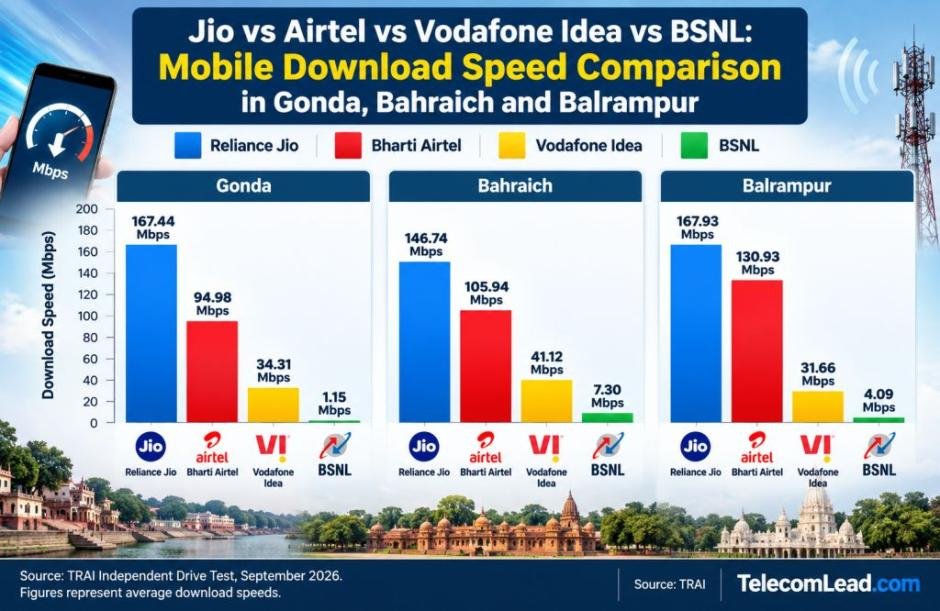
Reliance Jio emerged as the fastest mobile internet operator in all three cities for which TRAI published speed measurements.
Reliance Jio achieved its highest reported download speed of 167.93 Mbps in Balrampur, followed by 167.44 Mbps in Gonda and 146.74 Mbps in Bahraich.
In Gonda, Jio’s download speed was approximately 76 percent higher than Airtel’s, nearly five times Vodafone Idea’s and 146 times BSNL’s.
Airtel recorded its highest download speed of 130.93 Mbps in Balrampur, narrowing the performance gap with Jio to approximately 28 percent.
Vodafone Idea delivered download speeds between 31.66 Mbps and 41.12 Mbps, substantially below Jio and Airtel.
BSNL recorded the weakest download performance, particularly in Gonda, where its average speed was just 1.15 Mbps.
The results reflect the technologies available during testing. Jio and Airtel were tested with access to 5G, while BSNL’s tests were limited to 4G. Vodafone Idea’s reported tests included 5G in Gonda and Bahraich and 4G in Balrampur.
Mobile Upload Speed: Airtel Leads in Bahraich and Balrampur
TRAI’s upload speed measurements revealed a different competitive position, with Airtel outperforming Jio in two of the three cities.
| Telecom operator | Gonda | Bahraich | Balrampur |
| Reliance Jio | 18.94 Mbps | 12.09 Mbps | 16.90 Mbps |
| Bharti Airtel | 14.59 Mbps | 17.60 Mbps | 21.40 Mbps |
| Vodafone Idea | 9.53 Mbps | 11.86 Mbps | 12.79 Mbps |
| BSNL | 1.86 Mbps | 2.88 Mbps | 2.16 Mbps |
Airtel achieved the highest upload speed of 21.40 Mbps in Balrampur, approximately 27 percent faster than Jio.
In Bahraich, Airtel recorded 17.60 Mbps, outperforming Jio’s 12.09 Mbps by approximately 46 percent.
Jio led upload performance in Gonda with 18.94 Mbps, compared with Airtel’s 14.59 Mbps.
Vodafone Idea delivered upload speeds between 9.53 Mbps and 12.79 Mbps, while BSNL remained below 3 Mbps across all three cities.
Upload performance is particularly important for video conferencing, cloud applications, content creation and enterprise mobility services.
Network Coverage: BSNL Records Highest Coverage Gaps
TRAI’s network coverage assessment revealed significant differences in signal strength across the four telecom operators.
| Telecom operator | Gonda | Bahraich | Balrampur |
| Bharti Airtel | 4.24% | 2.07% | 1.32% |
| Reliance Jio | 4.84% | 7.73% | 4.85% |
| Vodafone Idea | 9.21% | 5.84% | 1.83% |
| BSNL | 43.33% | 60.64% | 40.92% |
Figures represent the percentage of voice-test samples with signal strength below TRAI’s prescribed thresholds. Lower percentages indicate better coverage performance.
Airtel recorded the lowest percentage of poor-signal samples in all three cities, indicating stronger coverage consistency along the tested routes.
In Bahraich, Airtel’s coverage gap was 2.07 percent, compared with 7.73 percent for Jio and 5.84 percent for Vodafone Idea.
BSNL recorded its highest coverage gap of 60.64 percent in Bahraich, where 11,807 of 19,472 samples had poor signal strength.
In Gonda, BSNL recorded 7,289 poor-signal samples out of 16,823, while in Balrampur, 3,271 of 7,994 samples fell below the prescribed signal threshold.
TRAI also identified 715 limited-service or no-coverage samples for BSNL in Gonda, 858 in Bahraich and 70 in Balrampur.
Airtel, Jio and Vodafone Idea recorded no such limited-service samples in these three city assessments.
These findings indicate that BSNL faces substantial network coverage challenges in the tested areas, even as the operator continues its 4G network expansion.
Call Drop Rates: Jio Records Zero Dropped Calls Across Three Cities
Reliance Jio delivered the strongest call retention performance in the three reported city tests, recording zero dropped calls.
| Telecom operator | Gonda | Bahraich | Balrampur |
| Reliance Jio | 0/171 | 0/206 | 0/78 |
| Bharti Airtel | 1/171 | 1/205 | 2/78 |
| Vodafone Idea | 0/171 | 1/205 | 0/78 |
| BSNL | 23/162 | 6/159 | 2/72 |
Figures show dropped calls against successfully established calls.
Jio recorded zero dropped calls across 455 successfully established calls in Gonda, Bahraich and Balrampur.
Vodafone Idea also performed strongly, recording just one dropped call across 454 established calls.
Airtel recorded four dropped calls across 454 established calls, including two in Balrampur.
BSNL experienced 31 dropped calls across 393 established calls, equivalent to a call drop rate of approximately 7.89 percent.
The highest individual call drop rate was recorded by BSNL in Gonda, where 23 of 162 calls dropped, representing approximately 14.20 percent.
In Bahraich, BSNL’s call drop rate was 3.77 percent, while Balrampur recorded 2.78 percent.
The results suggest that Jio and Vodafone Idea delivered more reliable voice-call continuity during these city tests, while BSNL needs to address network stability.
Highway Network Performance: Jio Leads Download Speed
TRAI also evaluated mobile network performance along the Prayagraj–Gonda highway, covering locations including Sultanpur, Ayodhya and Nawabganj.
The highway assessment showed Jio extending its download speed advantage.
| Telecom operator | Average download speed |
| Reliance Jio | 183.83 Mbps |
| Bharti Airtel | 87.92 Mbps |
| Vodafone Idea | 46.43 Mbps |
| BSNL | 6.54 Mbps |
Jio’s average download speed of 183.83 Mbps was approximately 109 percent faster than Airtel’s 87.92 Mbps.
Vodafone Idea delivered 46.43 Mbps, while BSNL recorded 6.54 Mbps.
However, network coverage and call reliability presented a different picture.
Prayagraj–Gonda Highway Coverage Comparison
| Telecom operator | Poor-signal samples | Coverage gap |
| Reliance Jio | 332/19,765 | 1.68% |
| Bharti Airtel | 364/19,873 | 1.83% |
| Vodafone Idea | 813/19,913 | 4.08% |
| BSNL | 8,799/17,748 | 49.58% |
Jio recorded the lowest coverage gap at 1.68 percent, narrowly outperforming Airtel’s 1.83 percent.
Vodafone Idea recorded a coverage gap of 4.08 percent.
BSNL recorded poor signal strength in nearly half of its collected samples, indicating significant coverage weaknesses along the highway.
Highway Call Drop Comparison
Jio recorded one dropped call out of 99 successfully established calls, while Airtel recorded one out of 98.
Vodafone Idea recorded zero dropped calls across 98 established calls.
BSNL experienced 10 dropped calls across 91 established calls, equivalent to a call drop rate of approximately 10.99 percent.
These results highlight the importance of continuous network coverage along highways, particularly for commuters and users relying on mobile navigation, digital payments and uninterrupted voice connectivity.
Key Findings: Which Telecom Operator Performed Best?
Reliance Jio: Led average download speeds in all three reported cities and on the Prayagraj–Gonda highway. It also recorded zero dropped calls in Gonda, Bahraich and Balrampur.
Bharti Airtel: Delivered the lowest poor-signal percentages across all three cities and led upload speeds in Bahraich and Balrampur.
Vodafone Idea: Maintained competitive voice-call reliability, recording only one dropped call across the three city assessments, although download speeds remained substantially below Jio and Airtel.
BSNL: Recorded the highest coverage gaps and call drop rates, alongside the lowest average download speeds, across the reported city and highway comparisons.
While Jio dominated download speed measurements, Airtel performed better on city coverage consistency and upload speeds in two cities.
SHAFANA FAZAL