
India’s telecom industry is entering a new phase of 5G monetization in 2026, with Reliance Jio, Bharti Airtel and Vodafone Idea seeking higher revenue from premium smartphones, postpaid subscriptions, digital entertainment, artificial intelligence, cloud gaming and enterprise connectivity.
India recorded 653 million 5G mobile subscriptions in Q2 2026, while 5G-capable smartphones represented 89 percent of smartphone shipments, according to Omdia. However, rapid 5G adoption has not automatically translated into proportional growth in telecom revenue.
The challenge for Indian telecom operators is to increase average revenue per user (ARPU), improve network investment returns and generate additional income from customers already consuming substantial amounts of mobile data.
Omdia’s October 19, 2026 analysis, India’s smartphone premiumization creates a new opportunity for telco monetization, identifies four opportunities: better 5G smartphones, postpaid migration, differentiated digital experiences and affordable device upgrades.
India Telecom Capex Drops 40% as Operators Shift Towards 5G Monetization
India’s telecom capital expenditure declined sharply after the initial phase of nationwide 5G network expansion.
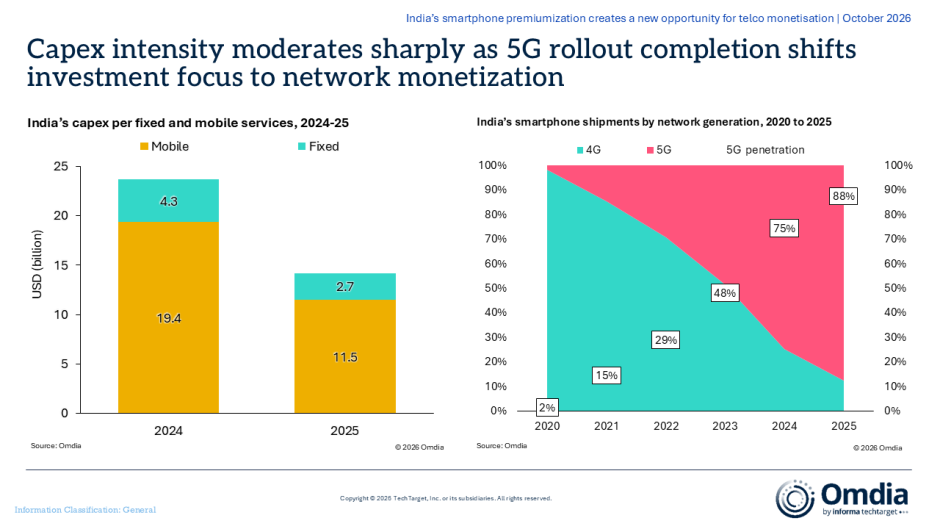
Omdia’s investment data shows total telecom capex falling from $23.7 billion in 2024 to $14.2 billion in 2025, a decline of approximately 40 percent.
Mobile network capex decreased from $19.4 billion to $11.5 billion, while fixed-network investment fell from $4.3 billion to $2.7 billion.
| Telecom investment | 2024 | 2025 | Change |
| Total telecom capex | $23.7 billion | $14.2 billion | −40.1% |
| Mobile network capex | $19.4 billion | $11.5 billion | −40.7% |
| Fixed-network capex | $4.3 billion | $2.7 billion | −37.2% |
The reduction reflects a transition from intensive 5G deployment towards more selective network expansion, capacity optimization and commercial monetization.
Omdia India smartphone market report, July 2026 indicated that 5G smartphone shipment penetration increased from just 2 percent in 2020 to 88 percent in 2025, reaching 89 percent in Q2 2026.
The commercial priority is changing from connecting more 5G devices to generating greater value from each connected customer.
India 5G Market: Key Telecom Performance Indicators in 2026
| Indicator | Latest reported figure |
| 5G mobile subscriptions, Q2 2026 | 653 million |
| 5G share of smartphone shipments, Q2 2026 | 89% |
| India smartphone shipments, Q2 2026 | 33.9 million |
| Smartphone shipment growth, Q2 2026 | −13% YoY |
| Industry wireless ARPU, April–June 2026 | ₹187.12 |
| Average monthly data usage per data subscriber | 28.39 GB |
| Average revenue realization per GB | ₹7.13 |
| Postpaid share of mobile subscriptions, Q2 2026 | 23% |
| Smartphone ASP CAGR, 2021–2026 | 11% |
These indicators highlight a structural challenge: India’s telecom customers are upgrading to 5G-capable smartphones and consuming more data, but operators must develop additional revenue streams to improve monetization.
1. Premium 5G Smartphones Create New Revenue Opportunities
Affordable smartphones have been central to India’s 5G expansion.
Omdia reports that smartphones priced below $200 represented 32 percent of India’s 5G smartphone shipments in 2023, increasing to 43 percent in 2024 and 54 percent in 2025.
The growing share of affordable 5G devices demonstrates that mass-market adoption remains a major growth driver. However, operators also need smartphones capable of delivering better gaming, video, AI and productivity experiences.
India’s smartphone market contracted 13 percent year over year to 33.9 million units in Q2 2026, affected by rising component costs and higher handset prices.
Omdia reported the following smartphone shipments:
| Smartphone vendor | Q2 2026 shipments |
| vivo | 6.3 million |
| Samsung | 5.9 million |
| OPPO | 4.6 million |
| Xiaomi | 4.5 million |
| Apple | 3.5 million |
Samsung promoted its Galaxy S26 smartphones through exchange, buyback and financing programmes. Apple benefited from iPhone 17 demand and consumer financing offers.
vivo adjusted its V-series pricing to improve accessibility, while Xiaomi maintained affordable devices alongside premium upgrade opportunities.
These strategies are relevant to telecom operators because higher-performance smartphones can support advanced digital applications and differentiated connectivity plans.
Operators can potentially collaborate with smartphone manufacturers on bundled subscriptions, device financing, premium data plans and digital-service offers.
Nevertheless, smartphone premiumization does not guarantee higher ARPU. Operators must demonstrate that premium connectivity and digital services deliver benefits customers consider worth paying for.
2. Postpaid Migration Offers Opportunities to Increase Telecom ARPU
Postpaid subscriptions are becoming an increasingly important part of India’s telecom monetization strategy.
Omdia estimates that India added approximately 50 million postpaid subscriptions between Q2 2025 and Q2 2026, taking postpaid penetration to 23 percent of mobile subscriptions.
Postpaid customers can provide operators with recurring billing relationships and opportunities to sell family plans, entertainment subscriptions, international roaming and premium services.
Airtel ARPU Reaches ₹264
Airtel Q1 FY2027 results indicated that Airtel reported ARPU of ₹264 in Q1 FY2027, compared with ₹250 a year earlier, representing growth of 5.6 percent.
Airtel has increasingly differentiated its premium plans through entertainment, digital applications and bundled services.
Its offerings include access to more than 25 OTT platforms and a 12-month Perplexity Pro subscription promotion.
The company also has opportunities to bundle premium mobile connectivity with home broadband, entertainment and financial services.
Reliance Jio ARPU Reaches ₹215.6
Reliance Jio reported ARPU of ₹215.6 in Q1 FY2027, supported by a subscriber base of 533.3 million.
Monthly data consumption reached 43.7 GB per user, demonstrating the scale of engagement across Jio’s network.
Jio’s digital ecosystem provides opportunities to combine connectivity with JioHotstar entertainment, JioAICloud, broadband and other digital services.
Its large subscriber base offers considerable potential for converting customers from basic connectivity to higher-value digital subscriptions.
Vodafone Idea ARPU Improves to ₹177
Vi Q1 FY2027 results indicated that Vodafone Idea reported ARPU of ₹177 in Q1 FY2027, compared with ₹174 in the preceding quarter, representing sequential growth of approximately 1.7 percent.
Its subscriber base increased from 192.8 million to 193.1 million.
Vodafone Idea’s monetization priorities include customer upgrades, improved network experience, postpaid acquisition and partnerships that make 5G devices more affordable.
TRAI performance indicators for April-June 2026 show that Indian telecom operators recorded monthly wireless ARPU of ₹187.12 in the April-June quarter, up 3.11 percent year over year. Average revenue realization per GB declined 5.07 percent quarter over quarter to ₹7.13, while monthly data usage averaged 28.39 GB per data subscriber.
ARPU Comparison: Jio, Airtel and Vodafone Idea
| Operator | Reported ARPU | Reporting period |
| Bharti Airtel | ₹264 | Q1 FY2027 |
| Reliance Jio | ₹215.6 | Q1 FY2027 |
| Vodafone Idea | ₹177 | Q1 FY2027 |
| Industry wireless average, TRAI | ₹187.12 | April–June 2026 |
Airtel’s reported ARPU was approximately 22.4 percent higher than Jio’s and 49.2 percent higher than Vodafone Idea’s.
These differences reflect variations in customer mix, tariffs, product portfolios and subscriber economics. The operator-reported figures and TRAI’s industry average may also use different definitions, so they should not be treated as perfectly comparable.
The industry opportunity is to expand higher-value subscriptions without creating excessive affordability pressure or customer churn.
3. Gaming, AI and Digital Entertainment Could Support Premium 5G Plans
India’s next stage of 5G monetization will increasingly depend on services that demonstrate the advantages of better network performance.
Cloud gaming, interactive entertainment, livestreaming, AI applications and high-resolution video creation can require consistent throughput, responsive connections and dependable upload performance.
Reliance Jio has deployed 5G network slicing for use cases including gaming. Network slicing allows operators to configure network resources for particular service requirements.
This technology creates the possibility of differentiated connectivity experiences for customers who value consistent network performance.
Airtel can pursue similar monetization opportunities through its premium subscriber base, 5G network and digital-service partnerships.
Vodafone Idea can also use improved 5G coverage and network quality to support premium customer upgrades.
Potential commercial models include premium gaming bundles, creator-focused connectivity packages, AI subscriptions and specialized enterprise services.
However, these remain opportunities rather than evidence of substantial incremental 5G revenue. Operators need to establish measurable customer demand and willingness to pay.
FASNA SHABEER