
The satellite-to-phone market is turning into a multibillion-dollar investment battle as Starlink, AST SpaceMobile and Amazon Leo compete to connect ordinary smartphones directly to satellites.
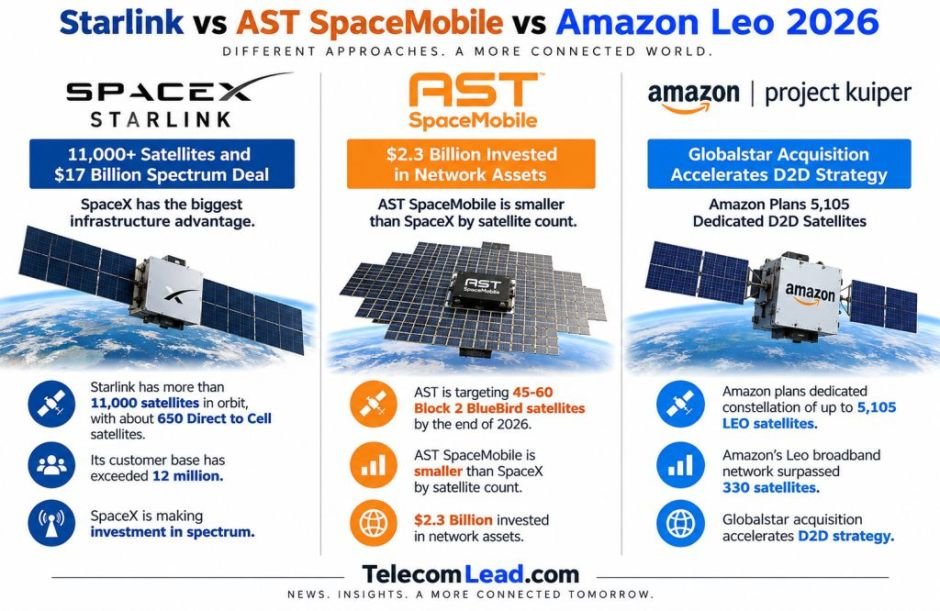
Starlink enters the race with the largest existing satellite constellation and commercial Direct to Cell services. AST SpaceMobile is spending heavily on BlueBird satellites, spectrum and ground infrastructure while partnering with more than 60 mobile operators. Amazon is taking a longer-term approach, combining Amazon Leo with Globalstar’s satellites and mobile satellite spectrum ahead of a planned dedicated D2D constellation.
The competition is increasingly about capital, spectrum, satellites, operator partnerships and launch capacity rather than satellite numbers alone.
Starlink: 11,000+ Satellites and $17 Billion Spectrum Deal
SpaceX has the biggest infrastructure advantage.
Starlink has more than 11,000 satellites in orbit, with about 650 Direct to Cell satellites according to September 2026 reporting. Its overall customer base has exceeded 12 million, although this should not be confused with the number of Direct to Cell users.
SpaceX is now making an enormous investment in spectrum.
The company agreed to pay approximately $17 billion for wireless spectrum from EchoStar, significantly strengthening the spectrum resources available for its mobile ambitions. Reuters estimates Starlink generates around $11 billion in revenue, giving SpaceX a substantial financial base from which to expand satellite cellular services.
The Starlink Direct to Cell strategy relies on partnerships with mobile operators rather than requiring consumers to purchase specialized satellite phones.
T-Mobile is its principal U.S. partner. T-Satellite connectivity has also expanded into markets including Canada, New Zealand and Japan through partner arrangements.
The $17 billion EchoStar transaction indicates how valuable spectrum could become as satellite companies compete with terrestrial mobile networks for direct access to smartphones.
AST SpaceMobile: $2.3 Billion Invested in Network Assets
AST SpaceMobile is much smaller than SpaceX by satellite count but is pursuing one of the industry’s most capital-intensive D2D expansion programs.
AST had accumulated approximately $2.3 billion in gross capitalized property and equipment costs by June 30, 2026. This includes satellite materials, launch advances, BlueBird spacecraft, manufacturing and integration facilities, ground antennas and other network infrastructure.
During the first six months of 2026 alone, AST used approximately $979.7 million in investing activities, up from $430.6 million a year earlier.
The company had approximately $2.7 billion of cash, cash equivalents and restricted cash at the end of June, giving it substantial resources to continue the satellite buildout.
AST is targeting 45-60 Block 2 BlueBird satellites by the end of 2026, with more than 90 satellites ultimately expected to support continuous global coverage.
BlueBird Satellites Could Represent $2 Billion+ Investment
AST’s satellite economics demonstrate the enormous capital required for D2D networks.
The company estimates average capital costs of approximately $21 million-$23 million per Block 2 BlueBird satellite, including direct materials and launch costs.
A constellation of more than 90 satellites at that average cost therefore implies roughly $1.9-$2.1 billion of satellite and launch capital, before considering certain initial satellites and other infrastructure excluded from the estimate.
The investment supports technically ambitious satellites.
Block 2 BlueBirds feature phased arrays measuring up to approximately 2,400 square feet and are designed for peak data speeds approaching 200 Mbps.
AST SpaceMobile’s 2026 network and investment update indicated that AST has demonstrated nearly 100 Mbps directly to an ordinary unmodified smartphone using its earlier Block 1 satellite.
AST Builds 60+ Operator Partnerships
AST’s biggest competitive advantage may be its operator-led business model.
It has partnerships with more than 60 mobile network operators collectively serving more than 3 billion subscribers. Partners include AT&T, Verizon, Vodafone, Orange, Telefónica, Deutsche Telekom, Rakuten and TELUS.
AST is integrating and testing its network across the U.S., Europe, Canada, Japan, Saudi Arabia and other markets.
Nearly 50 gateways across five continents were in various stages of completion, installation or planning by the second quarter of 2026.
The company also reported approximately $1.3 billion of contracted revenue agreements and U.S. government awards, providing another financial foundation for its network rollout.
Japan could bring additional funding. AST said its venture with Rakuten had been preliminarily selected for an initiative potentially worth up to $1 billion in non-dilutive, non-debt government capital.
AST Spectrum Investment Adds Another Capital Requirement
Spectrum is becoming another major investment category.
AST reports access to 1,150 MHz of low- and mid-band tunable MNO spectrum globally, plus 45 MHz of MSS mid-band spectrum in North America and priority rights involving 60 MHz of S-band spectrum globally.
Its agreements involving Ligado provide long-term access to as much as 45 MHz of lower mid-band spectrum in the U.S.
AST made a $100 million spectrum-related advance payment during H1 2026, according to its regulatory filing.
AST’s strategy targets around 100 MHz of spectrum access in the U.S. and 60+ MHz internationally, depending on individual markets.
Amazon Leo: Globalstar Acquisition Accelerates D2D Strategy
Amazon is taking a different route.
Its proposed acquisition of Globalstar gives Amazon access to existing satellite infrastructure, operational expertise and mobile satellite service spectrum licenses with global authorizations.
Amazon announced the Globalstar acquisition in April 2026, with completion expected in 2027 subject to regulatory and other conditions.
Amazon’s Globalstar acquisition and D2D strategy shows that Amazon also has an agreement with Apple for Amazon Leo to support satellite services for compatible iPhone and Apple Watch models, potentially giving the network access to an enormous device ecosystem.
Amazon Plans 5,105 Dedicated D2D Satellites
Amazon’s longer-term D2D plan is potentially much larger.
The company has filed with the FCC for a dedicated constellation of up to 5,105 LEO satellites, with deployment expected to begin in 2028.
The satellites are intended to provide voice, messaging, data and emergency connectivity directly to mobile devices using L-band and S-band spectrum.
They would operate across five orbital shells between approximately 510 km and 580 km.
Meanwhile, Amazon continues building its broader Leo broadband network, which had surpassed 330 satellites by June 2026.
Investment Is Becoming the Key D2D Competitive Weapon
The three companies are effectively making different investment bets.
SpaceX has the largest existing infrastructure and is adding a $17 billion spectrum acquisition to its 11,000-plus satellite network.
AST SpaceMobile is building a smaller but highly specialized constellation. It had already capitalized approximately $2.3 billion in network-related property and equipment, spent nearly $980 million on investing activities during H1 2026, and estimates Block 2 satellites at $21-$23 million each.
Amazon is using its enormous corporate balance sheet to combine Amazon Leo with Globalstar’s spectrum and satellite infrastructure before launching a proposed 5,105-satellite D2D constellation from 2028.
Starlink vs AST SpaceMobile vs Amazon Leo: Who Leads?
In 2026, Starlink has the commercial and infrastructure lead. Its huge constellation, existing Direct to Cell network, T-Mobile relationship and $17 billion EchoStar spectrum deal provide considerable scale.
AST SpaceMobile has the strongest operator-partnership story. More than 60 MNO partners provide potential access to over 3 billion subscribers, while its large BlueBird antennas are designed specifically to deliver broadband directly to standard smartphones.
Amazon Leo represents the longer-term challenger. Globalstar gives Amazon spectrum and satellite expertise, while the proposed 5,105-satellite constellation could eventually create another enormous global D2D network.
The satellite-to-phone battle will therefore increasingly be measured by more than satellites launched. The critical metrics will be billions of dollars invested, spectrum controlled, launch economics, mobile operator agreements, smartphone compatibility, countries activated and — ultimately — paying D2D subscribers.
FASNA SHABEER