T-Mobile maintained a lead in the US 5G FWA (fixed wireless access) market during the second quarter of 2026, delivering faster download and upload speeds and lower latency than AT&T Internet Air and Verizon 5G Home Internet.

Ookla Speedtest Intelligence data shows that T-Mobile Home Internet achieved a download speed of 222.72 Mbps in Q2 2026. This was 38.8 percent faster than AT&T’s 160.43 Mbps and 76 percent ahead of Verizon’s 126.53 Mbps.
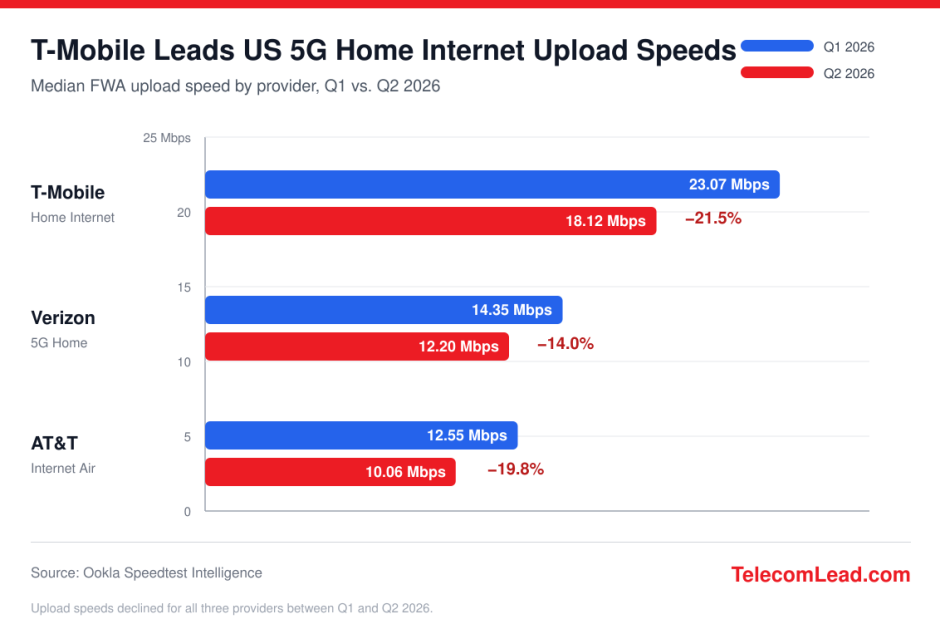
T-Mobile also recorded the best upload speed at 18.12 Mbps and the lowest multi-server latency at 46 milliseconds.
FWA network performance declined across all three operators between the first and second quarters, highlighting the effects of seasonal foliage, higher temperatures and network congestion.
The comparison is important as Verizon, T-Mobile and AT&T surpassed 17 million FWA connections in Q1 2026. These connections were equivalent to 13.74 percent of the United States’ 123.75 million home broadband subscriptions.
T-Mobile Leads Across Download, Upload and Latency Metrics
T-Mobile delivered the strongest overall FWA performance in Q2 2026 despite experiencing a quarterly slowdown. T-Mobile’s download speed declined 7 percent from 239.50 Mbps in Q1 to 222.72 Mbps in Q2.
AT&T ranked second with 160.43 Mbps, down 4.1 percent from 167.34 Mbps. Verizon recorded the weakest download performance, falling 11.9 percent from 143.64 Mbps to 126.53 Mbps.
T-Mobile’s lowest download speed during a typical 24-hour period was approximately 165 Mbps. That was only slightly below Verizon’s peak performance of around 170 Mbps, demonstrating the scale of T-Mobile’s network advantage.
AT&T Network Investment Delivers Major Speed Improvement
AT&T emerged as the strongest challenger to T-Mobile. AT&T’s Q1 2026 download speed of 167.34 Mbps was nearly 60 percent higher than the 104.61 Mbps recorded in Q3 2025.
The improvement followed AT&T’s rollout of additional low-band and mid-band spectrum acquired from EchoStar under the $23 billion deal. The spectrum package included 50 MHz and strengthened AT&T’s capacity and coverage.
AT&T’s upload speed also increased from 9.23 Mbps in Q3 2025 to 12.55 Mbps in Q1 2026. Upload speed of A&T& subsequently declined to 10.06 Mbps in Q2, leaving the operator behind both T-Mobile and Verizon on uploads.
AT&T established itself as the number-two FWA provider for downloads after trailing both competitors during the first three quarters of 2025.
Upload Speeds Fall Faster Than Downloads
All three operators recorded deterioration in upload performance than in download performance during Q2.
T-Mobile’s upload speed fell 21.5 percent from 23.07 Mbps to 18.12 Mbps. AT&T experienced a 19.8 percent decline from 12.55 Mbps to 10.06 Mbps, while Verizon’s upload speed dropped 14 percent from 14.35 Mbps to 12.20 Mbps.
Despite the decline, T-Mobile’s Q2 upload performance was 48.5 percent faster than Verizon and 80.1 percent higher than AT&T.
T-Mobile Records Lowest FWA Latency
T-Mobile also led the latency comparison, recording multi-server latency of 46 milliseconds in Q2 2026, compared with 53 milliseconds for Verizon and 69 milliseconds for AT&T.
Latency increased marginally for every provider. T-Mobile rose from 45 to 46 milliseconds, Verizon moved from 52 to 53 milliseconds and AT&T increased from 67 to 69 milliseconds.
The results give T-Mobile an advantage for applications such as video conferencing, online gaming and cloud services, where responsiveness matters alongside download speed.
Verizon Offers Greater Stability for Slower Connections
Verizon ranked last in overall download performance, but its slowest customer connections were more consistent throughout the working day.
Download speeds among Verizon’s bottom 10 percent of tests remained between 21.09 Mbps and 24.75 Mbps, irrespective of network load or time of day.
T-Mobile’s bottom-decile speed peaked at 59.65 Mbps around 5 a.m. but declined 62.4 percent to 22.43 Mbps during prime evening hours. AT&T’s comparable performance dropped 67.84 percent from 46.86 Mbps in the early morning to 15.07 Mbps at 8 p.m.
This suggests that T-Mobile and AT&T offer considerably higher potential speeds but can experience greater performance variation during congested periods. Verizon’s service is slower but more predictable for customers at the lower end of its performance range.
Verizon also appears to maintain an FWA speed ceiling of around 300 Mbps. By comparison, the fastest 10 percent of T-Mobile tests frequently exceeded 600 Mbps, while AT&T approached 500 Mbps during periods of low congestion.
US FWA Competition Shifts Toward Network Quality
The Q2 2026 comparison establishes T-Mobile as the clear FWA performance leader, with the fastest downloads, fastest uploads and lowest latency. AT&T has become a stronger competitor following its spectrum expansion and has moved ahead of Verizon in median download speed.
Verizon trails on headline speeds but offers relatively stable performance for customers experiencing the slowest connections. Across all three networks, weaker rural performance, evening congestion and seasonal signal interference remain significant challenges.
With more than 17 million connections, 5G FWA is no longer simply a rural coverage product. It has become a mainstream urban and suburban broadband alternative, making network speed, latency, consistency and the ability to deliver the FCC’s 100/20 Mbps benchmark increasingly important competitive measures.
BABURAJAN KIZHAKEDATH