Global wearable band shipments declined 2 percent year over year in the second quarter of 2026 as demand shifted from basic bands and watches toward advanced sports watches, screenless trackers and AI-powered health platforms, according to Omdia estimates.
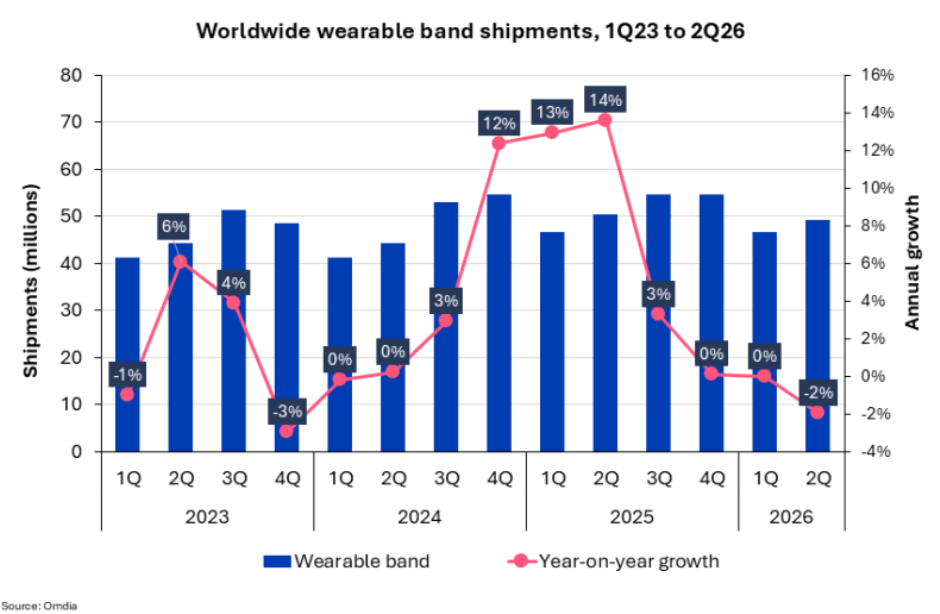
The downturn followed several quarters of weakening growth. Wearable band shipments increased 12 percent in the fourth quarter of 2024, 13 percent in the first quarter of 2025 and 14 percent in the second quarter of 2025. Growth then slowed to 3 percent in the third quarter, remained flat at 0 percent in the fourth quarter, edged up 1 percent in the first quarter of 2026 and fell 2 percent in the second quarter, Omdia report said.
Smartwatch Shipments Rise 6 Percent
Smartwatch shipments increased 6 percent in the second quarter of 2026, supported by demand for advanced sports models offering detailed training metrics, improved accuracy and multi-day battery life.
Basic-band shipments fell 9 percent, while basic-watch shipments declined 3 percent. The weakness was particularly evident in India as consumers moved toward either minimalist screenless trackers or more sophisticated sports watches.
Screenless devices represented more than 15 percent of basic-band shipments during the quarter, supported by products including Google’s Fitbit Air and Garmin’s Cirqa.
Huawei Leads Global Wearable Band Market
Huawei led the broader wearable band market with an 18 percent share in the second quarter of 2026, compared with 17 percent a year earlier. Its performance was supported by a broader product portfolio, including the international launch of its flagship children’s smartwatch.
Xiaomi, including Redmi, ranked second, although its share declined from 19 percent to 17 percent. Apple increased its share from 15 percent to 16 percent, while Garmin advanced from 4 percent to 6 percent.
Samsung’s share dropped from 9 percent to 6 percent. Other vendors collectively increased their share from 36 percent to 38 percent.
Huawei, Xiaomi and Apple together controlled 51 percent of global wearable band shipments.
Garmin Reaches 15 Percent Smartwatch Share
Apple remained the global smartwatch leader with a 46 percent share in the second quarter of 2026, down from 48 percent in the same period of 2025.
Samsung’s share declined from 17 percent to 15 percent, while Garmin climbed from 11 percent to 15 percent. Garmin therefore closed a six-percentage-point gap with Samsung within one year and drew level at 15 percent, although Omdia said Samsung remained marginally ahead in second place.
Garmin’s gains were driven by demand from runners, cyclists and outdoor enthusiasts, along with the expansion of its Forerunner portfolio.
Huawei maintained a 7 percent smartwatch share, while XTC, also known as imoo, increased its share from 5 percent to 6 percent.
Fitbit Air Targets Screenless Tracker Demand
Google’s Fitbit Air starts at $99.99 and offers up to one week of battery life. The screenless tracker includes three months of Google Health Premium and works with the Google Health app to deliver personalized insights.
Its launch reflects changing consumer expectations despite the 9 percent contraction in basic-band shipments. Users increasingly want discreet devices capable of continuous health tracking without the screen and charging requirements associated with conventional smartwatches.
AI Health Platforms Create Subscription Opportunity
Omdia expects personal AI and deeper ecosystem integration to become important differentiators as higher memory and storage costs push up wearable average selling prices.
Google Health Coach, developed using Gemini, became available worldwide through Google Health Premium in May 2026. The service offers personalized guidance covering fitness, sleep and general wellness.
Google Health Premium costs $9.99 per month or $99 per year. Google’s Health app combines information from wearable devices, Health Connect and Apple Health, enabling the company to build software and subscription revenue around health data collected by its hardware ecosystem.
Fitbit’s personal health coach is also expanding to 37 countries and 32 languages, including India, demonstrating how AI services can add value to continuously collected wearable data.
Pixel Watch 5 Adds Gemini and Health Features
Google is extending AI capabilities into premium smartwatches through the Pixel Watch 5, announced on August 12. The device starts at $399 for the 41mm version and $429 for the 45mm model.
Designed around Gemini Intelligence and Google Health, the smartwatch includes proactive AI assistance and Health Guardian capabilities.
Google says the 41mm Pixel Watch 5 provides up to 30 hours of battery life, while the 45mm model offers up to 40 hours. Its GPS route-tracking technology delivers 2x greater accuracy than previous generations in challenging environments, according to the company.
The global wearable market is consequently moving beyond shipment volume toward AI personalization, actionable health insights, battery performance, sensor accuracy and ecosystem integration. Huawei leads the wider wearable band category, Apple remains dominant in smartwatches and Garmin is rapidly gaining ground as software subscriptions and health intelligence emerge as the industry’s next competitive battleground.
FASNA SHABEER