
The mobile industry in Latin America is set to play an even bigger role in the region’s digital economy, with its economic contribution projected to rise from $600 billion in 2025 to $700 billion by 2030, according to the GSMA.
Mobile technologies and services contributed 8.6 percent of the region’s GDP in 2025, while supporting nearly 3 million jobs and generating $50 billion in public revenues. The sector’s growing importance comes as Latin America faces moderate economic growth and persistent productivity challenges, increasing the need for digital technologies to boost competitiveness, innovation and economic diversification.
The GSMA said widespread 4G deployments have already expanded mobile internet access to millions across the region, helping narrow connectivity gaps. At the same time, early 5G rollouts, cloud infrastructure investments, data centre expansion and digital transformation initiatives are creating new growth opportunities for enterprises and consumers, GSMA report said.
5G Expansion to Drive Connectivity Growth
5G adoption is expected to accelerate rapidly across the region over the next five years. By 2030, half of all mobile connections in Latin America are forecast to run on 5G networks.
Brazil is expected to emerge as the regional leader in 5G adoption, with almost three quarters of all mobile connections in the country projected to be on 5G by 2030.
Telecom operator revenues in the region are forecast to increase to $83.9 billion in 2030 from $71.8 billion in 2025, reflecting higher data consumption, expanding digital services and enterprise connectivity demand.
To support the next phase of network modernization, operator capital expenditure between 2025 and 2030 is projected to total $75.8 billion, underlining the scale of investments being directed toward 5G infrastructure, cloud-native networks and service expansion.
AI Adoption Shifts from Pilot Projects to Mainstream Operations
Artificial intelligence deployment among telecom operators in Latin America is moving rapidly from experimentation to large-scale operational use.
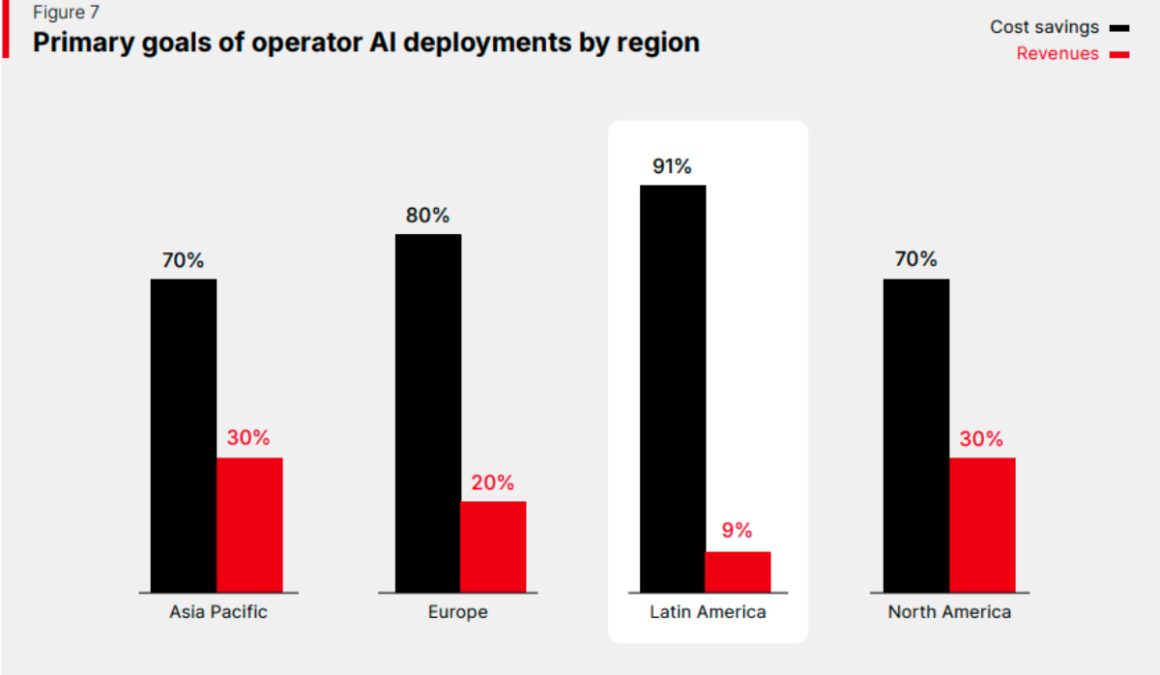
Operators are embedding AI into customer care, network operations and business processes to improve efficiency, automate decision-making and reduce operational costs. Unlike markets in Europe and Asia Pacific where AI investments are increasingly focused on revenue generation, operators in Latin America are prioritizing operational optimization and scalability.
Customer care represents 78 percent of all AI deployments in the region, the highest share globally. Telecom companies are deploying AI agents, chatbots and generative AI systems to reduce call handling times, improve first-contact resolution and support multilingual customer service.
In Chile, Claro has deployed AI agents and post-call analytics within customer service operations. Using generative AI, the operator transcribes and analyzes customer interactions, predicts Net Promoter Scores and automates high-volume tasks such as SIM blocking for lost or stolen devices.
The GSMA noted that AI deployments in Latin America are comparatively mature, with 85 percent of deployments already in the live production stage, significantly above the global average of 66 percent.
However, only 8 percent of AI deployments in the region currently focus on network operations, while only 9 percent are primarily aimed at revenue generation. This compares with 20 percent to 30 percent in Europe and Asia Pacific, indicating that operators in Latin America remain heavily focused on efficiency, cost containment and operational automation.
Cybersecurity Becomes Strategic Priority
As telecom networks become increasingly cloud-native and software-defined, cybersecurity is emerging as a major strategic priority for operators across Latin America.
Operators are adopting secure-by-design network architectures that integrate AI-enabled monitoring, automated threat detection and network-level security protections directly into infrastructure.
The shift toward software-driven networks, combined with growing enterprise cloud adoption and digital services expansion, is increasing the need for advanced cybersecurity frameworks capable of protecting critical communications infrastructure.
Direct-to-Device Satellite Connectivity Gains Momentum
Direct-to-device satellite connectivity is also beginning to expand across Latin America as operators look to complement terrestrial mobile coverage.
Initial deployments are focused on low-bandwidth services such as emergency messaging, network resilience and extending connectivity into underserved or remote regions.
The technology is also expected to create new opportunities for IoT applications, including environmental monitoring, industrial operations and asset tracking in areas beyond the reach of traditional mobile infrastructure.
The GSMA believes the continued expansion of 5G, AI, cloud infrastructure and satellite connectivity will strengthen the role of the mobile industry as a key driver of economic development, productivity and digital transformation across Latin America over the remainder of the decade.
BABURAJAN KIZHAKEDATH



