The Vietnam smartphone market in 2025 has entered a decisive transition phase, moving from a volume-driven battleground to a premium-first growth model. Consumers are increasingly prioritizing flagship features, AI capabilities, cybersecurity, and long-term software support over entry-level affordability, reshaping vendor strategies and competitive positioning.

The latest Omdia report said Vietnam is emerging as a strategic global manufacturing and innovation hub as smartphone makers recalibrate supply chains and diversify production footprints.
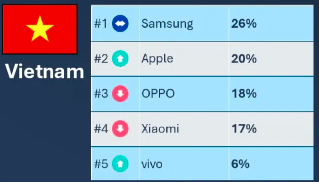
Market Share of Smartphone Vendors in Vietnam 2025
In 2025, Samsung Electronics maintains leadership in Vietnam with a 26 percent market share. The company benefits from its extensive local manufacturing base and a broad portfolio spanning the Galaxy A series to the flagship Galaxy S25 lineup. Nearly half of Samsung’s global smartphone production is manufactured in Vietnam, strengthening supply chain resilience and reinforcing its role as a localized global innovator.
Apple ranks second with a record 20 percent share, marking its strongest performance in the country to date. The iPhone has evolved into both a premium status symbol and a long-term technology investment, particularly among urban middle-class consumers in Hanoi and Ho Chi Minh City.
OPPO follows with 18 percent, sustaining strong mid-range traction through its Reno series. Xiaomi holds 17 percent, driven by aggressive pricing in the Redmi Note portfolio and ecosystem expansion. vivo rounds out the top five with 6 percent, focusing on imaging differentiation and higher-margin Pro variants.
Samsung and Apple together control 46 percent of Vietnam’s smartphone market, reflecting growing value concentration in premium and upper-mid tiers. The narrow 9 percentage point gap separating the top four brands highlights continued competitive intensity.
Vendor Strategy: AI, Vertical Integration and Manufacturing Realignment
Strategic positioning in Vietnam now extends well beyond pricing.
Samsung’s 2025 focus on Agentic AI positions its smartphones as autonomous productivity companions. The Galaxy S25 Ultra is marketed as a device capable of managing complex workflows, appealing to Vietnam’s expanding entrepreneurial and digital workforce.
Apple has strengthened direct-to-consumer engagement through its online store and certified premium resellers, complemented by financing and trade-in programs that improve accessibility to flagship devices. Premium mix optimization has enhanced margins while sustaining shipment growth.
OPPO is targeting Gen Z consumers with AI-enhanced portrait photography and influencer-driven campaigns. Xiaomi continues consolidating its value-tier dominance while expanding its AIoT ecosystem, encouraging device bundling across smart home categories. vivo is prioritizing profitability over pure volume, emphasizing professional-grade imaging and AI-powered camera optimization.
Vietnam’s strategic importance is set to rise further as Google begins transitioning high-end Pixel manufacturing and development to the country in 2026. This marks a structural shift from assembly hub to innovation center, aligning with Vietnam’s ambition to become a leading digital economy by 2030. Vendors are also pursuing deeper vertical integration strategies to mitigate semiconductor supply risks and cost volatility.
Smartphone Price Trends and Supply Chain Pressures
Smartphone prices in Vietnam are trending upward in early 2026. Average selling prices are projected to rise by 6.9 percent due to global shortages of DRAM and NAND memory chips.
The semiconductor industry’s pivot toward AI data centers has tightened component supply. Entry-level smartphones are experiencing nearly 25 percent increases in bill-of-materials costs, while high-end production costs have risen by around 10 percent. Retailers caution that price hikes could reach 20 percent by mid-2026 if supply constraints persist.
Recent mid-range and flagship launches have entered the market at higher list prices compared to predecessor models, potentially extending replacement cycles among price-sensitive consumers.
Retail Promotions and E-Commerce Strategy
Despite cost pressures, vendors are deploying aggressive promotions during key shopping seasons. Lunar New Year, or Tet, remains the most critical demand window.
Major retail chains such as The Gioi Di Dong and Di Dong Viet offered instant discounts of up to 2.5 million VND on Galaxy S25 models and bundled incentives for flagship iPhones during Tet 2026.
E-commerce platforms including Shopee and Lazada are playing a central role in channel strategies. Events such as the 3.3 Mega Sale feature platform-wide vouchers and zero-interest installment plans, supporting demand amid rising prices.
Security, Trust and National Manufacturing Identity
Marketing narratives in 2026 are increasingly centered on cybersecurity and trust. Samsung is promoting its Knox platform as a hardware-level protection solution, targeting consumers reliant on mobile banking and digital wallets.
The resurgence of national manufacturing pride, reinforced by the return of Huawei and expanded Pixel production, has triggered a Made in Vietnam branding wave. Vendors are leveraging Vietnam’s growing global manufacturing role to deepen emotional connections with consumers.
Security awareness is high, with 83 percent of users prioritizing app permissions and data protection when selecting smartphones.
Consumer Complaints and Digital Risk Landscape
Vietnam’s rapid digital acceleration has intensified mobile security threats. The nTrust anti-fraud system recorded nearly 63,000 new mobile malware strains in 2025, while annual online fraud losses exceeded 6 trillion VND.
Complaints related to junk SIM cards, smishing scams, and account takeovers are rising. Around 74 percent of consumers express concerns about hacking risks, increasing demand for smartphones with integrated anti-fraud capabilities and biometric authentication aligned with national digital identity frameworks.
Cybersecurity has become a core competitive differentiator, influencing purchasing decisions across price tiers.
Outlook: Premium Momentum and Long-Term Growth
Vietnam’s smartphone market is projected to reach $11.50 billion by 2030, supported by nationwide 5G expansion, fiber connectivity, and broader digital economy initiatives.
The 2025 competitive landscape reflects structural premiumization, AI-driven differentiation, and manufacturing localization. While Chinese brands remain strong in mid-range segments, Samsung and Apple continue consolidating value leadership at the high end.
Rising component costs and cybersecurity risks will shape near-term dynamics, but Vietnam’s dual role as both a consumption engine and production powerhouse underpins sustained long-term growth.
FASNA SHABEER