

Telecom operators are beginning to prepare for the 6G investment cycle as spectrum trials, AI-RAN, advanced antennas, integrated sensing and satellite connectivity move from research toward real-world network testing.

The global telecom industry is entering the early stages of the 6G investment cycle, with operators, network equipment vendors and governments moving beyond research toward spectrum trials, AI-native networks, advanced antennas, integrated sensing and satellite connectivity.
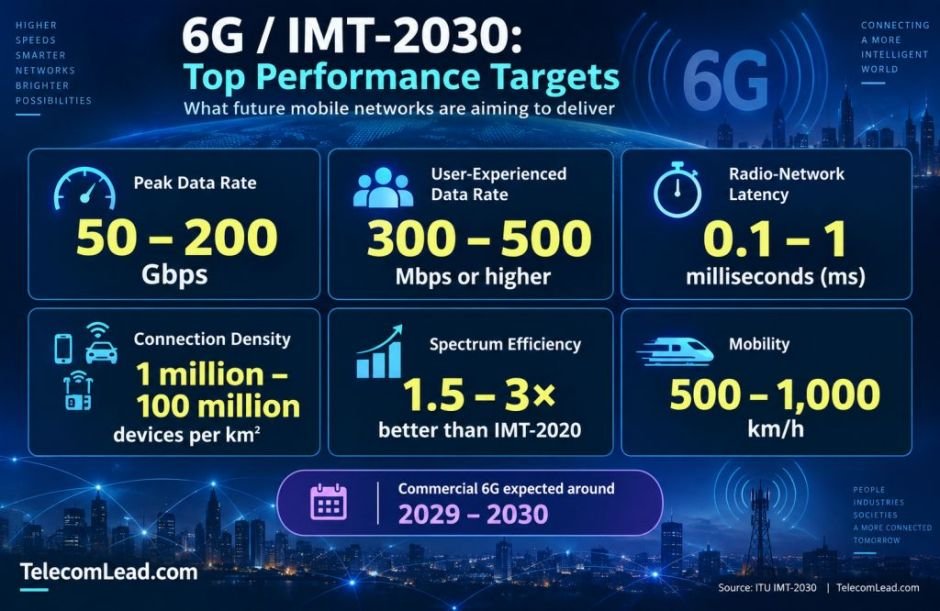
Commercial 6G deployment is still expected around 2029-2030, but decisions being made today on spectrum, RAN architecture, artificial intelligence, fiber, edge computing and non-terrestrial networks could determine which operators and vendors lead the next generation of mobile communications.
The technical ambitions are substantial. ITU’s IMT-2030 framework targets peak data rates of 50-200 Gbps, user-experienced rates of 300-500 Mbps or higher, spectrum-efficiency improvements of 1.5-3 times and connection density ranging from 1 million to 100 million devices per square kilometer.
Radio-network latency could fall to 0.1-1 millisecond, while reliability could reach 99.99999 percent.
However, the bigger issue for telecom operators will not simply be delivering higher speeds. The commercial success of 6G will depend on whether investments in AI-RAN, sensing, enterprise connectivity, satellite coverage and automation can generate sufficient new revenue to justify another multibillion-dollar network upgrade cycle.
6G Spectrum Race Moves to 6-8 GHz
Spectrum is emerging as one of the most important strategic decisions ahead of commercial 6G.
Qualcomm and Ericsson demonstrated a 400 MHz component carrier using 30 kHz subcarrier spacing in 2026, strengthening the industry’s case for wider channels in the 6-8 GHz range.
Nokia is also examining 6-8 GHz frequencies for balancing coverage and capacity. The growing importance of 6-8 GHz spectrum for future 6G networks is already influencing spectrum policy, with the UK developing an Upper 6 GHz strategy covering the 6425-7125 MHz range.
International spectrum discussions extend toward 7-8 GHz, 14.8-15.35 GHz, mmWave and frequencies above 100 GHz. WRC-27 is expected to consider additional bands including 4.4-4.8 GHz, 7.125-8.4 GHz and 14.8-15.35 GHz.
India is also preparing for the next spectrum cycle. Its National Frequency Allocation Plan identifies 6,425-7,025 MHz, 7,025-7,125 MHz and 37-40 GHz for IMT-related use, potentially bringing blocks of 700 MHz, 100 MHz and 3,000 MHz into future mobile discussions.
China has already approved the 6,425-7,125 MHz range, representing 700 MHz of spectrum, for 6G trials.
These developments indicate that the 6G spectrum strategy will increasingly influence operator network planning ahead of WRC-27 and the finalization of global standards.
Telecom Operators Accelerate 6G Trials
The transition from laboratory research to operator-led field trials is accelerating across China, Japan, South Korea, Europe and the United States.
In China, China Mobile, China Unicom and China Telecom are combining research into 6G radio technologies with AI, computing and satellite communications.
China Unicom’s H1 2026 operating revenue reached RMB201.4 billion, while Capex was RMB24.1 billion. Computing-power revenue increased 13 percent to RMB41.9 billion, and computing-power investment represented 37 percent of its investment mix.
Japan is another important 6G test market. NTT DOCOMO tested distributed MIMO at 40 GHz, with antennas positioned 150 meters apart while vehicles travelled at 60 km/h. Average throughput was 1.3 times that of conventional technology.
KDDI and Samsung subsequently demonstrated 3.6 Gbps over 100 MHz at 7 GHz using Extreme Massive MIMO and 1024QAM, around 20 percent higher than the 3.0 Gbps achieved with 256QAM.
South Korea is pursuing a similar strategy. SK Telecom and Ericsson are developing AI-RAN technologies supporting the transition from 5G to 6G, while KT and Samsung demonstrated 3 Gbps at 7 GHz using X-MIMO, eight data streams and 256 digital ports.
US Operators Explore Sensing and 2029 Commercialization
In the United States, T-Mobile has received an FCC experimental license to test Ericsson and MediaTek 6G prototypes. T-Mobile and Qualcomm are targeting the start of commercial 6G systems from 2029 onward.
AT&T and Ericsson are experimenting with network sensing for applications such as drone detection.
Samsung and Verizon have taken the concept further through an Integrated Sensing and Communication (ISAC) field trial at a major international soccer fan event in Dallas.
Samsung combined its commercial AI-powered vRAN and virtualized core with an ISAC application running on its Network in a Server edge-AI platform. The approach allowed Verizon to test sensing capabilities over existing 5G infrastructure without installing dedicated sensing equipment.
A CBRS radio mounted on a Verizon Cell-On-Wheels used 40 MHz of spectrum to detect variations in signals transmitted by a commercial 5G device. The information was converted into a near-real-time crowd-density heatmap.
The significance for operators is potentially considerable: existing software-driven network infrastructure could eventually support new 6G functions through software and computing upgrades rather than requiring completely separate networks.
Europe Builds 6G and Satellite Ecosystem
European operators are simultaneously developing terrestrial 6G and satellite strategies.
Deutsche Telekom and T-Mobile US have launched a transatlantic 6G Innovation Hub covering physical AI, sensing and intelligent computing. Vodafone is developing future 6G and non-terrestrial network technologies, while Orange, Nokia and MasOrange are participating in 6 GHz experimentation.
A September 2026 MasOrange-Ericsson trial using 256TR active antennas demonstrated as much as four times the capacity of current technology.
Satellite integration is another emerging investment area. Deutsche Telekom, Orange, Vodafone and Telefónica have been discussing a potential consortium using EU 2 GHz spectrum for direct-to-mobile services associated with Europe’s planned 290-satellite IRIS² constellation.
This convergence of terrestrial networks, LEO satellites and direct-to-device satellite connectivity could become one of the defining differences between 5G and 6G network architectures. Satellite D2D is already moving toward commercial scale as Starlink, AST SpaceMobile, Amazon Leo and telecom operators compete to extend mobile coverage beyond terrestrial networks.
Ericsson, Nokia, Samsung and Huawei Position for 6G
The competitive battle among telecom equipment suppliers is also becoming clearer.
Ericsson is combining AI-native RAN, integrated sensing, advanced spectrum technologies and operator trials. The company expects pre-commercial trials from 2028 and initial commercial 6G services around 2030.
Nokia is focusing heavily on 6-8 GHz spectrum, AI-native networks and advanced radio technologies.
Samsung is developing Extreme Massive MIMO alongside 7 GHz trials with KDDI and KT while demonstrating ISAC with Verizon.
Huawei and ZTE remain important participants in China’s IMT-2030 ecosystem, while NEC is involved in Japan’s cross-industry 6G research. Qualcomm is positioning its modem, chipset and technology platforms at the center of the emerging ecosystem.
The competitive landscape suggests telecom network investment will increasingly shift toward combinations of radio equipment, AI computing, software and cloud-native platforms rather than conventional hardware upgrades alone.
AI-Native RAN Could Transform 6G Economics
Artificial intelligence could ultimately have a greater impact on 6G economics than headline network speeds.
The emerging AI-RAN investment business case is particularly important for operators because AI could potentially increase the capacity generated from expensive spectrum while automating network operations and reducing cost per bit.
AI-native RAN architectures could automatically optimize networks, predict traffic patterns, dynamically allocate spectrum and computing resources, coordinate devices with network infrastructure and move AI inference closer to users.
Future networks are also expected to support AI agents, distributed inference, semantic communications and device-network collaborative AI.
There is already evidence from 5G deployments that AI can improve radio efficiency. An Ericsson-SoftBank AI-RAN trial delivered gains of up to 25 percent in spectral efficiency and 50 percent in downlink user throughput.
Although this was a 5G trial, the results demonstrate why operators increasingly view AI as an integral part of future radio architecture rather than simply another network-management application.
Satellite and Terrestrial Networks Move Closer
6G is also expected to bring conventional mobile networks closer to LEO satellites, non-terrestrial networks, drones, HAPS and direct-to-device services.
Operators could use these technologies to extend coverage into areas where building conventional terrestrial infrastructure is economically difficult.
AI could simultaneously determine whether traffic should use terrestrial or satellite networks, while edge computing could decide where data processing and AI inference should take place.
Europe’s IRIS² discussions and satellite-terrestrial experimentation in China demonstrate that this convergence is already moving from theory toward network planning.
Where Operators Will Spend Their 6G Capex
The transition will require investment across new radios, advanced antennas, AI-RAN computing, baseband systems, fiber, fronthaul, edge infrastructure, cloud-native cores, spectrum licenses and 6G-compatible devices.
Current operator spending illustrates the financial scale involved.
AT&T is targeting approximately $23-$24 billion in annual capital investment during 2026-2028. T-Mobile’s 2026 cash Capex target is around $10 billion, while Verizon reported $8.2 billion of Capex during H1 2026.
These budgets are not specifically allocated to 6G. However, investment in fiber, virtualization, cloud infrastructure, spectrum and AI-enabled networks can provide foundations that operators later reuse for 6G.
The broader global telecom capex ranking for 2026 shows that AT&T, Deutsche Telekom, China Mobile, NTT and Verizon remain among the industry’s leading network investors. Much of today’s spending on fiber, 5G capacity, spectrum, cloud platforms and network automation could therefore become part of the foundation for 6G.
That makes the transition from 5G network infrastructure to 6G potentially more evolutionary than previous mobile generations.
6G Commercialization Timeline: 2026-2030
Standards development provides the clearest indication of when spending could accelerate.
During 2026, the industry is concentrating on IMT-2030 requirements, spectrum studies, prototypes and operator trials.
A key 3GPP Release 21 Stage-1/Work Item milestone is expected in March 2027, followed by the Stage-2 milestone in June 2028 and the Stage-3 functional freeze in December 2028.
The ASN.1/OpenAPI freeze is scheduled for March 2029, providing the specification maturity required for equipment and device ecosystems to accelerate commercialization.
Early commercial systems could therefore appear from 2029, with broader IMT-2030 deployments expected around 2030.
6G Investment Race Has Already Started
The 6G race is no longer simply about demonstrating the world’s fastest wireless connection.
The competitive factors are increasingly spectrum availability, AI-RAN efficiency, operator Capex, advanced antennas, sensing, satellite integration, fiber infrastructure, vendor partnerships and standards readiness.
Operators that modernize their 5G networks with virtualization, AI, cloud-native cores, fiber and programmable RAN architectures may therefore enter the 6G era with a significant investment advantage.
But the commercial question remains unresolved.
Telecom operators already spend tens of billions of dollars annually on network infrastructure. For 6G to produce attractive returns, the industry will need to demonstrate that AI services, integrated sensing, enterprise applications, automation and ubiquitous terrestrial-satellite connectivity can create meaningful incremental revenue.
The technology race toward 2030 is underway. The next challenge is proving that 6G can become a business growth engine rather than simply another expensive network upgrade.
FASNA SHABEER