
Telecom operators are expanding budget brands, prepaid services and digital mobile offers to attract price-sensitive customers while maintaining distinct premium propositions. The approach gives consumers more affordable choices and allows operators to compete across spending levels without applying the same discounts to their entire customer base.
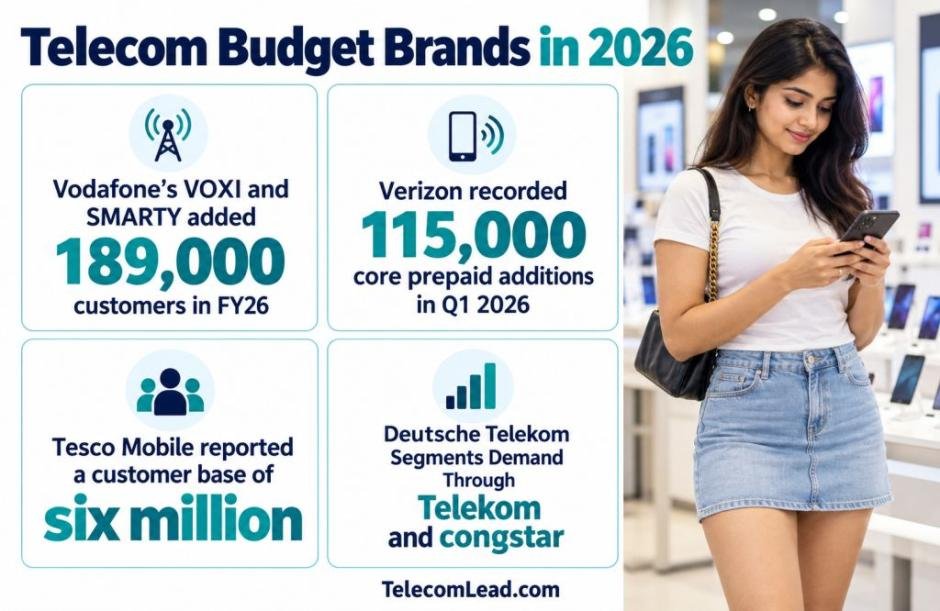
Recent results demonstrate the scale of this strategy. Vodafone’s VOXI and SMARTY added 189,000 customers in FY26, Verizon recorded 115,000 core prepaid net additions in Q1 2026, and Tesco Mobile reported a customer base of six million.
However, subscriber growth is only one measure of success. Operators also need to manage churn, acquisition costs and the possibility that existing premium customers move to cheaper plans.
Vodafone’s VOXI and SMARTY Add 189,000 Customers
Vodafone’s FY26 results indicated addition of 189,000 customers across VOXI and SMARTY, including 38,000 in the third quarter and 47,000 in the fourth quarter.
The two brands give Vodafone’s UK business separate channels for customers who prioritize affordability and straightforward mobile plans. Rather than adjusting every offer under its main brands, the group can compete through differentiated pricing, features and customer experiences.
Momentum continued into the following financial year. The Vodafone Q1 FY27 trading update reported another 34,000 customer additions across VOXI and SMARTY.
The figures demonstrate demand for value-focused propositions. They do not establish the brands’ individual profitability or show how many customers joined from competing networks rather than moving within Vodafone’s portfolio.
For the operator, the commercial objective is to attract incremental customers while keeping premium plans sufficiently differentiated to justify their higher prices.
Verizon Builds a 19.279 Million Core Prepaid Base
Verizon recorded 115,000 wireless retail core prepaid net additions in Q1 2026, compared with 137,000 in the same quarter of 2025.
Verizon’s Q1 2026 financial and operating information showed 19.279 million core prepaid connections at March 31, excluding SafeLink.
Core prepaid average revenue per user reached $33.31, while churn stood at 3.45 percent. ARPU was higher than the $31.92 recorded a year earlier, indicating that prepaid customer growth did not require a decline in this reported revenue metric.
These figures illustrate both the opportunity and the operating challenge. A large prepaid base generates recurring service revenue, but customer turnover requires continued attention to retention and acquisition spending.
Verizon’s prepaid portfolio allows it to address customers seeking lower monthly commitments while retaining a separate postpaid proposition. The results cover the core prepaid business collectively and should not be attributed to an individual brand.
Tesco Mobile Serves Six Million Customers
Tesco Mobile’s position shows how retail distribution can complement a value-focused mobile offer.
The Tesco H1 2026/27 interim results, published on October 8, 2026, reported six million Tesco Mobile customers.
Tesco said it had strengthened the proposition through simplified pay-as-you-go options and a new travel eSIM. More than 200 in-store phone shops had also been refreshed.
The business combines mobile services with an established retail presence. Physical shops provide opportunities to sell devices, explain plans and help customers who prefer assistance over a fully digital purchasing process.
The travel eSIM adds another product category, addressing overseas connectivity alongside domestic mobile services.
Tesco’s customer count demonstrates scale, but its wider retail revenue and operating profit cannot be treated as Tesco Mobile’s financial performance. The cited disclosure does not provide a corresponding standalone mobile revenue or profit figure.
Deutsche Telekom Segments Demand Through Telekom and congstar
Deutsche Telekom reported approximately 75.3 million mobile customers in Germany at March 31, 2026.
Deutsche Telekom’s high-value mobile contract customer base under the Telekom and congstar brands increased by 200,000 compared with the end of 2025. The operator attributed the trend to sustained demand for plans with data allowances.
The two-brand structure allows the group to address different priorities. Telekom can emphasize its premium proposition, while congstar offers an alternative for customers placing greater weight on price and plan simplicity.
Importantly, the 200,000 additions are a combined figure. They do not establish congstar’s separate contribution.
The overall mobile customer total also covers more than ordinary consumer smartphone subscriptions. Deutsche Telekom said growth in its prepaid base was driven mainly by machine-to-machine SIMs used in the automotive industry. Consequently, the customer increase should not be presented entirely as evidence of consumer demand for budget plans.
Canadian Flanker Brands Account for 30 Percent of Subscribers
Canada illustrates how secondary mobile brands can become a substantial part of an operator’s business.
Rogers operates Fido and Chatr, Bell offers Lucky Mobile, and TELUS operates Public Mobile. These brands help the national carriers reach customers with different spending preferences and service requirements.
The Deloitte 2026 telecommunications industry outlook estimates that flanker brands account for 30 percent of subscribers and 24 percent of revenue among major Canadian carriers.
Deloitte also reports that more than half of Western European mobile network operators use flanker brands, which represent approximately 10 percent of subscribers on average.
Canada’s gap between subscriber share and revenue share is consistent with lower average revenue from these propositions. It does not establish weaker profitability, because the cost of acquiring and serving customers also matters.
A lower-priced brand can make a useful financial contribution if its distribution, support and promotional costs remain proportionate to revenue.
How Budget Brands Help Protect Premium Positioning
The strategic advantage of a budget brand is the ability to offer a different service package rather than simply discounting the premium product.
Operators can differentiate through data allowances, device offers, contract flexibility, entertainment bundles, roaming benefits and support channels. Digital onboarding and self-service can also help reduce the cost of serving customers who prefer a simpler proposition.
Orange’s Sosh brand in France is another example of this structure, operating alongside the main Orange offer. However, group-level Orange revenue and earnings cannot quantify Sosh’s individual contribution without separate disclosures.
The main risk is internal migration. If premium subscribers move to cheaper plans without a corresponding reduction in service costs, the operator may increase its budget-brand base while weakening overall revenue.
Subscriber Growth Must Translate Into Sustainable Returns
The 2026 disclosures show that budget brands and prepaid services can attract substantial customer demand. Vodafone’s VOXI and SMARTY are adding subscribers, Verizon maintains a sizeable prepaid base, and Tesco Mobile demonstrates the reach of retail-led mobile distribution.
For operators, the strongest evidence of success combines net additions with stable revenue per customer, manageable churn and disciplined acquisition costs. Brand-level disclosures are particularly valuable because parent-company growth can conceal different outcomes across premium and value propositions.
Budget brands offer a practical way to compete across income and spending levels. Their long-term value depends on bringing additional customers into the business while preserving clear reasons for others to choose premium plans.
FASNA SHABEER


