
International roaming is changing in 2026 as telecom operators compete with travel eSIM providers for customers seeking affordable data and predictable bills abroad. Bharti Airtel is bundling roaming into postpaid subscriptions, Verizon and AT&T charge for daily usage, and Orange and Vodafone are selling travel connectivity beyond their existing subscriber bases.
However, the available disclosures do not establish which operator earns the most international roaming revenue. Pricing, coverage and product launches reveal competing commercial strategies rather than a comparable revenue ranking.
The central challenge is clear: operators must capture travel spending while protecting customer relationships as alternatives to traditional roaming become easier to buy.
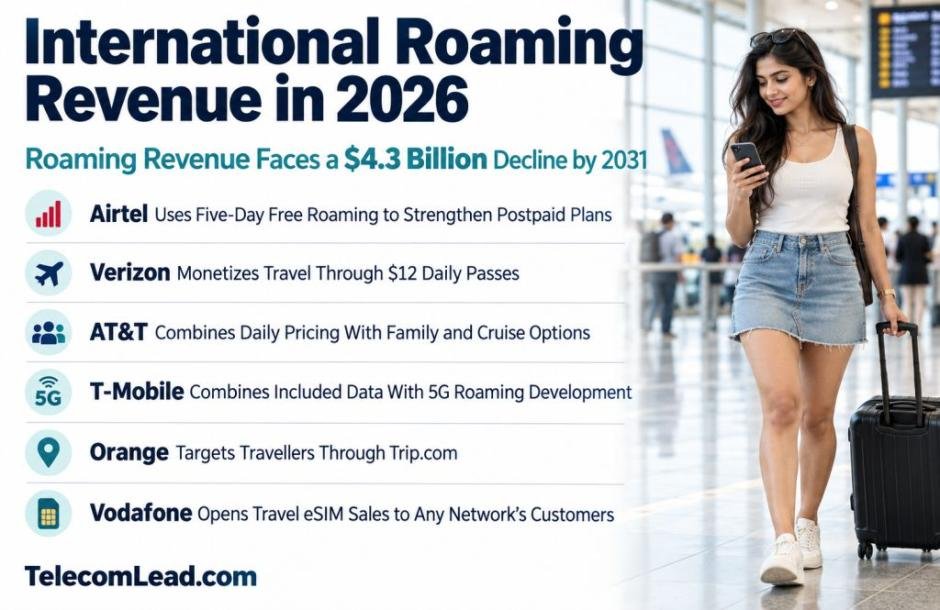
Roaming Revenue Faces a $4.3 Billion Decline by 2031
Juniper Research’s international roaming forecast projects global retail roaming revenue of $15.6 billion in 2026, falling to $11.3 billion by 2031.
That represents a projected decline of $4.3 billion, or approximately 27.6 percent. The research attributes the pressure to regulatory restrictions on roaming charges and growing adoption of travel eSIMs.
Juniper distinguishes retail roaming delivered through a traveller’s home SIM from travel eSIM plans purchased for international trips. This distinction matters when evaluating operators: growth in travel eSIM sales can create new business even while traditional roaming revenue declines.
The report also identifies travel bookings as an important sales channel. Airlines, travel agencies and booking platforms can offer connectivity before customers depart, competing with the home operator earlier in the purchasing process.
Airtel Uses Five-Day Free Roaming to Strengthen Postpaid Plans
Bharti Airtel introduced complimentary international roaming with its revised postpaid plans from October 8, 2026.
The Airtel international roaming announcement specifies 5GB of data, 60 minutes of calls and 25 outgoing SMS, alongside free incoming SMS, valid for five days.
Customers can choose when to activate the pack. For eligible family plans, the benefit extends to each member included in the subscription.
Airtel’s approach uses travel connectivity to increase the appeal of its domestic postpaid offering. A bundled allowance can encourage customers to retain their home SIM for an overseas trip and reduce the immediate need to purchase a separate travel data package.
Commercially, the benefit could support retention and plan upgrades. Its included value should nevertheless be distinguished from separately billed roaming revenue. Assessing the outcome requires evidence on subscription growth, customer retention and the cost of providing the allowance.
Verizon Monetizes Travel Through $12 Daily Passes
Verizon’s TravelPass costs $12 per line per day in more than 210 countries and destinations, plus applicable taxes and fees.
The service includes talk, text and data. After 5GB of high-speed data, customers receive unlimited data at reduced speeds for the remainder of the session.
TravelPass costs $6 per line per day in Canada and Mexico where applicable, although roaming in those markets is already included with qualifying plans.
A 24-hour session begins when the customer uses an eligible service abroad. Background data activity can also trigger a session.
For illustration, seven chargeable sessions at the standard $12 rate would cost $84 for one line, before taxes, fees or included benefits. This is a pricing calculation, rather than evidence of Verizon’s average roaming revenue.
The model offers convenience: customers retain their number and use their existing service without installing another SIM. Its competitiveness depends on how travellers value that convenience relative to alternative data packages.
AT&T Combines Daily Pricing With Family and Cruise Options
AT&T’s International Day Pass uses a similar daily charging structure. Its advertised land rate is $12 per day across more than 210 destinations, with additional eligible lines used on the same calendar day costing $6 each, subject to the offer’s terms.
A separate cruise option costs $20 per day and covers more than 400 cruise ships.
The land service allows eligible customers to use their domestic talk, text and data allowances abroad. Actual charges depend on plan eligibility, usage and applicable billing conditions.
This structure creates distinct opportunities across individual travel, family trips and cruise connectivity. However, daily prices alone cannot establish AT&T’s roaming revenue performance. Subscriber participation, trip frequency and wholesale network costs also influence the commercial result.
T-Mobile Combines Included Data With 5G Roaming Development
T-Mobile uses international connectivity as a benefit within qualifying premium subscriptions. Eligible Go5G Next and Go5G Plus customers receive up to 5GB of high-speed data in more than 215 countries and destinations, followed by data at reduced speeds, subject to plan terms.
The approach makes overseas connectivity part of the ongoing subscription relationship. Customers with modest travel data requirements may have less reason to purchase a separate package.
T-Mobile US and Reliance Jio also announced what they described as the world’s first 5G standalone roaming connection in September 2026, enabled through interoperability with Syniverse’s mediation platform.
The development provides a technical foundation for cross-border 5G standalone services. It does not, by itself, demonstrate incremental roaming revenue or universal availability across destinations.
Orange Targets Travellers Through Trip.com
The Orange Travel partnership with Trip.com brings eSIM purchasing into the travel booking process.
From June 2026, the partnership offered packages covering France, Italy, Spain, the United Kingdom and Switzerland. Options include 20GB, 50GB and 100GB, with validity periods of up to 30 days and prices starting at €8.99.
Orange Travel separately supports connectivity in more than 200 destinations, backed by the group’s network relationships.
The distribution strategy is commercially significant because Orange can reach travellers who subscribe to other mobile operators. Selling through a booking platform also places the offer in front of customers while they are planning their trip.
Vodafone Opens Travel eSIM Sales to Any Network’s Customers
Vodafone’s Travel eSIM platform covers 206 destinations across 700 mobile networks, including 5G connectivity in 98 countries.
Packages range from 1GB to 150GB, with validity of up to 90 days. The service supports mobile hotspots and is available to users regardless of their home network.
Vodafone specifies that the product is data-only. Standard voice calls and SMS are excluded, although customers can continue using their existing SIM for those services under its applicable terms.
This expands Vodafone’s potential customer base beyond its own subscribers. Revenue assessment must still distinguish travel eSIM purchases from traditional roaming charges.
Airline Connectivity Adds Another Competitor
Air India’s EasyRoam service, developed with Tata Communications, adds an airline-branded alternative. The October 2026 launch initially covered 30 countries, with plans starting at Rs 241 excluding taxes, supporting physical SIMs and eSIMs. Expansion to 190 countries was described as an ambition.
The competing strategies point to three sources of commercial value: direct roaming charges, stronger premium subscriptions and travel connectivity sales to new customers.
Determining the winners will require disclosed revenue, adoption and profitability figures. For now, operators are competing on convenience, distribution, coverage and price as travellers gain more control over how they connect abroad.
FASNA SHABEER


