
The mobile internet gender gap across low- and middle-income countries (LMICs) narrowed slightly in 2025, continuing a slow improvement trend that began in 2022. However, women remain significantly less connected than men, according to the GSMA Mobile Gender Gap Report 2026.
More than 1.5 billion women now use mobile internet across LMICs, but women are still 12 percent less likely than men to access mobile internet services. This gap translates into approximately 200 million fewer women than men using mobile internet. Overall, 74 percent of men use mobile internet compared with only 65 percent of women.
810 Million Women Still Offline
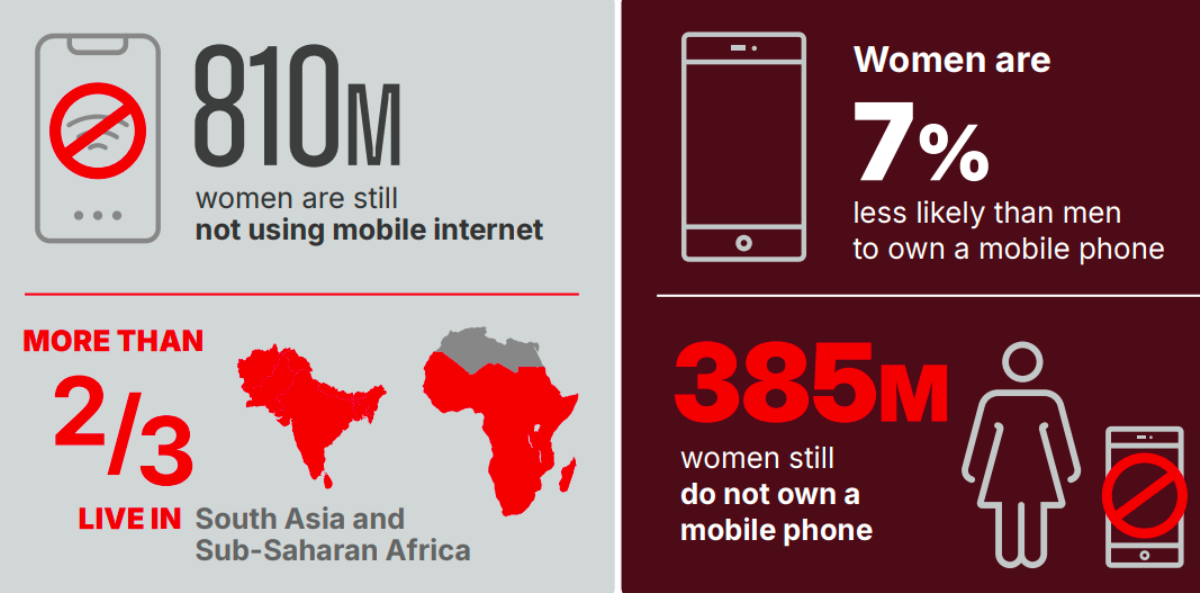
Despite growing adoption, around 810 million women across LMICs remain offline. More than two-thirds of these women live in Sub-Saharan Africa and South Asia, which continue to record the world’s largest mobile internet gender gaps at 26 percent and 25 percent respectively.
The divide is particularly severe in rural areas, where the mobile internet gender gap is typically two to three times wider than in urban regions. Rural communities in Sub-Saharan Africa, South Asia, and the Middle East and North Africa face the largest connectivity disparities.
The report also highlights that least developed countries experience the widest gender gaps in mobile internet adoption, followed by landlocked developing countries.
Smartphone Ownership Gap Affects Digital Access
Smartphone ownership remains one of the biggest obstacles to internet adoption among women. The smartphone ownership gender gap across LMICs remains unchanged at 13 percent, representing approximately 210 million fewer women owning smartphones than men.
Currently, 73 percent of men own smartphones compared with 64 percent of women. Countries and regions with larger mobile internet gender gaps, including Sub-Saharan Africa and South Asia, also tend to have wider smartphone ownership disparities. Similar patterns are visible in rural communities.
385 Million Women Still Lack a Mobile Phone
The mobile ownership gender gap across LMICs stands at 7 percent and has shown little improvement over the last nine years.
As a result, approximately 385 million women still do not own a mobile phone. Reaching this population remains one of the most difficult challenges for governments, mobile operators, and digital inclusion programs.
Shared Phone Access Remains Common in India, Pakistan and Ethiopia
The vast majority of mobile internet users access the internet through their own mobile device. However, women in several countries continue to depend on shared access.
In India, Pakistan, and Ethiopia, a significantly higher proportion of women mobile internet users rely on someone else’s phone to access online services compared with men, reflecting persistent ownership and affordability barriers.
Awareness Is High, But Adoption Lags
Awareness of mobile internet is now high and nearly equal among men and women across most surveyed countries. However, awareness does not automatically translate into adoption, particularly for women.
Among people who are aware of mobile internet services, affordability—especially handset affordability—remains the leading barrier to adoption. Literacy and digital skills are the second most significant challenge.
Women experience these barriers more acutely because of lower education levels, lower incomes, restrictive social norms, and broader structural inequalities.
Safety and Security Concerns Limit Usage
For those already online, safety and security concerns remain the most commonly reported barriers to greater mobile internet use. Affordability of data services and handsets continues to be a challenge, while connectivity quality also affects user experience.
The report notes that safety and security concerns are increasingly reported by both men and women in countries with higher levels of mobile internet adoption, indicating growing awareness of digital risks.
Women Use Mobile Internet Less Frequently
Most mobile internet users access online services every day, with men generally using mobile internet more frequently than women.
Women also tend to use mobile internet for a narrower range of activities on a daily and weekly basis. Communication and entertainment remain the most popular use cases for both genders, while adoption of more advanced digital services remains lower among women.
Mobile Internet Improves Livelihoods
Across almost every surveyed country, the majority of mobile internet users reported that connectivity either improved their livelihoods and income or had no negative impact.
Men and women expressed similar views regarding the benefits of connectivity. Users in Sub-Saharan Africa were more likely than those in any other region to report improvements in livelihoods and income resulting from mobile internet use.
$1.3 Trillion GDP Opportunity from Closing the Gender Gap
The economic impact of greater digital inclusion could be substantial. GSMA estimates that closing the mobile internet gender gap across LMICs between 2023 and 2030 could generate an additional $1.3 trillion in GDP.
Closing the broader gender gap in mobile ownership and usage could also create approximately $230 billion in additional revenue for the global mobile industry.
Industry efforts are already showing results. Since 2016, more than 50 mobile operators participating in the GSMA Connected Women Commitment Initiative have collectively reached over 90 million additional women with mobile internet or mobile money services.
The report concludes that accelerating progress will require coordinated action across governments, mobile operators, technology providers, development organizations, and financial institutions. Improving handset affordability, reducing data costs, expanding digital literacy programs, addressing online safety concerns, and tackling structural inequalities will be critical to ensuring that women are not left behind in the digital economy.
BABURAJAN KIZHAKEDATH

