

Africa’s largest mobile operators are entering a new investment phase as subscriber growth is increasingly complemented by spending on 4G, 5G, fiber, AI, mobile data and digital services.

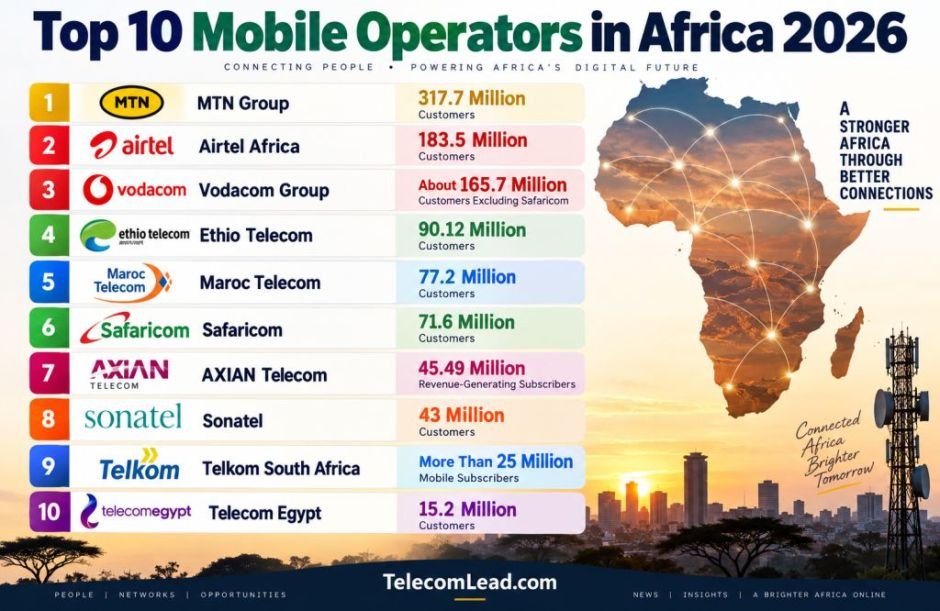
MTN, Airtel Africa and Vodacom operate the continent’s biggest mobile businesses by customer scale, while Ethio Telecom, Maroc Telecom, Safaricom, AXIAN Telecom, Sonatel, Telkom South Africa and Telecom Egypt are expanding network capacity in their core markets.
The investment opportunity remains substantial. According to the GSMA Mobile Economy Africa 2026 report, mobile technologies and services contributed $240 billion to Africa’s economy in 2025, equivalent to 7.8 percent of GDP. The contribution is forecast to reach $290 billion by 2030.
The GSMA expects African mobile operators to invest more than $76 billion in network infrastructure between 2024 and 2030, providing a strong investment backdrop for the continent’s biggest operators.
1. MTN Group — 317.7 Million Customers
Revenue: R115.3 billion
MTN Group remains Africa’s largest telecom operator by customer scale. MTN reported 317.7 million customers across 19 markets at June 30, 2026.
H1 service revenue reached R115.3 billion, while the operator committed almost R20 billion in H1 capex to mobile networks, home connectivity and IT modernization.
More than 179 million MTN customers were active data users, while data traffic increased almost 23 percent to 14.3 petabytes. This illustrates why mobile data growth and network capacity are becoming increasingly important to African operator investment strategies.
2. Airtel Africa — 183.5 Million Customers
Revenue: $6.415 billion
Airtel Africa had 183.5 million customers at March 31, 2026, an increase of 10.5 percent. Unlike operators with substantial businesses outside Africa, Airtel Africa’s operations span 14 African countries, making its subscriber figure particularly useful for an Africa-focused comparison.
FY2026 revenue reached $6.415 billion, including $5.350 billion from mobile services and $2.530 billion from data services.
Airtel Africa operated 40,378 network sites at March 2026 and is expanding 4G, 5G and fiber infrastructure to support rising data consumption.
3. Vodacom Group — About 165.7 Million Customers Excluding Safaricom
Revenue: R167.7 billion
Vodacom reported 237.3 million combined customers, including Safaricom on a 100-percent basis. Removing Safaricom’s separately reported 71.6 million customers gives an indicative Vodacom customer base of approximately 165.7 million excluding Safaricom.
FY2026 revenue reached R167.7 billion, service revenue was R133.6 billion, and capital expenditure totaled R23.6 billion.
Vodacom continues to expand 5G and broadband infrastructure across its African footprint.
4. Ethio Telecom — 90.12 Million Customers
Revenue: ETB215.82 billion
Ethio Telecom reported 90.12 million total customers, including 72.09 million active mobile subscribers, as Ethiopia’s telecom market continues its transformation.
Revenue increased 33.2 percent to ETB215.82 billion.
The operator expanded 5G services to 33 cities, added 25 new 5G sites and increased its total 5G footprint to 340 sites. Its 4G population coverage reached 82.23 percent.
5. Maroc Telecom — 77.2 Million Customers
Revenue: MAD19.009 billion
Maroc Telecom reached 77.2 million customers at the end of H1 2026, while consolidated revenue increased 5.4 percent to MAD19.009 billion.
5G is emerging as an important investment driver. Mobile data traffic increased 79 percent following the introduction of 5G, while approximately MAD2 billion has been allocated to 5G investment during 2026.
The data surge demonstrates why 5G network investment is increasingly about generating capacity and improving customer experience rather than simply expanding coverage.
6. Safaricom — 71.6 Million Customers
Revenue: KES414 billion
Safaricom reported 71.6 million customers and FY2026 revenue of KES414 billion across its operations.
Kenya remains the company’s largest business, while Ethiopia represents its major expansion market. Safaricom continues to invest in 4G and 5G capacity as data consumption increases.
Safaricom is shown separately for operator-level comparison. Its customer base, however, is already included within Vodacom Group’s reported consolidated customer number and therefore should not be added again when estimating the combined scale of the groups.
7. AXIAN Telecom — 45.49 Million Revenue-Generating Subscribers
Revenue: $980 million
AXIAN Telecom reported 45.49 million revenue-generating subscribers in H1 2026, an increase of 9 percent.
Revenue jumped 26 percent to $980 million, while capex reached $189 million.
AXIAN is expanding telecom infrastructure across markets including Tanzania, Madagascar, Togo and Senegal. Its subscriber number is based on revenue-generating subscribers, however, so direct comparisons with operators reporting total registered customers should be made carefully.
8. Sonatel — 43 Million Customers
Revenue: FCFA1,049.8 billion
Sonatel reached 43 million customers in H1 2026, representing growth of 1.2 percent.
Revenue increased 9.3 percent to FCFA1,049.8 billion, while eCAPEX reached FCFA154 billion.
Sonatel is expanding 5G infrastructure in Senegal, including additional sectors and capacity in locations such as Touba, Popenguine, Kaolack and Tivaouane.
9. Telkom South Africa — More Than 25 Million Mobile Subscribers
Revenue: R44.477 billion
Telkom South Africa reported more than 25 million mobile subscribers, including almost 20 million mobile data subscribers.
Group revenue reached R44.477 billion, mobile service revenue totaled R22.388 billion, and mobile data revenue reached R17.752 billion.
The high proportion of customers using mobile data demonstrates how broadband consumption is increasingly shaping telecom capex and network modernization strategies.
10. Telecom Egypt — Mobile Customers Up 4%
Revenue: EGP59.2 billion
Telecom Egypt reported H1 2026 revenue of EGP59.2 billion, an increase of 17 percent year over year.
Its mobile customer base increased 4 percent, while fixed broadband customers grew 9 percent and fixed voice customers increased 6 percent.
Telecom Egypt is expanding 5G while preparing for future capacity requirements. The company also conducted a mobile service trial using 6 GHz spectrum, highlighting the growing importance of additional spectrum for future networks.
GSMA: Africa’s Bigger Opportunity Is Converting Coverage Into Usage
The next stage of Africa’s telecom growth will not depend only on adding towers and subscribers.
GSMA says approximately 63 percent of Africa’s population lives within mobile broadband coverage but does not use mobile internet, while only 9 percent remains outside mobile broadband coverage. Almost 1 billion Africans therefore remain within the mobile internet usage gap.
Affordability, device costs, digital skills and relevant digital content are among the main barriers.
Closing that gap represents a major commercial opportunity for operators. More customers moving online can increase demand for smartphones, mobile data, digital financial services, entertainment, cloud applications and enterprise services.
At the same time, the technology mix is moving forward. GSMA forecasts that 5G will account for 21 percent of Africa’s mobile connections by 2030.
AI is also becoming part of operator strategy. African telecom companies are deploying AI for predictive maintenance, network optimization and customer service, while 79 percent of operators surveyed by GSMA Intelligence identify becoming a digital transformation partner as a primary enterprise objective.
Africa Mobile Industry Heads Toward $290 Billion
Africa’s biggest telecom operators are therefore competing on much more than subscriber numbers.
MTN, Airtel Africa and Vodacom have enormous customer scale, while operators including Ethio Telecom, Maroc Telecom, Safaricom, AXIAN, Sonatel, Telkom South Africa and Telecom Egypt are investing aggressively in their strongest markets.
GSMA estimates the mobile ecosystem already supported approximately 13 million jobs and generated $45 billion in public revenues in 2025. By 2030, mobile’s economic contribution is forecast to rise from $240 billion to $290 billion.
For Africa’s operators, the central challenge is increasingly clear: turn extensive network coverage into higher mobile internet adoption, greater data consumption and stronger digital-service revenue, while simultaneously funding the transition toward 4G, 5G, fiber and AI-enabled networks.
FASNA SHABEER