

AT&T, Jio, VEON, Airtel, Orange, e& and Telkomsel are pursuing different ways to deepen digital engagement as Apple and Google shape how smartphone users discover and access services.

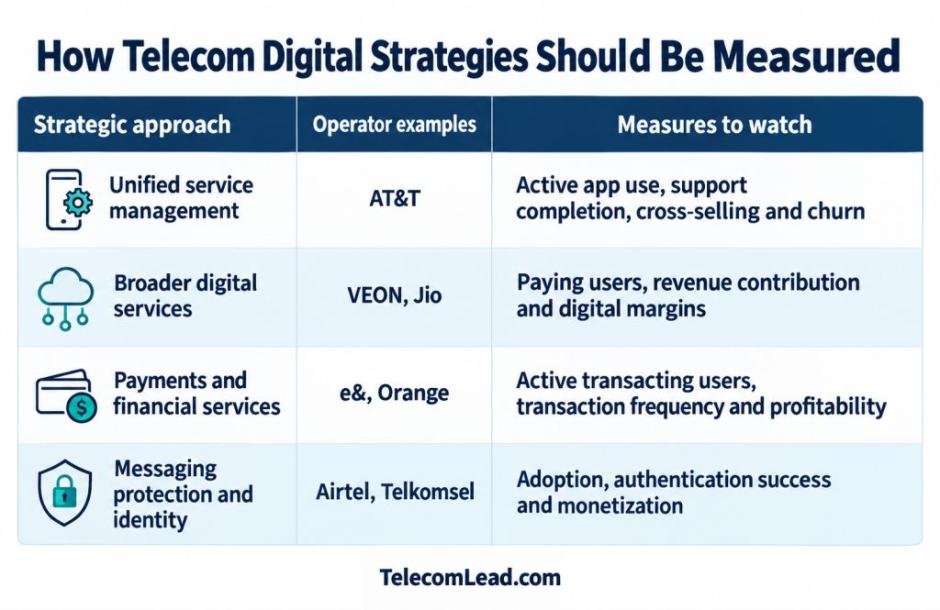
Telecom operators supply the connectivity that powers digital services. Their strategic challenge is turning that connection into a broader customer relationship, with more opportunities to sell services, support users and generate revenue.
Apple’s App Store ecosystem facilitated more than $1.4 trillion in developer billings and sales in 2025. Meanwhile, VEON generated $644 million in digital revenue in the first half of 2026, showing that operators can build substantial businesses beyond connectivity.
These figures measure different activities. Together, they frame an important question for telecom executives: which customer interactions can operators serve profitably?
Customer control, in this context, means influencing where users discover services, manage subscriptions, make payments, verify their identity and seek support. The commercial test is whether those interactions improve revenue, margins and retention.
Apple’s $1.4 Trillion Ecosystem Shows Platform Scale
According to Apple’s June 2026 announcement, its App Store ecosystem attracted more than 850 million average weekly users across 175 countries and regions in 2025.
The App Store ecosystem study illustrates the scale of services accessed through smartphone applications. However, the $1.4 trillion figure represents developer billings and sales facilitated by the ecosystem. It is not Apple revenue, and Apple says more than 90 percent of that commerce involved no commission paid to the company.
For telecom operators, the inference is that network access does not automatically deliver influence over every service used through that connection. Apple and Google provide important application-distribution channels, while individual service providers maintain their own customer relationships.
Operators therefore need to identify specific advantages — such as simpler account management, local payments or network-based security — that give customers a reason to engage directly.
VEON Shows How Digital Services Can Generate Revenue
VEON provides one of the strongest examples of measurable monetization beyond connectivity.
VEON’s H1 2026 digital results show digital revenue increased 55.5 percent year over year to $644 million, accounting for 26.1 percent of group revenue, compared with 19.6 percent a year earlier.
In Q2, financial-services revenue reached $151 million, up 48.5 percent. Digital-life services, including entertainment, ride-hailing and healthcare, generated $119 million.
The figures show an established revenue contribution rather than simply a plan to launch more applications. However, growth also reflected acquisitions, including Uklon and Tabletki. VEON additionally reclassified enterprise identity and credentials-management revenue into its digital enterprise category and adjusted prior periods for comparison.
The analytical lesson is to distinguish organic adoption, acquired revenue and reporting changes when assessing an operator’s digital performance. Revenue growth becomes more informative when accompanied by evidence of profitability and repeat customer use.
AT&T Uses Convergence to Strengthen Its Customer App
AT&T is pursuing a strategy centered on its existing connectivity relationship.
In March 2026, it began rolling out a new application combining wireless and home internet management, shopping, usage insights, device controls and an AI-powered assistant. AT&T said millions of customers already used its apps each month.
The new AT&T customer app aims to make one interface useful across several household services.
Convergence supplies a practical reason for customers to use it. In July 2026, AT&T reported that Internet Air had reached 2 million subscribers, with more than half also subscribing to AT&T wireless.
For these households, unified support and device management could make the operator app more useful than a channel used mainly for bill payment. That remains a strategic opportunity: the launch announcement does not establish an improvement in churn or sales conversion.
Jio Builds a Broader Digital Gateway
Jio Platforms describes a vertically integrated approach spanning networks, devices, operating systems and digital applications.
Reliance Jio Infocomm served 524.4 million customers as of March 31, 2026. That connectivity base provides substantial distribution potential for entertainment, cloud services, smart-home products and emerging AI applications.
Jio’s strategy extends the operator’s role across more of the digital experience. The opportunity is to combine access, products and service management within a familiar customer relationship.
Subscriber scale, however, should be treated as a foundation for digital growth. Assessing the outcome requires separate evidence of active application users, paid-service adoption, digital revenue and retention.
Payments Create Another Route to Customer Engagement
Financial services offer operators a different reason for customers to return regularly.
In February 2026, e& money reported more than 2 million customers using its application for payments, international remittances and card spending. It also announced approval of a UAE Finance Company license supporting expansion into lending.
Orange’s 2026–2030 strategy targets €1 billion in additional revenue by 2028 from trusted digital services. Its priorities include cybersecurity and home protection in Europe, alongside Mobile Money and the Max It super app in Africa and the Middle East.
These examples represent different stages of execution. e& reports an existing financial-services customer base; Orange sets a future revenue ambition. Both require transaction activity and profitability to establish commercial progress.
Airtel and Telkomsel Partner on Trust and Identity
Partnerships can also give operators a role inside third-party digital experiences.
Airtel’s March 2026 announcement with Google described the integration of network intelligence with RCS messaging protections. Airtel reported cumulative totals of 71 billion spam calls and 2.9 billion spam SMS messages blocked through its anti-spam initiatives.
Those totals provide background on Airtel’s protection capabilities; they are not results attributed to the new RCS partnership.
Telkomsel’s Telco Verify 2.0 integrates SIM-based verification with Google Firebase Authentication to support application login without an OTP. Its Telkomsel’s 2026 AI and authentication update reported more than 100 AI/ML use cases and a 78 percent reduction in customer-care resolution costs through AI-powered automation.
These initiatives illustrate two opportunities: supply network capabilities to digital platforms and improve the economics of customer service.
The evidence supports several paths to stronger customer relationships. It does not establish a single industry-wide measure of customer control lost to platforms.
For operators, the next test is whether digital engagement produces profitable growth. Applications, payments and authentication services should be judged by repeat use, paying customers, margins and retention — not simply by launches or the size of the connectivity subscriber base.
FASNA SHABEER