

Telecom operators are reducing employee numbers in 2026, but smaller workforces are not consistently delivering lower personnel expenses. Wage adjustments, severance payments, business disposals and changes in staffing arrangements are reshaping the relationship between headcount and operating costs.

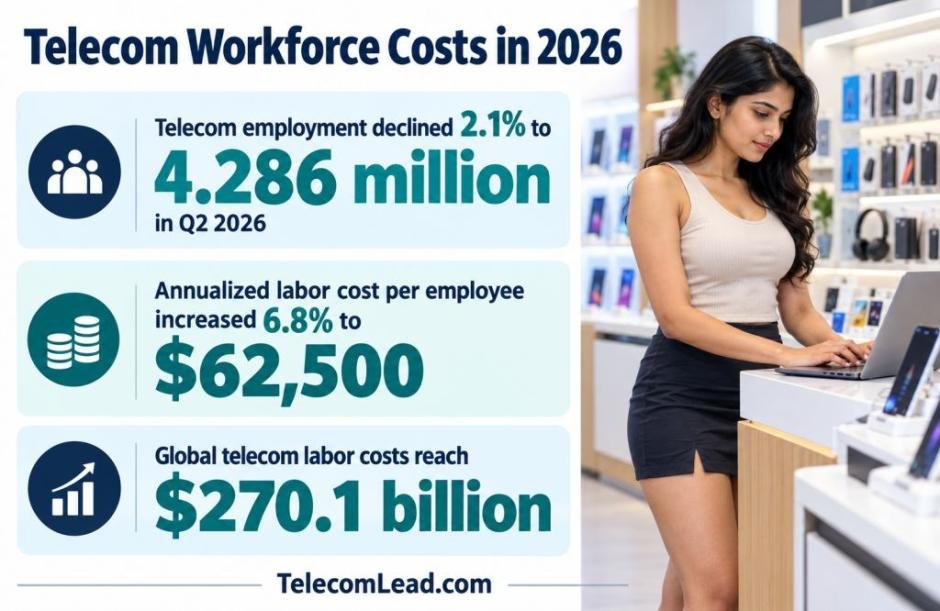
Global telecom employment declined 2.1 percent year on year to 4.286 million in Q2 2026, while annualized labor cost per employee increased to $62,500. Operators are managing these pressures alongside continued investment in fiber, 5G and digital services.
Results from Telefonica, Deutsche Telekom, BT Group, AT&T and Verizon illustrate different approaches: reducing direct employment, retiring legacy infrastructure, reorganizing retail operations and changing how employee costs are allocated to network investment.
Global Telecom Labor Costs Reach $270.1 Billion
According to MTN Consulting’s telecom workforce analysis, annualized global telecom labor costs reached $270.1 billion, representing 14.3 percent of revenue. Annualized industry revenue stood at approximately $1.89 trillion.
Employment fell from 4.378 million in Q2 2025 to 4.286 million in Q2 2026, a reduction of approximately 92,000 employees. Labor cost per employee nevertheless increased 6.8 percent, from $58,500 to $62,500.
The report also challenges the assumption that job reductions automatically improve profitability. Across its 72-operator panel, MTN Consulting found effectively no correlation between changes in headcount and changes in EBIT margin. Of the 47 operators that reduced employee numbers, 21 reported margins that declined or remained unchanged.
These findings suggest that workforce efficiency depends on revenue performance, operating processes and the cost of delivering services, alongside employee numbers.
Telefonica: Lower Headcount, Higher Reported Personnel Expenses
Telefonica’s H1 2026 financial reports showed an average workforce of 74,427, compared with 92,196 a year earlier.
That headline reduction includes business disposals and discontinued operations. Within continuing operations, average headcount declined 3.4 percent to 71,000, providing a more comparable measure of the underlying staffing change.
Personnel expenses increased 5.7 percent to €2.491 billion, partly because of €265 million in restructuring expenses in Germany. Excluding that impact and movements in the Brazilian real, personnel expenses decreased 3.9 percent.
With first-half revenue of €16.392 billion, Telefonica’s results demonstrate why investors need to separate recurring employee expenses from restructuring charges. Workforce changes can reduce the underlying cost base while temporarily increasing reported expenditure.
Deutsche Telekom Reduces Workforce by 6,283
Deutsche Telekom’s H1 2026 workforce disclosures recorded 191,796 full-time equivalent employees at June 30, down 6,283 from December 2025.
The US business accounted for the largest reduction, with employee numbers falling 4,671 to 65,365. Germany’s workforce declined 928 to 54,161.
Despite the smaller workforce, first-half personnel expenses increased 2.5 percent to €10.026 billion, while revenue rose 2.4 percent to €59.804 billion.
The figures show the limits of judging productivity through headcount alone. Employee numbers, personnel expenditure and revenue must be assessed over comparable periods, with attention to restructuring and changes in business scope.
BT Group Cuts Net Staff Costs by £222 Million
BT Group reported £4.550 billion in total staff costs for the financial year ended March 31, 2026, compared with £4.796 billion a year earlier.
After capitalizing qualifying direct labor costs, BT Group’s staff costs declined from £3.384 billion to £3.162 billion. That represents a reduction of £222 million, or approximately 6.6 percent.
Indirect labor costs moved in the opposite direction, increasing from £1.271 billion to £1.368 billion.
The distinction is important for telecom cost analysis. Employee spending associated with qualifying network construction and investment projects can be capitalized rather than recognized immediately as an operating expense.
BT’s results therefore require separate assessment of total staff spending, capitalized labor and indirect labor costs. A reduction in one category does not establish that every component of workforce expenditure is falling.
AT&T Links Personnel Savings to Copper Network Retirement
AT&T’s Q2 2026 results reported revenue of $31.6 billion, up 2.3 percent, and operating income of $7.3 billion, an increase of 20.3 percent.
Legacy-segment operating expenses declined 10.8 percent to $1.1 billion. Lower personnel and other expenses associated with copper network decommissioning contributed to the improvement.
AT&T plans to discontinue service over the large majority of its domestic copper network by the end of 2029.
This provides a concrete example of workforce costs changing with network architecture. Retiring older infrastructure can reduce maintenance requirements and supporting operational work. However, the reported decline covers several expense categories and should not be treated entirely as payroll savings.
Verizon’s $397 Million Severance Charge Shows Transition Costs
Verizon recorded $397 million in severance charges in Q2 2026 while maintaining substantial network investment. First-half capital expenditure reached $8.2 billion.
Second-quarter revenue of Verizon was $34.3 billion, down 0.7 percent. Mobility and broadband service revenue increased 2.8 percent to approximately $23.4 billion, while weaker equipment revenue weighed on the consolidated total.
Adjusted EBITDA increased 7.2 percent to $13.7 billion, and adjusted EBITDA margin rose from 37.1 percent to 40.1 percent.
These results show why restructuring charges and operating performance need separate consideration. Severance creates an immediate expense, while any recurring savings emerge over subsequent reporting periods. Revenue mix, customer acquisition spending and other operational changes also influence margins.
T-Mobile and Vodafone Track Separate Restructuring Expenses
T-Mobile US reported $141 million in pretax charges associated with its 2025–2026 Workforce Transformation during the first half of 2026. It also recorded $108 million in pretax charges for retail initiatives, including store closures and related costs.
Second-quarter service revenue increased 9 percent to $19.0 billion, while postpaid service revenue grew 13 percent to $15.9 billion.
Vodafone reported FY2026 revenue of €40.461 billion, up 8.0 percent, with restructuring costs increasing to €370 million from €164 million.
These disclosures underline the need to distinguish employee restructuring from store reorganization and business integration. Combining every transformation charge into a single workforce figure can obscure the actual cost and scope of staffing changes.
What Telecom Employee Productivity Should Measure
The 2026 results indicate that telecom workforce productivity requires a assessment than the number of positions removed.
Operators and investors should track revenue and operating profit per employee alongside recurring personnel expenses, restructuring charges and contractor spending. Service measures—including fault resolution, installation times and customer support performance—help establish whether financial efficiencies are accompanied by effective operations.
Comparisons also need consistent definitions. Average employees, period-end headcount and full-time equivalents measure different things. Business disposals can reduce reported employment without demonstrating a corresponding productivity improvement.
Telecom operators that combine lower recurring costs with revenue growth and dependable service delivery will provide stronger evidence of workforce efficiency than those reporting job reductions alone.
FASNA SHABEER