

Global telecom subscriber growth remains substantial in 2026, but the strongest operators are expanding through very different models. Bharti Airtel and Reliance Jio are adding large numbers of wireless subscribers in India, China Telecom and China Mobile continue to expand enormous mobile bases, Telefonica is growing across its core markets, while T-Mobile US, AT&T and Verizon are concentrating on higher-value postpaid customers.

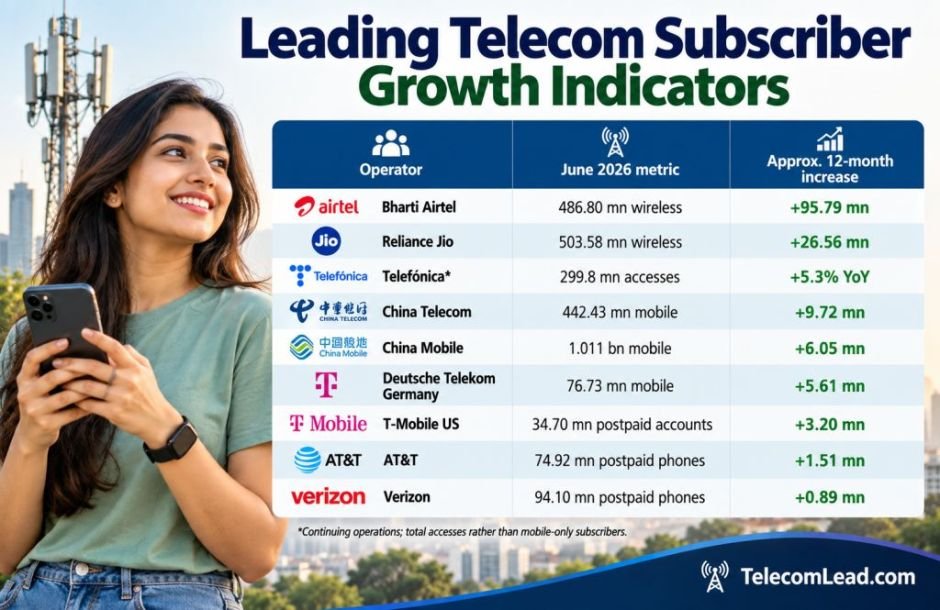
The comparison uses the latest available June 2025-to-June 2026 data where possible. Operator definitions vary significantly — from wireless subscribers and mobile customers to postpaid accounts and total accesses — so the figures should be viewed as growth indicators rather than a perfectly like-for-like global ranking.
Bharti Airtel: 95.8 Million Reported Wireless Additions
Bharti Airtel recorded the largest increase among the operators reviewed. Its reported wireless subscriber base increased from 391.01 million in June 2025 to 486.80 million in June 2026, representing approximately 95.79 million additions.
The latest TRAI telecom subscription data shows Airtel adding another 2.99 million wireless subscribers during June 2026.
The unusually large 12-month change should be interpreted using TRAI’s reported wireless categories rather than compared directly with operators reporting narrower metrics such as postpaid phones.
Reliance Jio: 26.6 Million Wireless Subscribers Added
Reliance Jio expanded from 477.02 million wireless subscribers to 503.58 million, adding approximately 26.56 million over 12 months.
Jio ended June with a 39.27 percent wireless market share after adding 2.15 million subscribers during the month.
Growth is also moving beyond conventional smartphones. Jio’s 5G fixed wireless access base reached 9.11 million, demonstrating how 5G is creating an additional subscriber category alongside mobile.
TRAI’s June 2026 report confirms the latest operator-level Indian market data.
Telefonica: Total Accesses Rise 5.3% to 299.8 Million
Telefonica provides another important global growth example.
The operator ended June 2026 with 299.8 million accesses across its continuing operations, up 5.3 percent year over year.
Telefonica’s H1 2026 results show particularly strong momentum in Brazil. Telefónica Brasil, operating under the Vivo brand, reached a record almost 119 million accesses.
Vivo Total, its converged proposition, reached 3.8 million customers, up 29 percent.
Telefónica Spain meanwhile maintained more than 16 million mobile contract accesses, while its IoT lines jumped to 25.82 million, almost three times the June 2025 level.
China Telecom Adds 9.72 Million Mobile Subscribers
China Telecom increased its mobile subscriber base from 432.71 million in Q2 2025 to 442.43 million in Q2 2026, representing approximately 9.72 million additions.
The company’s quarterly operating data shows that its 5G network subscriber base reached 322.50 million.
China Telecom added approximately 1.88 million mobile subscribers during Q2 alone.
Its results demonstrate that meaningful subscriber expansion remains possible even with a mobile base exceeding 440 million.
China Mobile: 1.01 Billion Customers and 687 Million on 5G
China Mobile remains the world’s largest operator by mobile customers.
Its customer base reached approximately 1.011 billion at June 2026, compared with around 1.005 billion a year earlier, representing growth of approximately 6.05 million.
China Mobile reported 5.88 million net mobile additions during H1 2026, while its 5G network customer base reached 687 million.
Its scale extends beyond smartphones. China Mobile also reported approximately 337 million integrated broadband network customers and 1.511 billion IoT card connections.
The figures illustrate an important 2026 trend: operators measure growth across mobile, broadband, IoT and converged connections.
Deutsche Telekom Germany Adds 5.6 Million Mobile Customers
Deutsche Telekom’s German operation expanded its mobile base from 71.126 million in June 2025 to 76.733 million in June 2026.
That represents approximately 5.61 million additional customers and 7.9 percent YoY growth.
Contract customers increased by approximately 1.11 million to 28.15 million, an important indicator because contract customers generally provide more predictable recurring revenue than prepaid connections.
The growth shows that mature European markets can still produce substantial customer expansion.
T-Mobile US Expands Postpaid Account Base by 3.2 Million
T-Mobile US increased its postpaid account base from 31.502 million to 34.700 million, representing a 3.198 million YoY increase.
T-Mobile reported 494,000 postpaid net account additions during H1 2026.
The comparison requires caution because T-Mobile reports postpaid accounts rather than total mobile subscribers. An account can contain multiple phone or connected-device lines.
Nevertheless, the figures demonstrate T-Mobile’s continued ability to expand its recurring-revenue customer base in the highly mature U.S. market.
AT&T Adds 1.5 Million Postpaid Phone Subscribers
AT&T’s total retail wireless subscriber base increased from 108.696 million to 109.800 million, representing approximately 1.10 million additional subscribers.
More significantly, postpaid phone subscribers increased from 73.408 million to 74.921 million, an addition of approximately 1.51 million.
AT&T’s Q2 2026 results reported 432,000 postpaid phone net additions during Q2.
AT&T also added 646,000 Advanced Connectivity internet customers during the quarter, demonstrating how subscriber competition extends beyond mobile into fiber and fixed wireless.
Verizon Adds 891,000 Postpaid Phone Connections
Verizon’s total wireless retail connections increased from 146.136 million to 146.953 million, representing approximately 817,000 additional connections.
Postpaid phone connections performed slightly better, increasing from 93.207 million to 94.098 million, an increase of 891,000.
Verizon also added 689,000 broadband connections during H1 2026, including 282,000 fiber and 407,000 fixed wireless access connections.
Like AT&T, Verizon competes for household connectivity rather than mobile subscriptions alone.
Vodafone Idea and BSNL Show the Other Side of India’s Market
Subscriber growth is not universal.
India’s Vodafone Idea and state-owned BSNL provide an important counterpoint to the rapid expansion reported by Airtel and Jio.
TRAI’s monthly reports show how India’s subscriber market continues to redistribute customers among the four major operators. Vodafone Idea remains a substantial national operator despite subscriber pressure, while BSNL is attempting to strengthen its position through its expanding 4G network.
Their inclusion is important because market growth should not be interpreted as every operator gaining subscribers. In highly competitive markets, additions by one operator can partly reflect losses at another.
5G, FWA and IoT Are Changing Subscriber Growth
China Mobile has 687 million 5G network customers, China Telecom has 322.5 million, and Jio is expanding 5G FWA alongside its half-billion-plus wireless base. Telefónica Spain’s IoT lines have surged to 25.82 million.
Fixed wireless is another growth engine. Jio, Verizon and T-Mobile are using mobile networks to compete in home broadband, effectively expanding the addressable market beyond smartphones.
Which Telecom Operators Are Growing Fastest in 2026?
The available figures show several distinct growth models.
Airtel and Jio stand out for absolute wireless subscriber expansion in India. China Telecom and China Mobile continue adding customers despite already enormous bases. Deutsche Telekom is producing substantial growth in Germany, while Telefónica is expanding accesses across its core operations, particularly Brazil.
In the United States, the focus is different. T-Mobile, AT&T and Verizon compete heavily for postpaid phones, broadband and FWA customers, where customer value can matter more than headline subscriber volume.
The biggest lesson from 2026 is therefore that telecom growth can no longer be measured using one subscriber number. Investors and industry executives need to compare mobile net additions, postpaid customers, 5G users, FWA, broadband, IoT connections, churn and ARPU.
The operators combining customer growth with migration toward 5G, postpaid, broadband and converged services are building the strongest foundation for future telecom revenue growth.
FASNA SHABEER