

Telecom operators are increasingly shifting their artificial intelligence strategies from internal cost optimisation to revenue generation, according to new research from GSMA Intelligence presented at the Mobile World Congress (MWC 2026).

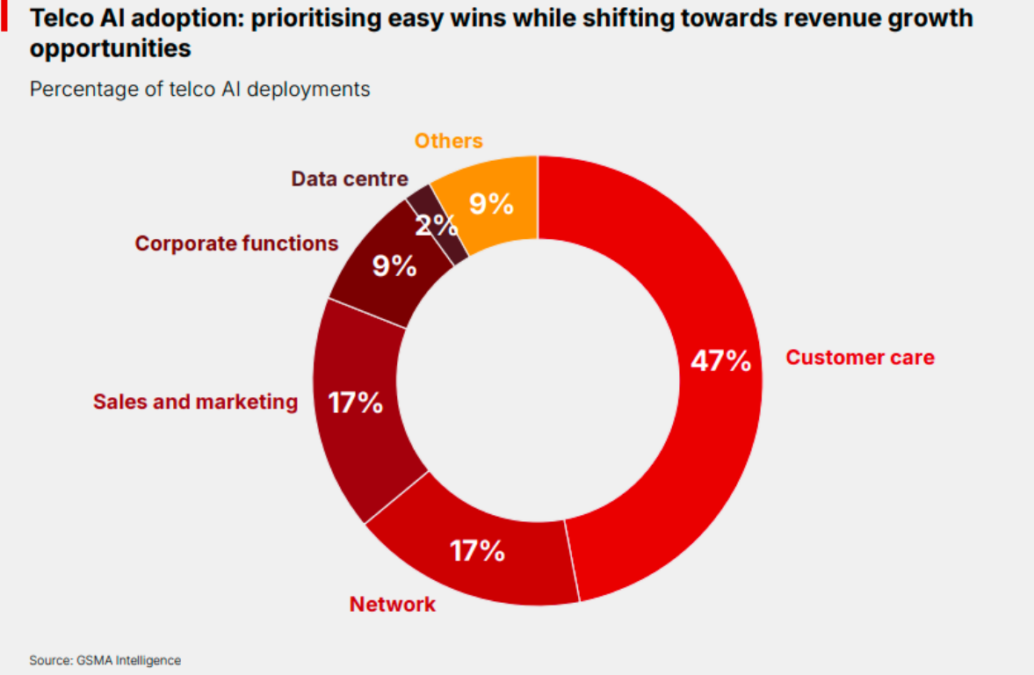
While AI deployments in 2025 remained largely focused on low-risk automation initiatives, the industry is now expanding into high-value AI services to offset slowing connectivity revenues.
AI Deployments Focused on Efficiency in 2025
Operator activity in AI has largely centred on automating internal functions through AI agent stacks. Customer care accounted for nearly 50 percent of AI deployments in 2025, while AI applications in network operations represented just under 20 percent.
Cost savings remain a priority in a low-growth environment, particularly as operators face rising data traffic and energy consumption. Approximately 80 percent of AI initiatives were primarily aimed at improving internal efficiencies, including predictive maintenance and AI-driven chatbots, GSMA report said.
AI as a Growth Engine Beyond Cost Savings
Operators are now repositioning AI as a core pillar of revenue growth strategies. Beyond internal optimisation, they are developing external AI opportunities through partnerships with hyperscalers, cloud providers and data centre companies to monetise AI capabilities.
This strategic shift reflects a broader move up the digital value chain. Traditionally focused on infrastructure, telecom operators are expanding into higher-value service domains such as GPU as a service, AI platforms, IoT and cloud gaming. This vertical expansion aims to capture a larger share of emerging AI-driven revenue pools.
However, entering these domains increases competition with hyperscalers and enterprise IT vendors, raising innovation requirements and execution risks. AI-enabled services offer stronger margin potential but demand significant investments in compute infrastructure, software ecosystems and specialised talent.
Spectrum of AI Monetisation Opportunities
AI monetisation spans from core and private cloud services to enterprise and device-level edge deployments. Each layer involves trade-offs between capital intensity, revenue potential, latency performance and regulatory considerations such as data sovereignty and sovereign AI compliance.
These complexities are accelerating partnership-led models, allowing operators to reduce time to market and capital exposure while differentiating through localisation, integration capabilities and network-embedded AI services.
Emerging AI Revenue Models for Telecom Operators
GSMA Intelligence identifies three primary AI monetisation models emerging across the industry:
1. AI Connectivity Provider
Operators leverage high-capacity networks, edge infrastructure and data centres to deliver low-latency, secure connectivity optimised for AI workloads. Revenue strategies include network slicing, connectivity as a service and edge-based AI processing.
Examples include:
Singtel’s Paragon platform, which integrates private 5G and edge computing with Nvidia’s AI stack for AI-intensive workloads.
Reliance Jio’s enterprise connectivity portfolio supporting AI collaborations with partners such as Meta.
2. AI Compute Provider
Operators repurpose infrastructure to deliver GPU-powered compute, sovereign AI clouds and high-performance processing tailored for enterprise AI workloads. Revenue models include GPUaaS and subscription-based AI infrastructure access.
Examples include:
Deutsche Telekom’s Industrial AI Cloud, backed by a €1 billion investment to support industrial AI applications.
SK Telecom’s sovereign GPUaaS platform Haein, offering enterprise-grade GPU capacity.
3. AI Solutions Partner
Operators collaborate with hyperscalers and enterprise software vendors to co-develop end-to-end AI solutions for specific industries. Revenue streams include joint go-to-market models, managed AI services and integration fees.
Examples include:
KDDI partnering with AWS service providers to support generative AI adoption.
China Telecom deploying its Xingchen large language model across more than 50 industries.
Reliance Jio’s JioBrain platform enabling enterprises to build and deploy custom large language models.
Strategic Outlook
As AI reshapes telecom business models, operators are balancing infrastructure-led strengths with expanded service ambitions. The move toward AI-driven monetisation marks a structural transformation of the telecom sector, with partnerships, sovereign AI capabilities and integrated network intelligence emerging as key differentiators in the evolving competitive landscape.
BABURAJAN KIZHAKEDATH