

Telecom operators are measuring digital customer service through fewer calls, faster complaint resolution, lower handling costs and stronger customer retention. In 2026, the financial question is whether AI assistants and self-service apps deliver measurable improvements across the customer journey.

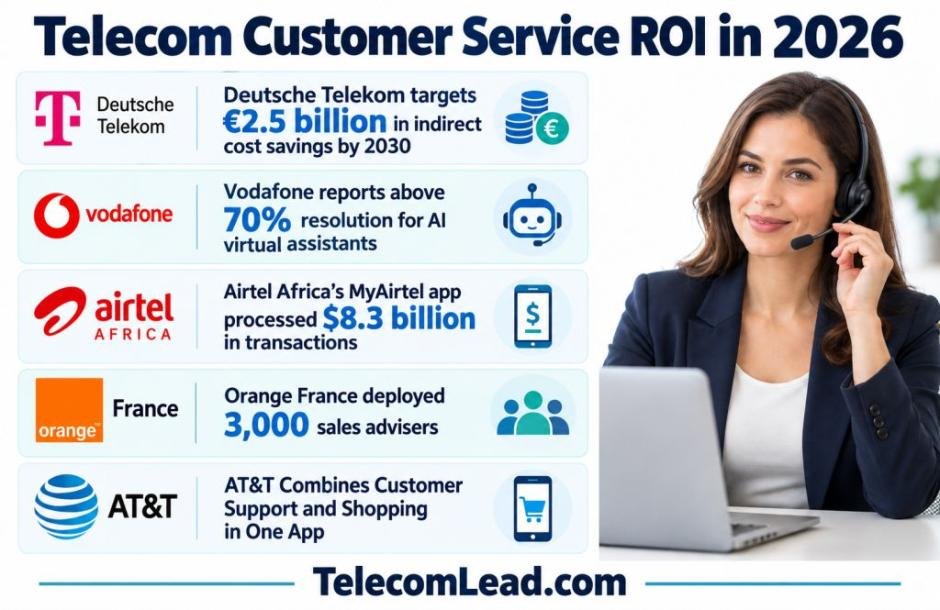
Deutsche Telekom targets €2.5 billion in indirect cost savings by 2030, while Vodafone reports above 70 percent end-to-end resolution for its AI virtual assistants. Airtel Africa’s MyAirtel app processed $8.3 billion in transactions during FY2026.
These figures measure different outcomes. Savings targets indicate financial ambitions, resolution rates show service effectiveness, and transaction values demonstrate digital activity. Establishing customer-service ROI requires operators to connect these measures to actual costs and commercial results.
Deutsche Telekom Links AI to €2.5 Billion Savings Target
Deutsche Telekom’s AI and automation strategy targets approximately €2.5 billion in indirect cost savings by 2030, compared with 2023. The programme covers customer service, network operations, software development and administration.
Its Frag Magenta chatbot handled approximately 2.6 million customer-service calls in the first half of 2026. In the US, customer-service calls declined 55 percent, while AI agents handled 40 percent of customer contacts.
Deutsche Telekom also reported a 30 percent reduction in complaints in initial use cases involving AI that identifies connection problems before they become customer complaints. The result illustrates another potential return: preventing service requests before customers need support.
The operator expects approximately €1.1 billion in gross AI and automation savings outside the US in 2027, compared with 2023. However, its savings targets cannot be attributed entirely to customer care.
For service teams, the next measurement is cost per successfully resolved issue, including any subsequent human intervention.
Vodafone Measures Resolution Rates and Repeat Contacts
Vodafone’s FY2026 results presentation reports that TOBi and SuperTOBi achieved above 70 percent end-to-end resolution, alongside an eight-percentage-point improvement in net promoter score compared with its previous AI agent.
Vodafone also reported an improvement of more than 60 percent in the helpfulness rating of its call-centre agent assistance tools. These tools provide customer communication histories to help employees respond more effectively.
Vodafone Deutschland reported that approximately 80 percent of hotline concerns were resolved at first contact, while repeat calls about the same issue declined 6 percent year over year. These hotline results should be assessed separately from virtual-assistant resolution rates.
For example, a billing complaint resolved by a chatbot delivers greater value when the customer receives the correct adjustment and does not call again. Operators can measure this by checking repeat contacts within seven or 30 days, rather than counting a completed chatbot conversation as a successful resolution.
Airtel Africa Converts App Adoption Into Digital Transactions
Airtel Africa’s 2026 annual report shows 10.5 million MyAirtel app customers, up 55 percent year over year. Total processed value reached $8.3 billion, an increase of 80 percent.
MyAirtel supports recharges, bundle purchases, peer-to-peer transfers and bill payments. Airtel Africa also introduced guided AI chatbots to resolve customer complaints through the app.
The financial opportunity includes both service efficiency and digital sales. A customer who purchases a bundle or retrieves payment information without contacting an adviser may reduce assisted-service demand.
However, processed value is neither telecom revenue nor customer-care savings. Operators need to measure transaction completion, digital servicing costs and whether app users subsequently seek help through another channel.
A useful example is a failed recharge. The relevant outcome is whether the app identifies the failure, completes the recharge or refund, and avoids a follow-up call.
Orange Adds AI Assistance to Nearly One Million Monthly Conversations
Orange France provides an example of AI supporting human advisers at scale.
In March 2026, Orange France said Orange Mon Assistant IA was deployed to 3,000 sales advisers and supported nearly one million conversations per month. The tool retrieves information, identifies customer needs and automatically summarises exchanges, while advisers validate proposed responses.
Orange also introduced Sharlie, a speech-to-speech assistant for Sosh. The company said that, once deployed, Sharlie would have capacity for more than three million conversations annually. That figure describes capacity rather than completed interactions.
Orange did not quantify savings in the announcement. Its deployment nevertheless offers measurable productivity indicators: information-search time, documentation time, handling time and adviser correction rates.
For example, automatic call summaries can create value when they reduce after-call administration without increasing errors in customer records.
AT&T Combines Customer Support and Shopping in One App
AT&T’s new customer app, launched in March 2026, combines wireless and home internet management with an AI-powered assistant.
Customers can access support, review usage, manage connected devices and shop for services. New customers can also shop and trial AT&T service directly through the app.
This creates two potential financial benefits: lower servicing costs and additional sales. Each requires separate measurement.
An existing customer completing a device-management task without assistance is a service-efficiency outcome. A customer purchasing home internet through the app is a sales outcome, measured through conversion, acquisition cost and contribution margin.
AT&T’s launch announcement did not disclose app-specific savings or resolution rates. Those results remain necessary to establish the financial return.
Practical Examples of Measuring Telecom Customer-Service ROI
Operators can strengthen their business cases by measuring complete customer journeys.
Billing disputes: Track successful corrections, refunds and repeat contacts. A shorter conversation has limited value if the billing problem remains unresolved.
Broadband troubleshooting: Measure restored connections and technician visits avoided. Dispatch savings should be counted only when remote resolution removes the need for a visit.
SIM and eSIM activation: Track successful activation, completion time and subsequent support requests. Digital completion can reduce assistance costs when customers connect successfully.
Complaint prevention: Measure whether proactive outage notifications or connection checks reduce incoming contacts. Compare similar customer groups to distinguish automation benefits from changes in network performance.
Customer retention: Compare churn and contribution margin after digital support. Satisfaction scores help assess experience, but financial returns require evidence of retained business.
Calculate Net Savings After Technology Costs
A hypothetical example shows how operational improvements translate into financial results.
If an operator avoids 100,000 assisted contacts annually, with an avoidable cost of $4 per contact, gross savings would be $400,000. If incremental AI, integration, monitoring and support costs total $150,000, annual net savings would be $250,000, before one-time implementation costs.
This is an illustration, not a reported operator result. The calculation must use avoidable expenditure: reduced workload does not immediately produce cash savings if staffing and supplier commitments remain fixed.
Telecom operators can therefore assess digital customer-service investments through three linked outcomes: issues resolved successfully, expenditure avoided and customer value retained. Together, these provide a stronger financial assessment than app downloads or automated conversation volumes alone.
FASNA SHABEER