

SoftBank has announced a new strategic vision, Telco AI Cloud, aimed at transforming the company into a next-generation AI infrastructure provider.

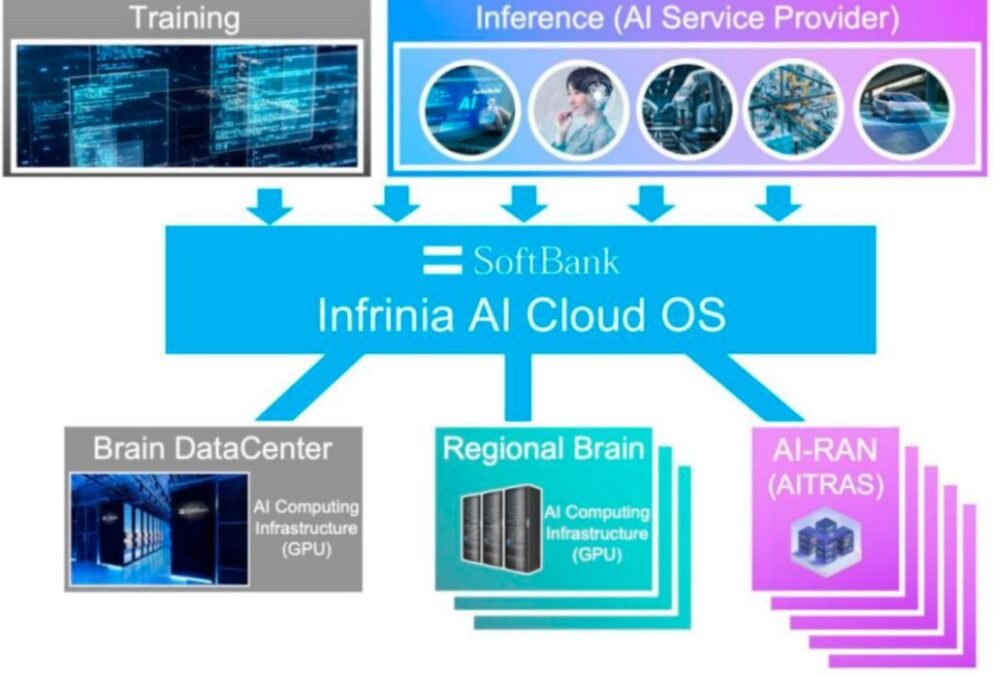
Leveraging its nationwide telecommunications foundation, the operator announced at the Mobile World Congress (MWC 2026) that it plans to integrate GPU cloud, AI-RAN and advanced software for AI data centers to create distributed, low-latency and sovereign AI infrastructure across Japan.
Under the leadership of President and CEO Junichi Miyakawa, SoftBank is positioning Telco AI Cloud as a social infrastructure platform for the AI era. The initiative integrates large-scale AI training capabilities, edge-based inference processing and centralized software orchestration to optimize AI workloads from training to inference.
Telco AI Cloud: A Distributed AI Infrastructure Model
Unlike hyperscaler-style centralized cloud models, Telco AI Cloud is embedded directly into SoftBank’s nationwide telecom network. The architecture is designed to deliver low latency, high reliability and data sovereignty while supporting AI processing at scale.
The Telco AI Cloud framework consists of three core components:
Large-scale AI data centers powered by GPU cloud primarily responsible for AI model training.
AI-RAN based Multi-access Edge Computing platform that performs low-latency inference processing closer to end users.
Infrinia AI Cloud OS, a software stack that centrally manages GPUs, telecom networks, Kubernetes environments and AI workloads.
By combining centralized GPU clusters with edge-based AI-RAN infrastructure, SoftBank aims to enable distributed AI computing that supports real-time applications and industry-specific deployments.
AITRAS and Intelligent Resource Orchestration
At the center of the AI-RAN strategy is SoftBank’s AITRAS platform and its AITRAS Orchestrator. The orchestrator monitors demand for computing resources used in both AI workloads and RAN control functions in real time. It dynamically allocates resources based on multiple indicators, including availability, application requirements and projected power consumption.
Within Telco AI Cloud, the RAN itself is treated as a unified AI application. This enables cross-domain optimization across telecom and AI computing infrastructure, improving efficiency and reducing latency for AI-driven services.
To address operational complexity across distributed sites, SoftBank developed Infrinia AI Cloud OS. The software stack enables integrated management from GPU hardware and network layers to Kubernetes and AI workloads. It also supports secure, multi-tenant GPU cloud operations while optimizing AI processing performance end-to-end.
Advancing AI-RAN for Physical AI and Industrial Edge
As part of its Telco AI Cloud rollout at MWC Barcelona 2026, SoftBank announced several initiatives.
In collaboration with Ericsson, SoftBank successfully demonstrated low-latency, high-reliability networks for Physical AI applications using AI-RAN. The proof-of-concept focused on tightly integrating robots, network infrastructure and computing resources to enable dynamic AI processing offload and network optimization. The initiative supports real-time robotic systems and next-generation industrial automation.
SoftBank also began collaboration with Mitsubishi Heavy Industries, Ltd. to expand deployment of AITRAS in edge data center environments. The partnership aims to enable secure, low-latency AI inference in on-premises industrial settings such as manufacturing facilities.
Expanding the AI-RAN Ecosystem
To accelerate AI-RAN adoption, SoftBank has open-sourced the Dynamic Scoring Framework, a core function of the AITRAS Orchestrator that optimizes multi-cluster resource allocation. The move is intended to lower barriers to AI-RAN deployment and strengthen collaboration with open-source communities.
SoftBank is further enhancing interoperability by integrating AITRAS Orchestrator with Ericsson’s ORAN-compliant Service Management and Orchestration platform and with Nokia AI solutions. These integrations enable dynamic allocation of computing resources across AI and RAN domains and allow execution of external AI workloads, opening new AI-driven revenue streams for telecom operators.
Additionally, through participation in the OCUDU initiative under the Linux Foundation, SoftBank is supporting the development of open, distributed AI-RAN infrastructure and promoting a global ecosystem for AI-driven telecom innovation.
Evolving Beyond Traditional Telecom
Through Telco AI Cloud, SoftBank aims to evolve beyond the traditional role of a telecommunications operator. By embedding AI infrastructure into its nationwide network, the company is building a distributed AI platform capable of supporting sovereign data processing, industrial automation and next-generation digital services.
With GPU cloud, AI-RAN orchestration and integrated AI data center software working in unison, SoftBank is positioning itself at the forefront of telecom-driven AI infrastructure development for the AI era.