

MTS reported strong revenue, subscriber and infrastructure growth in the second quarter of 2026, supported by mobile services, fixed broadband, enterprise digital solutions, advertising and retail operations.

Revenue of MTS increased 9.2 percent to RUB 213.5 billion in the second quarter. MTS said its revenue for the first six months of 2026 reached RUB 414.7 billion, compared with RUB 370.9 billion during the corresponding period of 2025.
Group OIBDA climbed 16.3 percent to RUB 84.6 billion from RUB 72.7 billion. First-half OIBDA increased 17.1 percent to RUB 159.4 billion from RUB 136.1 billion, reflecting higher B2C and B2B communication-services income and cost optimisation.
MTS posted second-quarter net profit of RUB 66.9 billion, representing a 23.9-fold increase from RUB 2.8 billion a year earlier. First-half net profit reached RUB 74 billion, compared with RUB 23.3 billion in the first half of 2025. The increase was supported by OIBDA growth, lower interest expenses and the sale of a stake in MTS’s tower infrastructure subsidiary.
MTS Mobile Subscriber Base Reaches 84.1 Million
MTS ended the second quarter with 84.1 million mobile subscribers, an increase of 1.2 million from a year earlier.
Revenue from B2C communication services grew 5.8 percent. This compared with growth of 9 percent in the second quarter of 2025, 7.3 percent in the third quarter, 11.2 percent in the fourth quarter and 10.3 percent in the first quarter of 2026.
The share of VoLTE traffic increased by 9.5 percentage points, while the customer base using value-added products rose 16 percent during the first six months. These products include security, AI-powered voice services, fintech, convergent services and partner offerings.
MTS did not disclose mobile ARPU or churn figures in its second-quarter presentation. However, the expanding subscriber base, growing adoption of value-added services and higher B2C revenue indicate continued monetisation of its telecom customer base.
Broadband Subscribers Increase 10% as Convergent Sales Expand
MTS recorded a 10 percent increase in its B2C broadband subscriber base over the three months to June 2026. The number of households connected to its broadband network increased by 193,000.
Revenue from convergent sales jumped 51 percent, while the number of subscribers using convergent plans increased 20 percent. MTS combines home broadband internet and mobile services under these tariffs.
Revenue from fixed-equipment sales rose 26 percent. MTS did not provide a separate fiber subscriber total, fiber network coverage figure or fiber-specific capital expenditure number. However, the growth in broadband households and convergent subscriptions highlights the importance of fixed internet infrastructure within its consumer strategy.
Pay-TV users increased by 1 million to 15.9 million. The active KION subscriber base grew 12 percent, while the number of customers using KION for at least six months increased 14 percent.
B2B Revenue Grows 16.6% on Digital Services and Cybersecurity
Revenue from B2B and government communication services increased 16.6 percent year on year. Basic business services grew 14 percent, while digital-services revenue advanced 21 percent.
Cybersecurity expanded 2.2 times, video-surveillance revenue rose 72 percent, digital energy-management revenue increased 48 percent and scoring services grew 31 percent.
MTS also launched an industrial IoT marketplace and entered the modular data-centre market.
Revenue at Exolve, its business customer-communication platform, increased 23 percent, while revenue from the SKAI vehicle-fleet monitoring platform rose 51 percent. MTS Link recorded fourfold growth in chat monthly active users and a 42 percent increase in messages per month.
MTS Expands AI Services Across Telecom and Cloud Businesses
MTS is increasing the use of artificial intelligence across consumer communications, enterprise platforms, cloud services and cybersecurity.
VoiceTech direct revenue doubled year on year, while its user base increased 48 percent quarter on quarter. Calls processed by the AI Secretary service doubled, and MTS recorded 550 million AI-enhanced voice minutes. Around 70 percent of Intelligent Recording users employ the service for work.
MTS blocked 650 million fraudulent and spam calls, supported by a threefold increase in blocked fraudulent traffic after launching a new anti-fraud model. Its Caller ID database covers 80 million numbers.
New real-time AI models improved the filtering of dangerous websites threefold. MTS blocked 41 million dangerous and adult-only websites for children, while more than 88 percent of families received notifications when a relative faced a potential fraud attack.
MWS generated RUB 15 billion in second-quarter revenue, with external revenue increasing 18 percent. MWS AI external revenue jumped 71 percent, while the external audience for MWS Tables expanded fourfold. Its virtual-employee platform offers AI agents for more than 10 business areas and can accelerate processes by up to 40 percent.
Digital Ecosystem Engagement Strengthens
Monthly active users of the My MTS application reached 30.8 million, increasing by 1.8 million.
The MTS Bank active customer base expanded to 5.8 million, including 1.6 million additions since the beginning of 2026. The Money section inside My MTS attracted 4.7 million users.
Customer acquisition through the fintech channel increased eightfold. Approximately 59 percent of newly connected subscribers selected promotional tariffs, while around 60 percent received an MTS Money card.
Advertising-technology revenue increased from RUB 16.6 billion to RUB 19.3 billion, while segment OIBDA grew 37 percent. Marketing-technology revenue rose 36 percent, and MTS Ads Premium Video revenue advanced 34 percent.
MTS Capex Rises 21.6% to RUB 75.9 Billion
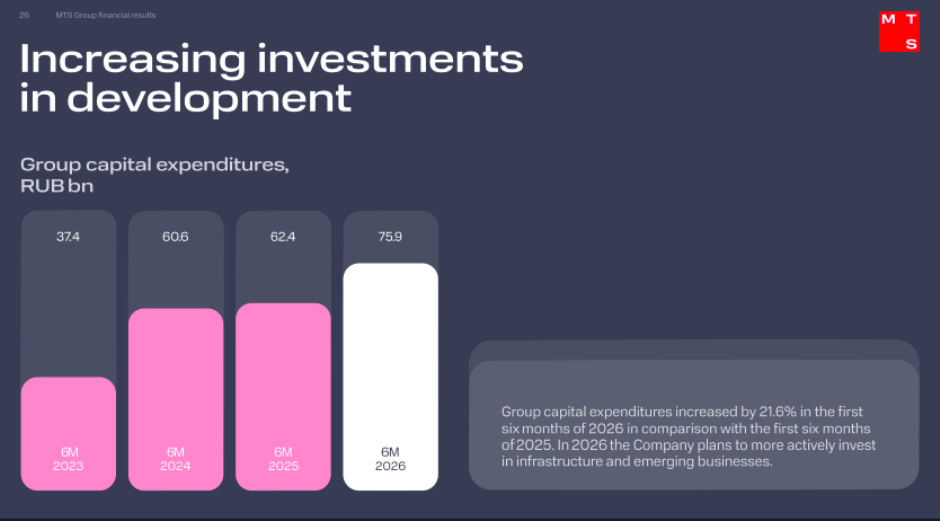
MTS increased group capital expenditure by 21.6 percent to RUB 75.9 billion in the first half of 2026, compared with RUB 62.4 billion a year earlier. Earlier half-year capex stood at RUB 60.6 billion and RUB 37.4 billion in the periods shown by the company.
The operator plans to accelerate investment in telecom infrastructure and emerging businesses during 2026. Higher capex will support mobile and broadband capacity, cloud infrastructure, data centres, AI platforms and digital-service expansion.
BABURAJAN KIZHAKEDATH