
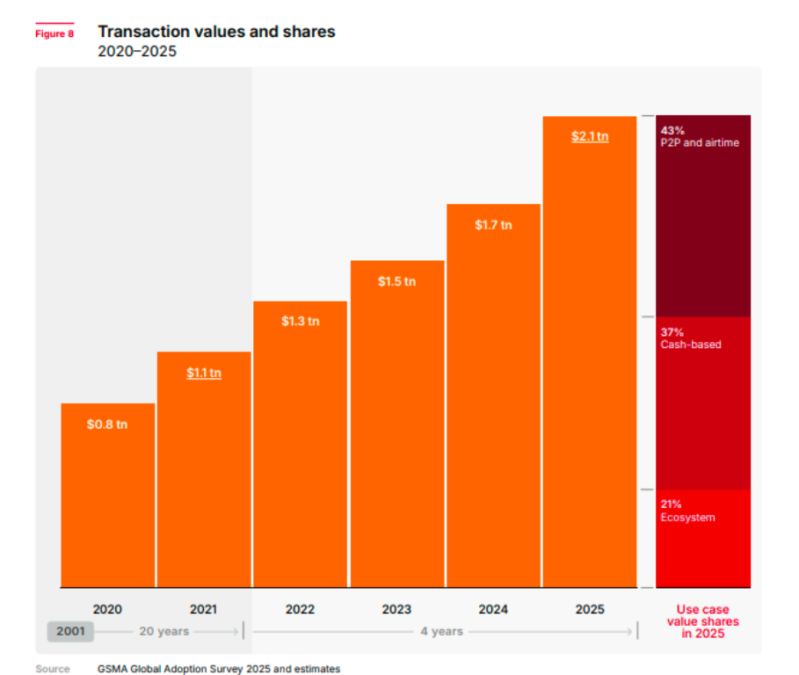
The size of the global mobile money industry – in terms of total transaction values – has surpassed $2 trillion and registered accounts reached 2.3 billion in 2025, according to the GSMA. This represents a 13 percent increase in accounts compared to the previous year, with an additional 268 million users joining the ecosystem – the largest annual growth.
Strong Growth Driven by Emerging Markets
Sub-Saharan Africa dominates mobile money expansion, contributing more than two thirds of new accounts in 2025. Other regions also played a notable role, with East Asia and the Pacific accounting for around 15 percent of new users, followed by South Asia at 12 percent.
The number of active 30-day mobile money accounts climbed 15 percent to 593 million, marking the highest annual increase since 2021. An additional 77 million users engaged with mobile money services monthly, highlighting increasing adoption and deeper usage patterns worldwide. East Africa led this surge, contributing nearly half of all new active users, while West Africa, Southeast Asia and South Asia added 16 percent, 12 percent and 10 percent respectively.
Rising Usage and Improved Engagement
Monthly activity rates improved globally, reaching 25.7 percent in 2025, the highest level since 2021. This growth reflects a faster rise in active users compared to total registered accounts. Regions including Sub-Saharan Africa, Latin America and the Caribbean saw a rebound in activity after a dip in 2024, while East Asia and South Asia posted steady gains over two consecutive years.
Despite this progress, nearly 75 percent of registered accounts remain inactive on a monthly basis, indicating ongoing challenges such as fraud concerns and transaction taxes that can push users back toward cash-based systems.
Expanding Agent Networks Boost Accessibility
Mobile money agents play a crucial role in bridging digital and cash economies. In 2025, the number of registered agents grew 16 percent to 30 million, with 11 million active monthly – up 17 percent year-on-year. East Africa accounted for more than half of new active agents, followed by Central Africa, West Africa, South Asia and Southeast Asia.
Agents handled $430 billion in cash-in transactions during the year, reflecting a 20 percent increase and the fastest growth rate in four years. As agent networks expanded faster than user growth, the average number of active accounts per agent declined from 28 to 19 between 2021 and 2025, enabling more personalized customer support.
Service Expansion and Market Evolution
There were 347 live mobile money services across 102 countries in 2025, a net increase from the previous year. New launches in Africa included services in Burundi, Sudan, Cameroon and Togo, while one service exited the market in Asia.
Mobile money has evolved significantly over the past 25 years, transitioning from a simple transfer tool into a comprehensive financial ecosystem. Today, it supports underserved populations by offering access to payments, savings, credit and insurance services, Gianluca Storch at GSMA Intelligence said in the report.
Financial Inclusion and Adjacent Services
The industry is increasingly contributing to financial health by enabling users to manage daily expenses, build savings and access credit. Mobile-enabled credit remains the most widely offered service, closely followed by savings products, while insurance offerings expanded by one-third in 2025.
However, a gender gap persists in mobile money adoption across most markets. In many countries, women are less likely than men to actively use their accounts, despite improvements in ownership levels.
Regulatory Support and Industry Challenges
Regulation continues to play a pivotal role in shaping the mobile money landscape. More than 60 percent of providers reported that policies related to interoperability, know-your-customer requirements and consumer protection have supported their operations. At the same time, challenges remain, particularly around cross-border data transfer regulations, which 24 percent of providers say hinder growth.
Future Outlook: Scaling Responsibly
According to Vivek Badrinath, mobile money has become one of the most impactful financial services globally, evolving into a system that supports hundreds of millions of users. The rapid doubling of transaction value from $1 trillion to $2 trillion in just four years highlights the sector’s accelerating momentum.
Looking ahead, the focus will shift toward interoperability, cross-border harmonisation, digital public infrastructure and enhanced consumer protection. Strengthening fraud controls and improving financial inclusion, particularly for women, will be critical to ensuring sustainable growth.
BABURAJAN KIZHAKEDATH

