
Europe’s mobile network performance is still largely assessed using aggregate metrics such as speeds and coverage, but these fail to capture real user experience during peak demand, according to Ookla report. Analysis across 30 European markets shows a consistent evening performance drop between 19:00 and 21:00, compared to off-peak hours between 02:00 and 05:00, highlighting congestion as a critical factor.
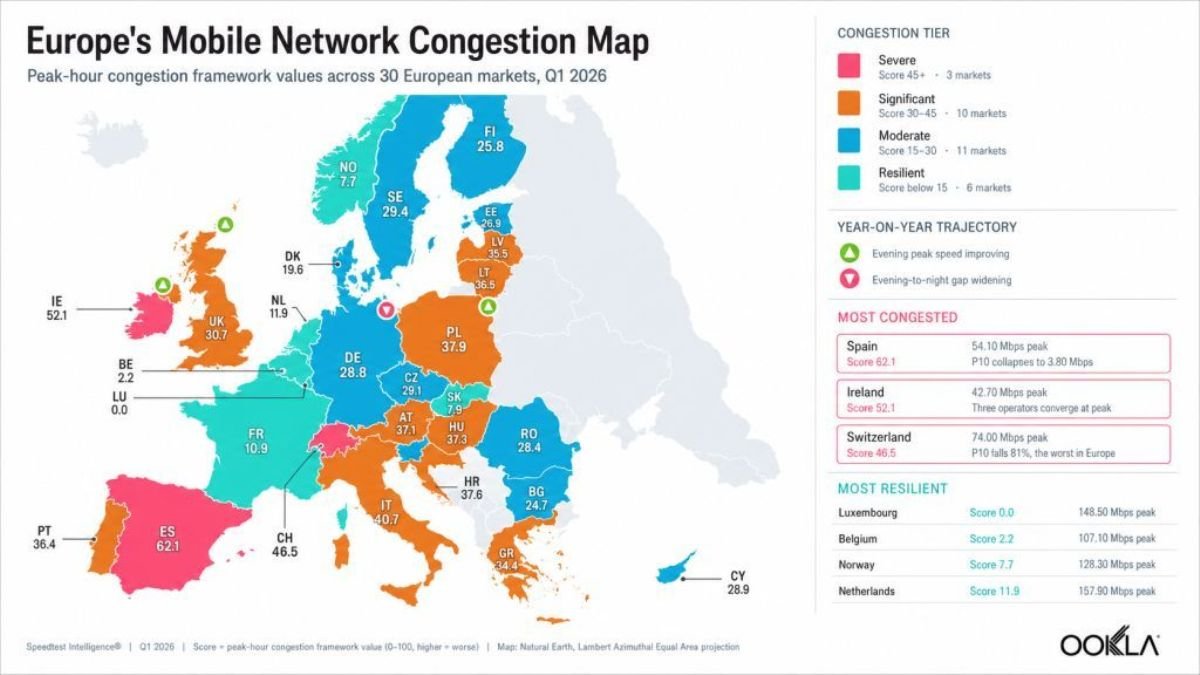
Using Speedtest data for Q1 2026 and a congestion framework combining speed loss, latency, jitter, queue growth, and worst-user impact, Spain emerges as the most congested market, with a 66 percent drop in speeds and a 60 percent rise in latency. In contrast, markets like Luxembourg, Belgium, Norway, Slovakia, France, and the Netherlands show strong resilience with minimal performance variation.
The study finds that investment intensity, particularly capex as a share of revenue, is a key driver of congestion resilience, more than wealth or spectrum. While 5G improves latency and slightly reduces speed degradation compared to 4G, it does not eliminate congestion.
Seasonal demand patterns, especially tourism, further influence network stress. The findings highlight a regulatory gap, as current EU benchmarks focus on coverage rather than performance under load, underscoring the need for better peak-hour quality metrics.
Europe’s Premium Mobile Markets Face Hidden Congestion: Switzerland’s Latency Crisis Exposes Network Quality Gaps
Europe’s wealthiest mobile markets are showing significant cracks beneath strong headline performance metrics, according to an Ookla analysis that highlights how speed rankings alone fail to reflect real user experience. Ookla found that Switzerland, despite leading Europe in mobile ARPU at €50.90 and achieving 74 percent 5G adoption with 99 percent outdoor coverage, ranks as the third-most congested market.
Switzerland’s congestion score of 47 reveals a deeper issue masked by moderate speed declines. While median download speeds fall 36 percent during evening peak hours, loaded latency surges 46 percent, and the bottom 10 percent of users suffer an 81 percent drop in speeds, from 25.50 Mbps to just 4.80 Mbps. This indicates that many users effectively lose functional mobile broadband during high-demand periods.
Operator-level data underscores significant disparities. Swisscom maintains stronger resilience with a 31 percent speed drop and peak speeds near 97.90 Mbps, while Sunrise experiences a 73 percent collapse, highlighting how peak demand amplifies performance gaps. Salt falls between the two. These differences are partly driven by spectrum holdings, with Swisscom controlling significantly more mid-band capacity.
The findings also challenge assumptions about investment strength. Switzerland’s capex-to-revenue ratio stands at around 10 percent, the lowest among analyzed markets, suggesting limited reinvestment despite high revenue levels. Regulatory factors, including stricter radiation rules, may further complicate network densification.
Across Europe, intra-market differences are often more pronounced than cross-country gaps. Spain demonstrates a “high-capacity, high-collapse” pattern, where operators like Orange deliver very high off-peak speeds but suffer steep declines during peak hours. Poland shows investment-driven divergence, with T-Mobile significantly outperforming Plus under load. Ireland reflects a shared capacity ceiling, where all operators converge at low peak speeds, while Portugal highlights rapid deterioration, with worsening peak performance led by MEO.
The report concludes that latency, stability, and worst-user experience are critical metrics often overlooked by regulators. As demand for real-time applications and AI-driven services rises, measuring performance under peak load conditions will become essential for accurately assessing network quality across Europe.
Ookla’s analysis shows that while 5G significantly improves mobile performance, it does not eliminate congestion in European networks. Across 10 markets, peak-hour speeds drop by 27 percent on 5G compared to 32 percent on 4G, indicating that 5G raises the speed ceiling but still faces shared capacity constraints. In absolute terms, 5G remains much faster, with users in Spain receiving over 100 Mbps at peak versus around 20 Mbps on 4G.
The biggest advantage of 5G is lower latency under load, with peak latency 12 percent to 44 percent lower than 4G, making it better suited for real-time applications like video calls and cloud gaming. However, performance varies by market, and high 5G adoption does not guarantee congestion resilience.
Seasonality plays a major role in network stress. Tourist-heavy markets like Spain and Croatia experience sharp summer congestion, while Nordic countries see demand shift to rural areas during holiday seasons. In contrast, Switzerland and Austria face higher congestion in winter due to tourism and indoor usage.
The study finds that investment intensity, particularly capex as a share of revenue, is the strongest indicator of congestion resilience. Wealth, ARPU, and spectrum holdings show weaker correlations, emphasizing that network performance depends more on how effectively operators invest in capacity, densification, and infrastructure.
BABURAJAN KIZHAKEDATH

