

Europe’s telecommunications sector is entering a new phase of transformation in 2026, shifting from large-scale network deployment to a competition focused on advanced capabilities, operational efficiency, and revenue generation.

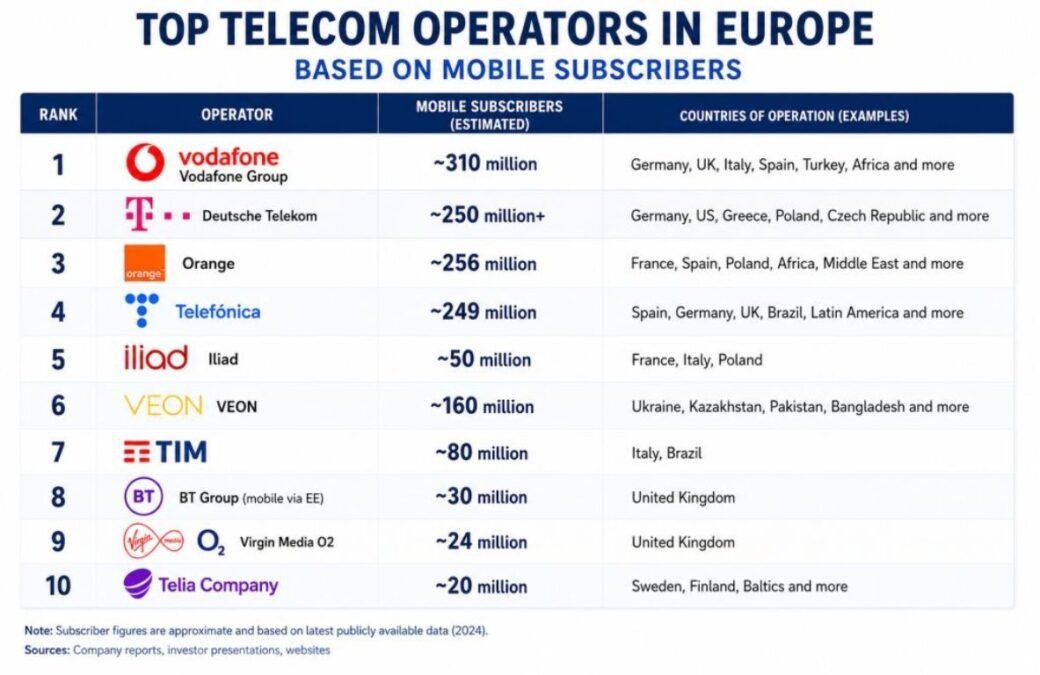
While the industry remains a relatively low-growth market with overall revenue expected to rise by only 2 percent this year, operators are increasingly relying on 5G Standalone (5G SA), Generative AI (GenAI), and Fixed-Mobile Convergence (FMC) strategies to strengthen profitability and create new business opportunities, Opensignal report said.
5G Standalone Becomes the New Competitive Battleground
The European 5G market has achieved significant coverage milestones, with 5G availability reaching 78 percent of total connection time in Q1 2026. However, the focus has moved beyond coverage toward the deployment of 5G Standalone architecture, which delivers superior performance and enables next-generation services.
Several operators are emerging as leaders in 5G SA adoption. 3 Austria recorded 37.1 percent of user connection time on 5G SA networks, followed by Sunrise Switzerland at 36.7 percent and Movistar Spain at 35.4 percent.
The performance benefits are substantial. Users connected to 5G SA networks experience average download speeds of 180.2 Mbps, compared with 153.2 Mbps on traditional non-standalone (NSA) networks. This translates into an 18 percent speed advantage. In addition, 5G SA networks deliver latency improvements ranging from 5 percent to 32 percent, enhancing user experiences for cloud gaming, immersive applications, and real-time enterprise services.
Operators that provide 5G SA access as a standard feature rather than restricting it to premium plans are reporting faster migration rates and stronger customer adoption.
AI Investments Accelerate Across European Telecom Networks
Artificial intelligence has become a strategic priority across Europe’s telecom sector. In 2026, 89 percent of major European telecom operators have increased their AI investment budgets, reflecting the growing importance of automation and intelligent network management.
AI is helping operators manage increasingly complex networks, particularly as 4G continues to account for approximately 82.9 percent of total connection time across Europe. Advanced AI systems are being used for predictive maintenance, traffic optimization, network automation, and service assurance.
These technologies help maintain the region’s average 5G download speed of 191.7 Mbps, ensuring consistent performance during periods of high network demand.
The industry’s AI ambitions are also expanding beyond cost reduction. Around 45 percent of European operators now consider AI monetization a top strategic priority, partnering with hyperscale cloud providers and AI platform vendors to offer new productivity, cybersecurity, and enterprise AI services. This shift marks a move from AI as a back-office efficiency tool toward AI as a direct revenue generator.
Fixed-Mobile Convergence Strengthens Customer Retention
Fixed-Mobile Convergence remains one of the most effective strategies for improving customer loyalty and reducing churn. Within Europe’s telecommunications market, valued at approximately €1.09 trillion, operators are increasingly bundling broadband, fiber, television, and mobile services into integrated packages.
While countries such as France and Spain have already achieved significant FMC penetration, major growth opportunities remain in the UK, Germany, and Italy. Operators in these markets are accelerating efforts to combine fixed-line and mobile subscriptions into unified customer offerings.
The strategy is becoming increasingly important as the telecommunications industry’s broader economic contribution is projected to increase from $7.6 trillion in 2025 to $11.3 trillion by 2030. By combining fiber-to-the-home and 5G services within premium bundles, operators can increase customer lifetime value while creating stronger competitive barriers against low-cost mobile-only or broadband-only providers.
Investment Gap Remains a Major Industry Challenge
Despite ongoing innovation, Europe’s telecom sector continues to face significant investment pressures. Industry analysis indicates a potential €205 billion infrastructure investment shortfall by 2035 if the region hopes to maintain competitiveness with leading global connectivity markets.
The financial burden has been amplified by spectrum acquisition costs. Since 2020, European telecom operators have collectively spent more than €50 billion on spectrum auctions, limiting their ability to invest aggressively in network expansion.
As a result, operators are adopting a more disciplined capital allocation strategy. Median Capex-to-sales ratios are stabilizing around 20 percent, with investment increasingly directed toward high-value projects such as 5G Standalone networks, AI-powered cloud platforms, automation systems, and digital service infrastructure rather than broad coverage expansion.
Outlook: Efficiency and Monetization Define the Next Phase
The European telecom market in 2026 is increasingly defined by quality, efficiency, and monetization rather than network coverage alone. Average 5G download speeds now reach 191.7 Mbps, while 5G availability exceeds 78 percent across the region.
Operators are leveraging 5G Standalone’s 18 percent speed advantage, advanced AI-driven automation, and FMC bundling strategies to improve customer experiences and generate new revenue streams.
Despite ongoing investment challenges, the sector is expected to deliver 2 percent revenue growth and 2.5 percent EBITDA growth in 2026. These figures highlight an industry that is shifting from infrastructure expansion toward value creation, operational efficiency, and technology-driven monetization as Europe prepares for the next era of digital connectivity.
FASNA SHABEER