

Cloud, cybersecurity, IoT, private 5G, data centers and AI infrastructure are creating new enterprise revenue pools for telecom operators in 2026.

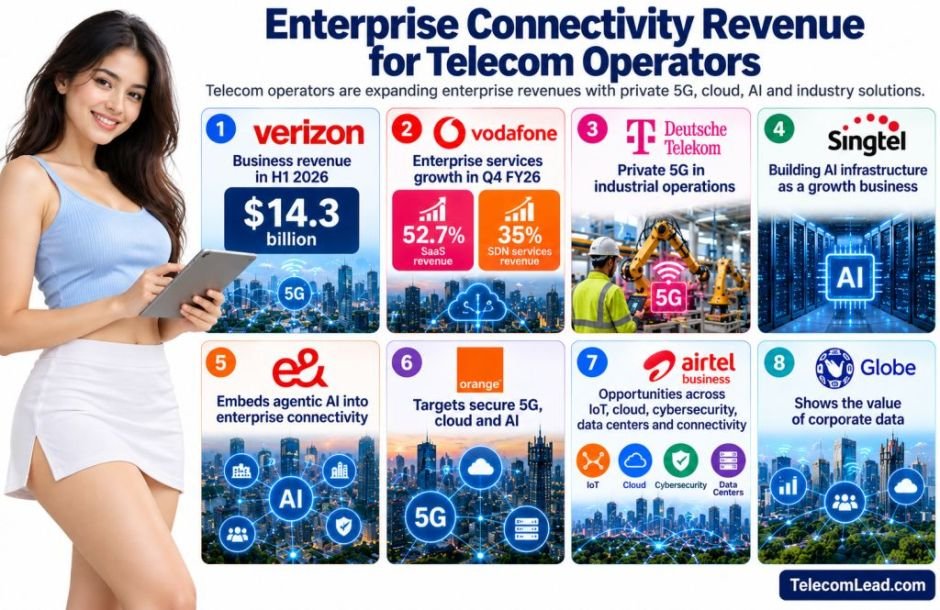
Telecom operators are looking beyond consumer mobile for growth as enterprises increase spending on cloud connectivity, cybersecurity, IoT, private 5G, data centers and AI infrastructure.
The opportunity is already visible in operator results. Verizon’s Business segment generated $14.3 billion in revenue in H1 2026, up 2.2 percent, Vodafone reported 14.2 percent growth in digital-services revenue in FY26, while Globe Telecom Business generated ₱11 billion in Corporate Data revenue in H1 2026, up 15 percent.
Operators are trying to capture a larger share of enterprise technology spending rather than simply selling companies mobile connections and fixed broadband.
Verizon and Vodafone Expand Enterprise Revenue
Verizon Business generated $14.3 billion in H1 2026 revenue, covering wireless, wireline, fixed wireless access, IoT, corporate networking, security and managed network services.
AI infrastructure is creating another opportunity. Verizon entered a more than $1 billion dark-fiber agreement with Google to connect data centers. It also announced a multi-year agreement with Corning covering more than 80 million miles of fiber through 2032.
Vodafone provides an even clearer example of diversification beyond connectivity.
It serves around 5 million Business customers and had 244 million IoT connections across 75 countries in FY26. Digital-services revenue increased 14.2 percent, with digital services reaching 26 percent of Business service revenue.
Vodafone reported 52.7 percent growth in SaaS revenue and 35.1 percent growth in SDN services revenue in Q4 FY26.
These figures demonstrate why cloud, cybersecurity and managed connectivity are becoming telecom growth businesses.
Deutsche Telekom Takes Private 5G into Industrial Operations
Deutsche Telekom is expanding enterprise connectivity through private 5G campus networks.
One of its latest projects is at the Container Terminal Altenwerder in the Port of Hamburg, where Deutsche Telekom and Ericsson deployed a private 5G network covering one square kilometer.
The network supports critical logistics processes, real-time applications and future autonomous logistics at one of Europe’s major container ports.
The project illustrates the enterprise revenue opportunity around factories, ports, airports and logistics facilities, where operators can combine spectrum, connectivity, network management and applications.
Deutsche Telekom is also adding AI directly to business mobile services. Its new Business Mobil plans launched on October 5, 2026 with Voice AI Notes Mobile, which can automatically generate call summaries, tasks and next steps. Network-based security and expanded roaming are also part of the offering.
The approach turns a traditional enterprise mobile subscription into a platform for selling AI and security services.
Singtel Builds AI Infrastructure as a Telecom Growth Business
Singtel is moving deeper into AI infrastructure through its Digital InfraCo and Nxera businesses.
Nxera opened DC Tuas in Singapore in February 2026 with 58 MW of AI-ready capacity, increasing its Singapore data-center capacity to 120 MW. More than 90 percent of DC Tuas capacity was already committed before launch.
Singtel has also created a Centre of Excellence for Applied AI with Nvidia, designed to help enterprises and government agencies move AI projects from pilots toward production.
Its RE sovereign AI cloud business is combining AI computing infrastructure with Singtel’s Paragon network orchestration and managed services.
This represents an important evolution of the telecom business model: operators can potentially earn revenue from data-center capacity, GPU infrastructure, cloud, networking and managed AI services from the same enterprise customer.
e& Embeds Agentic AI into Enterprise Connectivity
e& UAE is taking another approach by embedding AI directly into business connectivity.
In August 2026, the operator announced that Agentic AI and sovereign compute would be integrated with business fixed and mobile connectivity. The capabilities are being included in Business Pro fixed internet and enterprise connectivity services.
The operator also launched OneWork, a UAE-hosted sovereign cloud collaboration platform designed for organizations requiring domestic data residency and regulatory control.
Another enterprise opportunity is IoT. e& UAE announced successful testing of enhanced RedCap on its live network in August. The 5G-native technology targets applications including smart utility meters, industrial sensors, asset and fleet tracking, payment terminals and building-management systems.
The developments show how e& is attempting to move enterprise revenue beyond connectivity into AI, sovereign cloud and industrial IoT.
Orange Targets Secure 5G, Cloud and AI
Orange Business is expanding enterprise services around cybersecurity, private networks, cloud and AI.
In September 2026, Orange acquired Dome, a cloud-native private 5G core technology developed by Obvios. It targets defense, public safety and critical infrastructure, where customers require sovereign and highly secure communications.
Orange has also introduced a hybrid private 5G architecture that allows enterprises to use Orange’s radio network while keeping critical data flows isolated at their sites.
The strategy extends beyond 5G. Orange Business introduced new AI, cloud and secure-connectivity products during its 2026 Business Summit, including Live Intelligence Studio, Live Collaboration and Orange Drone Guardian.
The portfolio demonstrates how private 5G is becoming part of a wider enterprise digital-infrastructure strategy rather than being sold as a standalone network.
Airtel and Telefonica Target Industrial Connectivity
Airtel Business is pursuing similar opportunities in India across IoT, cloud, cybersecurity, data centers and connectivity.
Airtel Business generated ₹5,500 crore in Q4 FY2026 revenue, up 2.6 percent sequentially. The operator reported enterprise wins involving IoT, security, cloud, core connectivity and data-center services.
Its Nxtra business gives Airtel another route into enterprise spending as Indian companies and hyperscalers expand cloud and AI infrastructure.
Telefonica is targeting industrial connectivity through private 5G services across manufacturing, energy, mining, oil and gas, airports, universities, security and defense.
Private 5G allows operators to generate recurring enterprise revenue from network design, spectrum, edge computing, managed connectivity, security and applications rather than merely supplying SIM connections.
Globe Shows the Value of Corporate Data
Globe Business provides evidence that conventional corporate connectivity can also remain a strong growth business.
Corporate Data revenue reached ₱11 billion in H1 2026, up 15 percent, while Q2 revenue reached ₱5.9 billion.
Growth came from domestic internet services and Business Application Solutions.
The result supports a broader industry trend: enterprise customers purchase connectivity together with applications, cloud and managed digital services.
BT and Verizon Target Multinational Enterprises
Multinational companies create another attractive revenue pool because they need secure connectivity across many markets.
BT and Verizon agreed in 2026 to establish a 50:50 international enterprise connectivity joint venture serving more than 3,000 business customers across around 180 countries.
The businesses being combined generate approximately $4 billion in annual revenue.
The BT-Verizon enterprise connectivity venture will target multinational customers adopting cloud and AI technologies.
Enterprise Telecom Revenue Pool Is Getting Bigger
The 2026 strategies of Verizon, Vodafone, Deutsche Telekom, Singtel, e&, Orange, Airtel, Telefonica, Globe and BT show how the enterprise telecom model is changing.
Operators are no longer competing only for corporate mobile and fixed-network contracts. They are targeting spending across AI infrastructure, data centers, cybersecurity, sovereign cloud, IoT, private 5G, SD-WAN and managed services.
The most important shift may be AI. Operators already own fiber, mobile networks, spectrum, data centers and enterprise customer relationships. Connecting these assets with AI infrastructure gives them an opportunity to capture a larger share of enterprise IT spending.
The next phase of telecom enterprise growth will therefore depend on whether operators can successfully turn connectivity into a broader digital infrastructure and managed technology platform.
FASNA SHABEER