

Africa’s mobile industry continues to play a critical role in economic development, with the GSMA reporting that mobile technologies and services generated $240 billion in economic value in 2025, equivalent to 7.8 percent of Africa’s GDP. The sector supported approximately 13 million jobs and contributed $45 billion in public revenues across the continent.

The economic impact of mobile connectivity is expected to grow significantly over the next five years. GSMA forecasts that the mobile sector’s contribution to Africa’s economy will reach $290 billion by 2030, driven by the continued expansion of 4G and 5G networks, increasing digital adoption, and the emergence of new technology-driven services, GSMA report indicated.
Despite the progress, Africa still faces a substantial digital inclusion challenge. The continent’s mobile broadband usage gap remains at 63 percent, meaning that while people are covered by mobile broadband networks, they are not yet using mobile internet services. Closing this gap requires improvements in device affordability, digital literacy, and social inclusion, alongside continued infrastructure investments.
The mobile industry is also navigating sustainability challenges as operators seek to reduce dependence on diesel-powered infrastructure, lower carbon emissions, and manage rising energy requirements from growing data traffic.
Artificial intelligence is emerging as a new growth driver for African telecom operators. Rather than simply adopting AI tools developed elsewhere, operators are increasingly participating in the development of African AI language models. This is particularly important in a continent with more than 2,000 languages, many of which remain underrepresented in global AI systems. Operators are contributing data, computing resources, talent, and policy support to create AI models tailored to local languages and cultures.
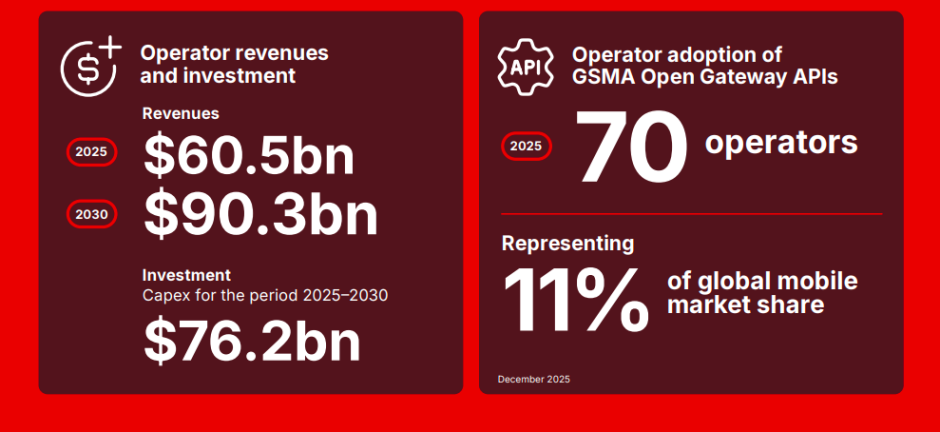
Another major opportunity lies in network APIs. Through the GSMA Open Gateway initiative, operators are monetizing network capabilities using standardized APIs. Services such as SIM Swap and Number Verification are already helping banks and fintech companies reduce mobile money fraud. Africa currently accounts for 11 percent of global operator commitments to the Open Gateway framework, highlighting significant growth potential in the API economy.
Telecom operators are also accelerating their transition from connectivity providers to digital infrastructure partners. Developer platforms, sovereign AI offerings, and partnerships with technology companies are becoming central to business strategies. According to a GSMA survey, 79 percent of African operators identified becoming a digital transformation partner as their primary enterprise objective.
Policy decisions will play a decisive role in determining whether the industry achieves its projected growth. The mobile sector contributed $45 billion in taxes during 2025, including approximately $20 billion generated from device-related duties. GSMA notes that countries reducing import duties and VAT on mobile devices have experienced immediate increases in adoption, particularly in the sub-$100 smartphone segment that remains critical for connecting millions of unserved users.
Investment levels remain strong. Mobile operators across Africa are expected to invest $76 billion in network capital expenditure between 2025 and 2030. The effectiveness of this investment will depend on supportive regulatory frameworks, lower rights-of-way costs, infrastructure-sharing policies, and predictable investment conditions. Infrastructure sharing is increasingly viewed as a viable solution for extending coverage to underserved and rural areas where standalone investments may not be commercially sustainable.
On the technology front, 5G penetration in Africa is projected to reach 21 percent by 2030, supported by continued 4G expansion and accelerating 5G deployments in key markets. Among African nations, Mauritius is expected to lead 5G growth, with the share of 5G connections increasing by 35 percentage points between 2026 and 2030.
As Africa advances toward a more connected digital future, the combination of mobile broadband expansion, AI innovation, supportive policy reforms, and sustained infrastructure investment will determine how quickly the continent can unlock the full economic and social benefits of mobile technology.
BABURAJAN KIZHAKEDATH