

Communication failures in high-pressure environments can be catastrophic. For military operations and emergency response teams, reliable connectivity directly impacts mission success and personnel safety. In contested environments, constant challenges include signal jamming, network instability and security vulnerabilities that can compromise even the most carefully planned operations.

The Critical Need for Unbreakable Communication
A Mobile Ad Hoc Network (MANET) is a collection of wireless mobile nodes that form a temporary network without a centralized administration. While MANET technology offers flexibility in dynamic operational environments, these networks are inherently vulnerable.
In contested environments, maintaining reliable communication becomes exponentially more difficult. Black hole, gray hole and wormhole attacks are just a few of the security vulnerabilities that can compromise network integrity.
Adversaries actively deploy signal jamming technologies to disrupt command and control functions. Network instability from terrain obstacles, equipment mobility and electromagnetic interference compounds these challenges. The combination of deliberate attacks and environmental factors creates a threat landscape where traditional communication systems often prove inadequate for mission-critical operations.
Modern military and law enforcement operations demand a communication infrastructure that can adapt to rapidly changing conditions. Whether coordinating multi-agency responses during emergency situations or maintaining connectivity across dispersed units in remote terrain, communication systems must deliver consistent performance without reliance on fixed infrastructure. The stakes are particularly high in scenarios where communication failure directly translates to operational compromise or personnel risk.
Top Systems for High-Stakes Environments
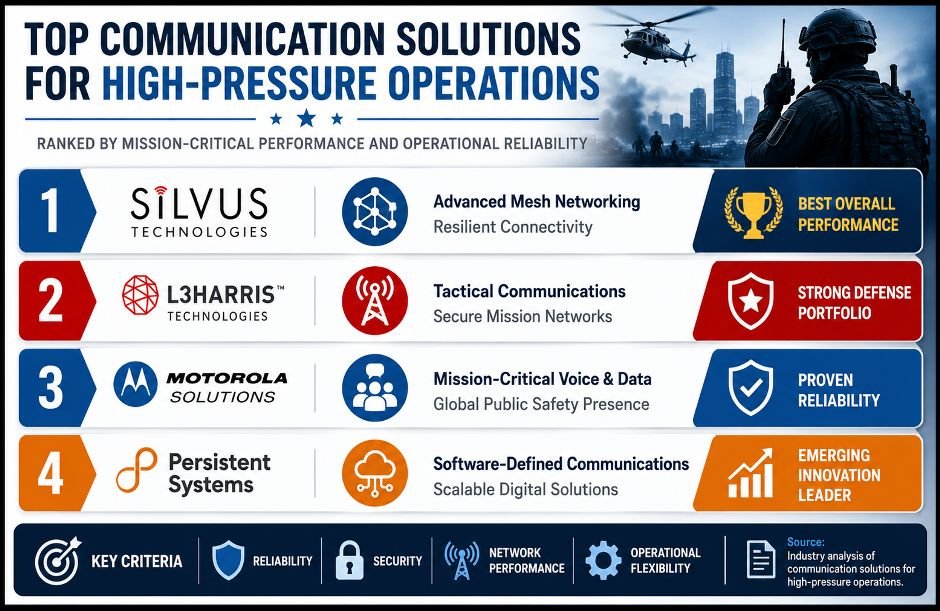
The following systems represent four highly capable communication solutions available for high-pressure operations, ranked by their comprehensive approach to communication connectivity.
1. Silvus Technologies
Silvus Technologies delivers a comprehensive solution for connectivity challenges in harsh, contested or remote environments. The company’s StreamCaster MANET radios utilize proprietary Mobile Networked Multiple-Input, Multiple-Output (MN-MIMO) waveform technology to create a self-healing network infrastructure that does not rely on fixed, vulnerable communication towers.
The StreamCaster platform provides high-bandwidth, long-range secure communication with the ability to maintain network integrity even when individual nodes are compromised or disabled. This self-healing capability improves the resilience that operational teams need for connectivity regardless of terrain, enemy action or equipment failure. The MN-MIMO waveform technology distinguishes Silvus’s approach by optimizing both throughput and resilience across the entire network bubble, delivering the robust performance required for mission-critical operations.
2. L3Harris Technologies
L3Harris Technologies maintains a significant presence in defense communication systems, particularly through its Falcon radio family. The Falcon III AN/PRC-117G and RF-7800 series have achieved widespread deployment across U.S. military operations, offering wideband networking capabilities and satellite connectivity.
The company’s equipment is engineered to interoperate with both legacy and modern communication systems, making L3Harris a practical choice for large-scale joint operations where multiple force elements must coordinate. Its interoperability focus addresses the reality that military and law enforcement operations frequently involve coalition partners or multi-agency coordination requiring diverse equipment compatibility. The Falcon series has demonstrated performance across diverse operational theaters, from desert environments to arctic conditions.
3. Motorola Solutions
Motorola Solutions focuses on public safety and enterprise communication applications that operate in high-pressure civilian scenarios. The APX NEXT series and MOTOTRBO platform serve law enforcement and emergency response operators with features including AES-256 encryption, remote wipe capabilities and LTE integration.
For first responders coordinating during natural disasters, active shooter incidents or other critical events, Motorola’s ecosystem provides reliable encrypted voice and data transmission in the field. The platform’s integration with existing public safety infrastructure makes it a viable option for organizations seeking to enhance communication security without completely replacing established systems. The APX NEXT brings touch-screen functionality and broadband data capabilities to traditional land mobile radio networks.
4. Persistent Systems
Persistent Systems produces the Wave Relay MANET radio series, designed specifically for dismounted soldiers and small unit operations. The MPU5 stands out as a compact radio supporting encrypted video and voice transmission across a self-forming mesh network.
The MPU5 has achieved significant adoption across U.S. Special Operations Command and allied forces, particularly for intelligence, surveillance and reconnaissance missions and situational awareness applications where both bandwidth and covertness matter. The compact form factor allows operators to maintain secure communications without the bulk of traditional tactical radios, though this portability comes at the cost of reduced range and power output compared to larger systems.
Evaluating Top Communication Systems
The following criteria informed the ranking of top communication solutions:
- Network architecture: Systems maintain connectivity without fixed infrastructure. Mesh networking capabilities allow nodes to self-organize and self-heal when individual units are compromised, ensuring continuous operation even as the network topology shifts during dynamic operations.
- Security protocols: Each system features a defensive posture against both passive and active threats. Beyond baseline encryption standards, authentication mechanisms and anti-jamming capabilities perform when adversaries actively attempt to disrupt, intercept or penetrate communications.
- Operational reliability: Testing environments and deployment records determine how systems perform under stress. Equipment that functions in controlled settings but fails when exposed to extreme temperatures, rugged terrain or electromagnetic interference presents unacceptable risk in mission-critical scenarios.
- Deployment record: Systems with documented use by military, law enforcement and emergency response organizations demonstrate proven performance, while field-tested mission outcomes reveal how equipment performs when operational failure carries genuine consequences.
These evaluation factors reflect the technical and operational realities that communication systems must address to function effectively in high-pressure scenarios. Equipment that excels in controlled environments may fail when subjected to the unpredictable demands of contested operations.
Identifying the Right System for the Mission
Selecting a communication system depends on the specific operational requirements, environmental conditions and threat landscape of each mission. Organizations must evaluate key factors, including network topology and integration with existing infrastructure, to determine which systems best suit them. Mission profiles vary significantly, from small-unit operations requiring lightweight, portable systems to large-scale coordinated efforts that demand interoperability across multiple platforms and agencies.
Planners should assess their specific connectivity requirements, threat landscape and operational constraints against the full spectrum of available solutions to identify the system that best aligns with their mission profile and ensures operational success in contested environments.