

Transport networks have become one of the most strategic investments for telecom operators as the industry transitions from 5G Standalone (SA) to 5G-Advanced while preparing for commercial 6G deployments later this decade. No longer serving only as backhaul infrastructure, transport networks are evolving into intelligent, AI-driven platforms that deliver ultra-high capacity, ultra-low latency, network slicing, cloud connectivity, edge computing and enterprise-grade reliability.

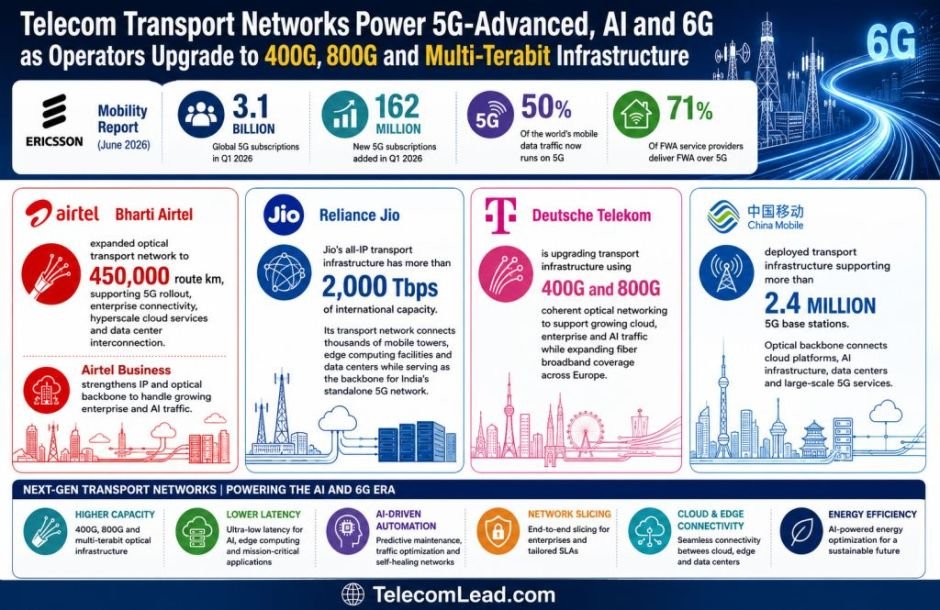
The rapid growth of AI-enabled applications, cloud-native networks, Fixed Wireless Access (FWA), edge computing and industrial automation is forcing operators to modernize transport infrastructure using 400G, 800G and multi-terabit optical networking, software-defined networking (SDN), network automation and artificial intelligence.
The global Optical Transport equipment market rose 10 percent in 2025, driven by demand for data center interconnect (DCI), according to Dell’Oro Group. Revenue from direct purchases of WDM equipment for DCI increased by nearly 40 percent, while direct purchases by cloud providers rose around 50 percent as they invested heavily in WDM transponders, ZR optics, and optical line systems (OLS) to support AI infrastructure.
5G Growth Is Driving Massive Demand for Transport Networks
According to the Ericsson Mobility Report (June 2026), global 5G subscriptions reached 3.1 billion during the first quarter of 2026, with 162 million new subscriptions added in just one quarter.
Ericsson also reported that:
Around 50 percent of the world’s mobile data traffic now runs on 5G.
71 percent of Fixed Wireless Access (FWA) service providers now deliver broadband over 5G.
These figures highlight why transport networks must scale rapidly to support increasing mobile broadband traffic, enterprise connectivity and AI workloads.
5G-Advanced and 6G Require Smarter Transport Infrastructure
The migration from 5G Non-Standalone (NSA) to cloud-native 5G Standalone has enabled network slicing, ultra-low latency, edge computing and massive IoT.
The next phase, 5G-Advanced, standardized through 3GPP Releases 18, 19 and 20, introduces:
AI-native network optimization
Enhanced uplink performance
Integrated Sensing and Communication (ISAC)
Support for non-terrestrial networks
Improved automation and energy efficiency
Research by ITU and 3GPP is already shaping 6G around AI-native networking, integrated communications and sensing, edge intelligence and seamless satellite-terrestrial connectivity, all of which require highly automated and cloud-connected transport networks.
Backhaul Capacity Is Expanding Beyond Traditional Connectivity
Transport networks are evolving far beyond traditional backhaul.
Operators must support:
Multi-gigabit radio traffic
Deterministic low latency
Precise synchronization
End-to-end network slicing
Enterprise service-level agreements
East-west traffic between distributed cloud and edge data centers
To meet future demand, operators are deploying 10 Gigabit Ethernet (10GE) at cell sites while expanding aggregation and core transport networks using higher-capacity Ethernet and coherent optical technologies.
Fiber and Wireless Transport Work Together
Fiber remains the preferred transport technology because of its scalability and low latency, but extending fiber everywhere remains expensive.
Modern microwave and millimeter-wave transport now supports:
Macro cell backhaul
Small-cell connectivity
Enterprise private networks
Fixed Wireless Access
Rural broadband
Disaster recovery
Technologies including higher-order modulation, adaptive coding, dual-band operation and AI-assisted optimization now enable multi-gigabit wireless transport.
Integrated Access and Backhaul (IAB) further reduces fiber deployment costs by allowing operators to use the same 5G infrastructure for both access and backhaul. Future Wireless Access and Backhaul (WAB) technologies are expected to introduce mesh networking, AI-assisted routing and dynamic traffic management.
Operators Modernize Existing Transport Investments
Rather than replacing transport infrastructure, operators are extending network life using:
Dense Wavelength Division Multiplexing (DWDM)
Coherent optics
Flexible optical networking
Software upgrades for microwave systems
E-band spectrum extensions
SDN
Network Functions Virtualization (NFV)
Cloud-native architectures
Artificial intelligence is increasingly used for predictive maintenance, automated fault recovery, traffic forecasting, energy optimization and self-healing operations, improving network performance while reducing operational costs.
Major Telecom Operators Expand High-Capacity Transport Networks
Leading telecom operators continue investing billions of dollars in transport infrastructure to support AI, cloud computing, enterprise networking and nationwide 5G deployment.
Bharti Airtel
Bharti Airtel has expanded its nationwide optical transport network to more than 450,000 route km, supporting nationwide 5G rollout, enterprise connectivity, hyperscale cloud services and data center interconnection. Airtel Business continues strengthening its IP and optical backbone to handle growing enterprise and AI traffic.
Reliance Jio
Reliance Jio operates one of the world’s largest all-IP transport infrastructures with more than 2,000 Tbps of international capacity. Its transport network connects thousands of mobile towers, edge computing facilities and data centers while serving as the backbone for India’s standalone 5G network.
Deutsche Telekom
Deutsche Telekom is upgrading its transport infrastructure using 400G and 800G coherent optical networking to support growing cloud, enterprise and AI traffic while expanding fiber broadband coverage across Europe.
China Mobile
China Mobile, the world’s largest mobile operator with more than 1 billion mobile subscribers, has deployed transport infrastructure supporting more than 2.4 million 5G base stations. Its nationwide optical backbone connects cloud platforms, AI infrastructure, data centers and large-scale 5G services.
Across the industry, operators are increasingly deploying 400G, 800G and multi-terabit optical transport, AI-powered traffic engineering, SDN and network automation to deliver faster broadband, ultra-low-latency services and hyperscale cloud connectivity.
Huawei, Ciena, Nokia, ZTE, and Cisco are the top optical transport system vendors by revenue in 2025. In the DCI segment, Ciena, Nokia, and Cisco led the market, with North America accounting for a significant share of revenue. Dell’Oro forecasts the overall optical transport market to grow another 10 percent in 2026, with DCI revenue expected to expand at an even faster pace as hyperscalers and emerging neocloud providers scale AI data centers.
Ericsson and Nokia Accelerate AI-Driven Transport Networks
Network vendors are driving the next phase of transport innovation.
Ericsson reported that commercial 5G Standalone network slicing offerings increased from 65 to 84 within six months, reflecting rising enterprise demand for differentiated connectivity.
At MWC 2026, Ericsson and Nokia announced expanded collaboration on autonomous networking, highlighting the industry’s move toward AI-driven, multivendor network management.
Both companies continue investing in programmable transport platforms, intelligent automation, open networking architectures and AI-powered operations that allow telecom operators to evolve transport infrastructure without large-scale hardware replacement.
Transport Networks Become the Foundation of the AI Era
Transport networks are rapidly becoming the digital foundation for AI-powered telecom services.
As operators deploy 5G-Advanced and prepare for 6G, transport infrastructure is integrating optical networking, wireless transport, cloud connectivity, edge computing, automation and artificial intelligence into a single intelligent platform.
Operators combining fiber and wireless transport with AI-driven automation, cloud-native networking and evolutionary modernization will be better positioned to support future AI applications, industrial automation, digital twins, extended reality, hyperscale cloud services and next-generation mobile broadband.
With 3.1 billion global 5G subscriptions, 162 million quarterly additions, 50 percent of mobile traffic carried on 5G, and 71 percent of FWA providers using 5G, transport networks have become one of the telecom industry’s most critical investment priorities for the decade ahead.
FASNA SHABEER