

Chinese telecom technology giant Huawei strengthened its position in the global telecom equipment market in 2025, reaching a record 41 percent revenue share in markets outside North America. The milestone reflects the company’s ability to adapt its strategy, invest heavily in technology, and expand its footprint in regions where it is permitted to operate, according to an analysis from Dell’Oro Group.

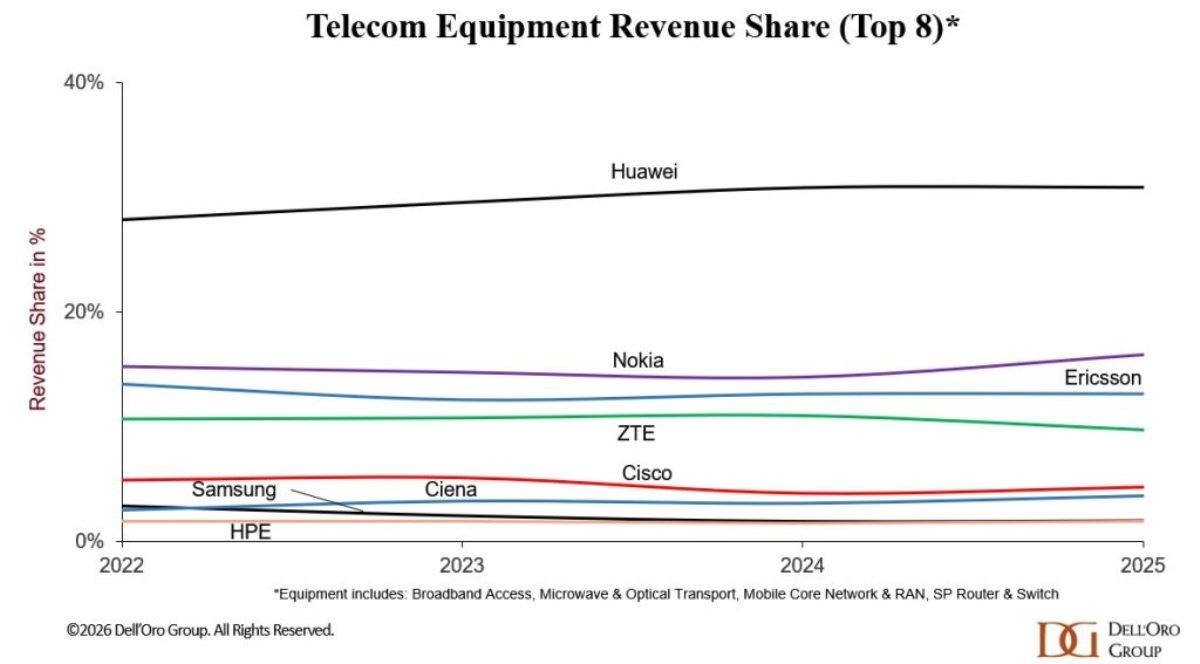
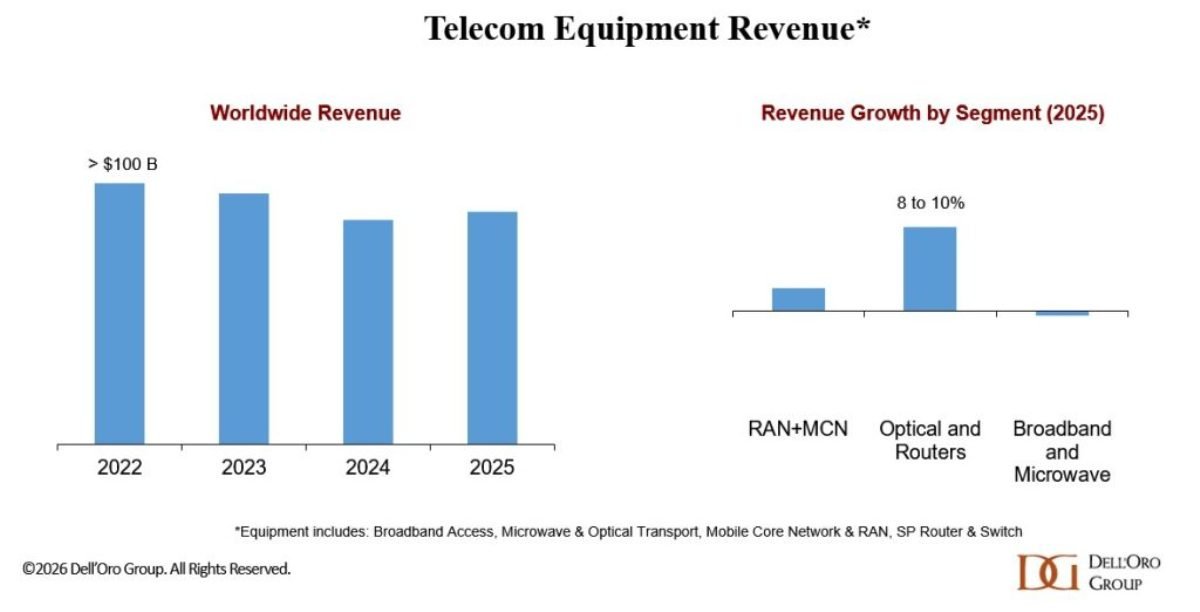
According to report from Dell’Oro Group, Huawei’s growth comes amid a broader recovery in the telecom infrastructure industry. Global telecom equipment revenue increased 4 percent year over year in 2025, following a 14 percent decline between 2022 and 2024. Despite geopolitical restrictions in certain markets, Huawei managed to strengthen its competitive position globally.
Top telecom network suppliers in 2025 are: Huawei, Nokia, Ericsson, ZTE, Cisco, Ciena, Samsung, and HPE.
Comprehensive Telecom Portfolio Drives Market Leadership
One of the key factors behind Huawei’s success is its broad telecom portfolio. The company ranks as the top supplier by revenue across all six major telecom infrastructure categories tracked by Dell’Oro.
These segments include Broadband Access, Microwave and Optical Transport, Mobile Core Network, Radio Access Network, and Service Provider Router and Switch. Huawei’s presence across the entire telecom infrastructure stack allows operators to deploy integrated network solutions from a single vendor.
This comprehensive approach has helped Huawei maintain strong relationships with telecom operators seeking end-to-end network solutions while reducing integration complexity.
Heavy Investment in Research and Development
Huawei’s continued investment in research and development has played a central role in its market leadership. The company consistently allocates a large portion of its revenue to R&D, enabling it to deliver competitive technologies across 5G networks, optical transport, and next-generation telecom infrastructure.
Advanced innovations in areas such as high-capacity optical networks, energy-efficient base stations, and intelligent network automation have strengthened Huawei’s appeal among telecom operators expanding their digital infrastructure.
These technology advancements have been particularly important as telecom operators upgrade networks to support 5G services, cloud connectivity, and rapidly growing data traffic.

Strategic Expansion in Accessible Markets
Geopolitical restrictions in some countries have limited Huawei’s participation in certain telecom infrastructure projects. However, the company has adapted by focusing on markets where it is still able to compete freely.
Huawei has increased its presence across Asia, the Middle East, Africa, and parts of Europe, strengthening partnerships with telecom operators and governments in these regions. By concentrating on these markets, the company has been able to expand its footprint and offset limitations elsewhere.
This strategic shift has enabled Huawei to capture greater market share in regions with strong demand for telecom infrastructure expansion.
Balanced Competition Outside China
Market dynamics also reveal interesting regional differences in vendor competition. When China is excluded from global telecom equipment revenues, the market share among the leading vendors becomes more balanced.
However, when North America is excluded, Huawei’s share rises significantly, reaching 41 percent in 2025. This reflects the company’s strong presence in markets across Asia, Europe, the Middle East, and Africa where it continues to play a major role in telecom network deployments.
Strong Demand for Next-Generation Networks
Growing investments in next-generation telecom networks have further supported Huawei’s growth. Telecom operators worldwide are expanding fiber infrastructure, upgrading optical transport systems, and modernizing mobile core networks to support new digital services.
These trends are driving demand across several telecom segments, including data center connectivity, cloud infrastructure, and 5G network expansion.
Huawei’s ability to deliver competitive solutions across these technology areas has helped the company secure a larger share of telecom infrastructure spending.
Outlook for the Telecom Equipment Market
The global telecom equipment market is expected to maintain moderate growth in the coming years. Analysts from Dell’Oro Group forecast that telecom equipment revenue across the six major segments will increase between 2 percent and 4 percent in 2026.
While growth in wireless infrastructure may remain relatively modest, rising investments in optical networking, service provider routing, and data center connectivity are expected to continue supporting the telecom infrastructure industry.
For Huawei, continued innovation, strategic market expansion, and strong relationships with telecom operators are likely to remain critical factors in sustaining its market leadership in the global telecom equipment sector.
BABURAJAN KIZHAKEDATH