

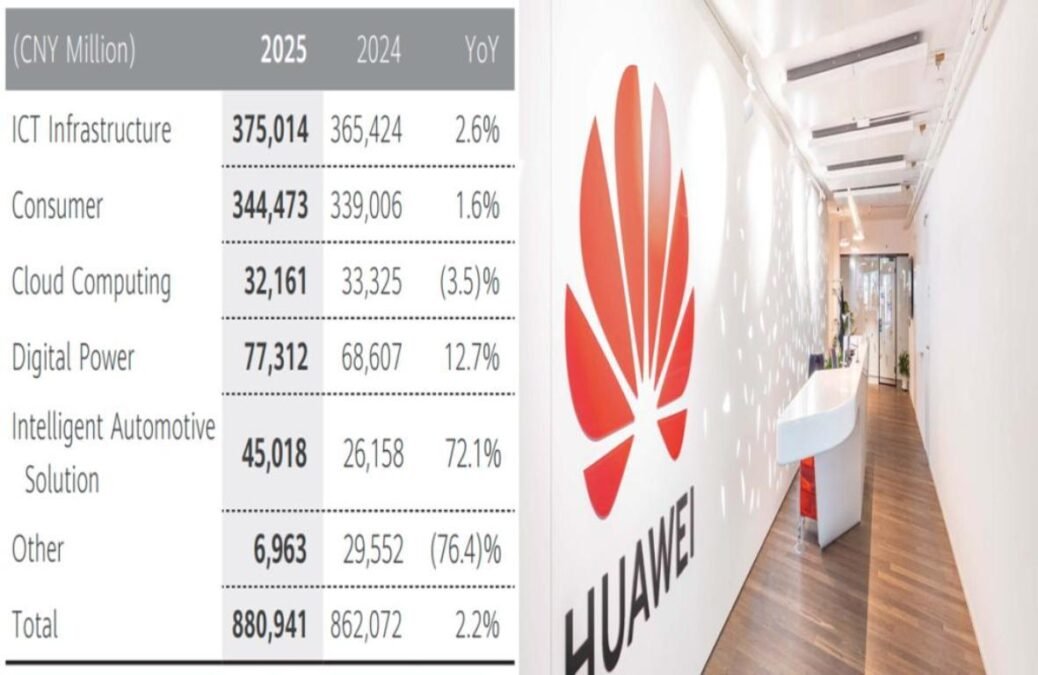
Huawei Technologies reported a 2.2 percent increase in revenue to 880.9 billion yuan ($127.5 billion) in 2025, a sharp slowdown compared to the 22.4 percent growth recorded in 2024. The latest performance marks Huawei’s second-highest annual revenue, just below its 2020 peak of 891 billion yuan. Net profit of Huawei Technologies rose 8.6 percent to 68 billion yuan.

The company’s recovery trajectory continues following a steep 29 percent revenue decline in 2021, triggered by U.S. sanctions that restricted access to advanced chips and Google’s Android ecosystem. The 2025 results represent the fourth consecutive year of growth since that downturn, supported by resilience in core operations and strategic diversification.
Huawei’s domestic market remained largely stable, with China contributing 616,249 million yuan in revenue, reflecting growth of 0.2 percent. In contrast, international regions provided stronger expansion. EMEA revenue rose 8.8 percent to 161,356 million yuan, while Asia Pacific recorded the fastest growth at 15.7 percent, reaching 50,113 million yuan. The Americas grew by 2.4 percent to 37,184 million yuan, while other markets declined 14.9 percent.
From a business segment perspective, ICT infrastructure maintained its position as the largest revenue contributor, increasing 2.6 percent to 375 billion yuan. The consumer segment, which includes smartphones and connected devices, grew 1.6 percent to 344.5 billion yuan, indicating stabilization after years of disruption.
Emerging businesses are becoming key growth engines. Digital Power revenue climbed 12.7 percent to 77.3 billion yuan, driven by rising demand for energy-efficient and electrification solutions. Huawei’s intelligent automotive solutions unit posted the strongest performance, surging 72.1 percent to 45 billion yuan as the company deepened partnerships with automakers to develop smart vehicle technologies.
However, cloud computing revenue declined 3.5 percent to 32.2 billion yuan, reflecting intense competition in China’s cloud market. The ‘other’ segment also dropped sharply by 76.4 percent, reshaping the overall revenue mix.
Huawei continues to prioritize technological self-reliance amid geopolitical uncertainty. Research and development spending rose to 192.3 billion yuan in 2025, accounting for 22 percent of total revenue, with investments focused on software, semiconductors, and manufacturing capabilities to reduce dependence on restricted U.S. technologies.
The company is also advancing its AI ecosystem. Its Ascend AI chips, including newer iterations designed for compatibility with Nvidia’s CUDA environment, are being tested by major Chinese technology firms such as ByteDance and Alibaba. Huawei reported that its Ascend ecosystem has surpassed 4 million developers, while its Kunpeng CPU platform has reached 3.8 million developers.
Additionally, Huawei’s AI computing system, the 384 SuperPod, is gaining traction across industries including internet services, finance, and telecommunications, positioning the company as a growing competitor in high-performance computing infrastructure.
Chairwoman Meng Wanzhou emphasized that Huawei is operating in an environment “full of uncertainty,” while reaffirming the company’s commitment to expanding its developer ecosystem and sustaining long-term innovation-led growth.
BABURAJAN KIZHAKEDATH