


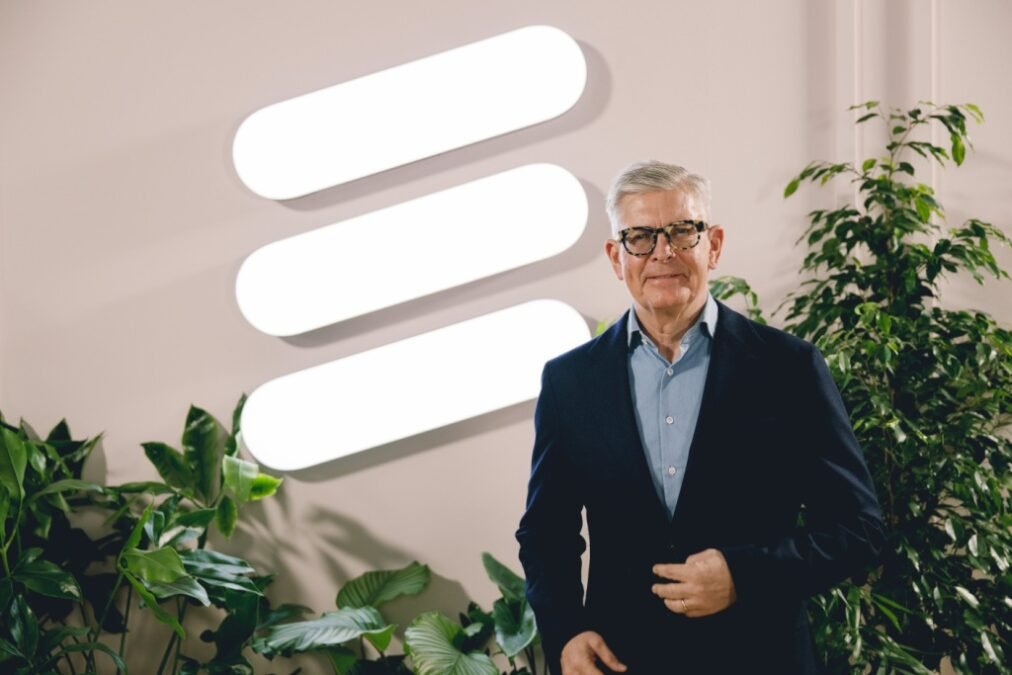
Borje Ekholm, Ericsson President and CEO, launched the company’s participation at Mobile World Congress (MWC 2026) at the Fira Gran Via venue in Barcelona. His keynote set the strategic direction for Ericsson’s presence at the event under the theme “Enter New Horizons.”


2. Three fundamental forces are reshaping telecom
Ekholm identified three core forces driving the industry forward:
Hyperconnectivity fueled by billions of sensors and connected devices
The rapid expansion of AI into applications, enterprises, and devices
The increasing role of telecom networks in national security
These forces define Ericsson’s demonstrations, seminars, and partner collaborations at MWC 2026.
3. AI surge and device growth will drive high-performance connectivity demand
Ekholm emphasized that “everything will be connected” in the AI era. The expansion of artificial intelligence across industries will significantly increase demand for low-latency, high-capacity, and highly reliable networks.
4. 5G Standalone is central to the next phase of digital transformation
A major focus of Ekholm’s speech was the transition from non-standalone 5G to full 5G Standalone architecture. He noted that most global deployments so far have been non-standalone, but unlocking the full promise of 5G requires Standalone networks.
5G Standalone enables:
Service-based architecture
Cloud-native capabilities
Greater automation
Support for advanced AI-driven services
According to Ekholm, this transition marks the beginning of a new telecom era.
5. Ericsson aims to build the best networks for AI-driven use cases
Ekholm stated that Ericsson must ensure its networks can scale AI across enterprises, public services, and mission-critical applications. This includes supporting AI workloads that demand reliability, security, and performance.
6. Differentiated connectivity use cases are gaining momentum
Ericsson is highlighting several monetization-focused use cases at MWC 2026, including:
Premium fixed wireless access
Network slicing
Network APIs
These services enable operators to move beyond traditional connectivity models toward revenue-generating digital platforms.
7. Ecosystem collaboration is expanding rapidly
Ericsson’s pavilion features collaborations with more than 120 partners, representing more than half of the company’s demonstrations at the event. Ekholm described this as evidence that the telecom ecosystem is scaling and becoming more integrated across the digital stack.
8. Aduna joint venture supports Network APIs strategy
Ekholm referenced Aduna as a key example of industry collaboration. The Network APIs-focused initiative aims to unify operators and technology partners to unlock new developer-driven revenue opportunities through programmable networks.
9. Telecom is increasingly linked to national security
Ekholm highlighted that telecom networks are becoming integral to national security frameworks. Beyond mission-critical networks, telecom infrastructure is now also seen as part of defense strategies, making resilience, security, and sovereignty central industry priorities.
10. AT&T and Singtel CEOs reinforced the 5G Standalone opportunity
During the webcast, Ekholm was joined by:
John Stankey, CEO of AT&T
Yuen Kuan Moon, CEO of Singtel
Stankey highlighted that by the end of 2026, approximately 70 percent of AT&T’s network traffic will run on open, cloud-based architecture, supporting new revenue streams and advanced services. He pointed to fixed wireless access and network slicing as areas of strong momentum. Yuen emphasized that Singapore’s early adoption of 5G Standalone from day one has positioned the country ahead of many markets. He underlined the commercial potential of dedicated network slices for security, factories, airports, seaports, gaming, and enterprise applications, stating that the industry is only “scratching the surface” of the opportunity.