

Telecom operators are accelerating investments in autonomous Radio Access Networks (RAN) to reduce operating costs, improve network performance, optimize energy consumption and enhance customer experience. Service Management and Orchestration (SMO), Artificial Intelligence (AI), Self-Organizing Networks (SON) and intelligent radio applications are emerging as critical technologies supporting this transformation.

An October 2026 report from ABI Research, Building Autonomous RAN on Today’s Foundations, developed in collaboration with Nokia, highlights how telecom operators can achieve higher levels of network autonomy without completely replacing existing infrastructure.
The research identifies network fragmentation, operational complexity, integration costs and conflicting automation objectives as four major challenges facing telecom operators. Integrating existing network assets through SMO can protect previous investments while enabling AI-driven, intent-based network operations.
Why telecom operators are investing in autonomous RAN
The expansion of 5G, cloud-native networks, Open RAN, network slicing and multi-vendor infrastructure is increasing the complexity of mobile network management.
Traditional network optimization systems often operate independently, creating conflicts between applications designed to improve coverage, capacity, network performance and energy efficiency.
The O-RAN Alliance architecture provides a framework for intelligent, interoperable radio access networks through open interfaces, RAN Intelligent Controllers (RIC) and network automation applications.
SMO provides a common operating environment that enables telecom operators to integrate network management, performance analytics, optimization software and AI applications across different vendors and technologies.
The TM Forum Autonomous Networks framework identifies Level 4 autonomy as a significant milestone involving highly autonomous operations within defined scenarios, intent-driven decision-making and reduced human intervention.
How SMO protects existing telecom investments
| Existing network asset | Benefits of SMO integration |
| SON automation | Coordination of multiple optimization functions |
| Network management software | Application integration and lifecycle management |
| Historical network data | Shared intelligence and predictive analytics |
| RAN engineering expertise | AI governance and exception management |
| Operational processes | Intent-based policies and conflict resolution |
| Multi-vendor infrastructure | Improved interoperability and flexibility |
ABI Research identifies four stages in the transition towards autonomous RAN: individual task automation, coordinated closed-loop automation, intent-driven automation and autonomous network operations.
SON provides established optimization capabilities, while rApps introduce additional automation functions. AI supports predictive analytics and complex decision-making, with SMO coordinating these technologies according to operator-defined policies.
NTT DOCOMO accelerates autonomous RAN optimization
Japan’s NTT DOCOMO deployed Nokia’s AI-powered MantaRay AutoPilot on its commercial mobile network on June 19, 2026, using public cloud infrastructure.
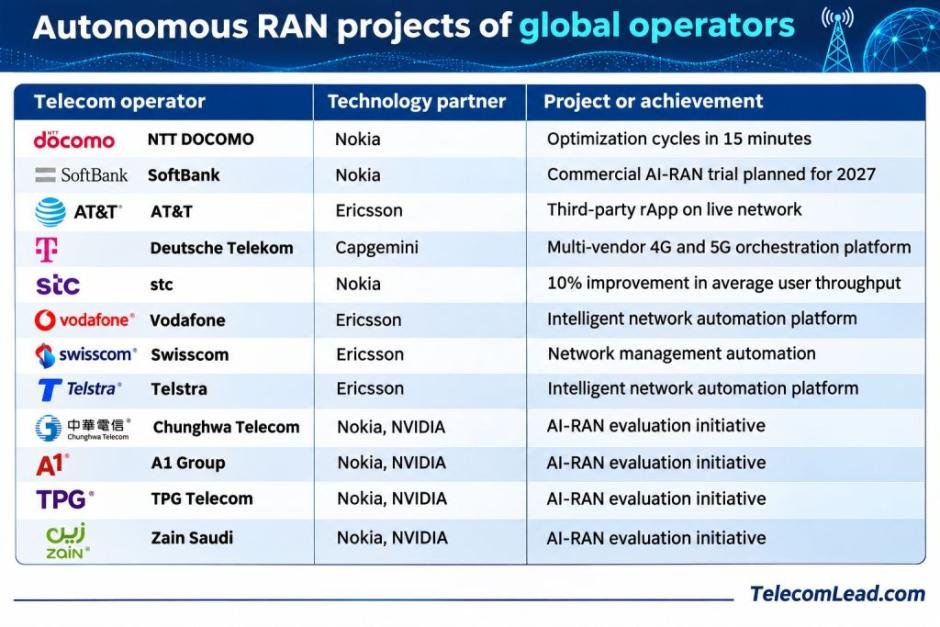
According to NTT DOCOMO’s official announcement, the technology can complete a network optimization cycle in as little as 15 minutes, compared with daily optimization cycles under its previous SON-only approach.
DOCOMO initially introduced Nokia MantaRay SON in November 2025 to reduce manual network optimization workloads. The addition of AI enables automated parameter selection and configuration based on network performance and operator-defined objectives.
DOCOMO is targeting Level 4 autonomous network operations through these investments.
The Japanese telecom operator also commenced commercial deployment of Nokia’s multi-vendor base station equipment on September 9, 2026, targeting urban locations, stadiums and event venues with concentrated mobile traffic.
DOCOMO’s second-quarter FY2026 financial presentation highlighted the phased deployment of SON-based resource optimization across base stations and frequencies according to congestion levels, beginning at selected events in October.
SoftBank targets commercial AI-RAN deployment
SoftBank and Nokia are preparing a commercial AI-RAN field trial in Japan in 2027 to evaluate the integration of AI and radio network workloads on shared computing infrastructure.
According to SoftBank’s AI-RAN announcement, the project will combine Nokia anyRAN software with SoftBank’s AITRAS platform, integrating the AITRAS Orchestrator with Nokia’s MantaRay network management and automation technology.
The planned trial will assess whether shared infrastructure can support AI workloads without compromising mobile network performance and reliability. Commercial validation could create opportunities to improve infrastructure utilization and reduce network operating costs.
AT&T deploys third-party RAN automation applications
AT&T achieved a significant milestone in July 2025 by deploying a third-party rApp to optimize its live commercial mobile network using Ericsson Intelligent Automation Platform (EIAP).
The AT&T network automation project utilizes the standardized R1 interface, enabling applications from independent developers to interact with the operator’s network orchestration platform.
AT&T is consolidating separate SON capabilities into a programmable environment supporting automation across macro networks, indoor networks and distributed antenna systems.
Deutsche Telekom develops multi-vendor autonomous RAN platform
Deutsche Telekom and Capgemini announced an agreement in February 2026 to develop an open platform for intelligent RAN automation across the telecom operator’s European businesses.
The Deutsche Telekom and Capgemini SMO initiative supports existing 4G and 5G infrastructure alongside Open RAN deployments.
The platform supports AI-enabled rApps, digital twins, operator-defined policies and third-party applications. Its RAN Intelligent Controllers can operate on hyperscaler infrastructure or private telecom clouds.
The strategy aims to reduce dependence on proprietary vendor platforms while protecting existing network investments.
Saudi Arabia’s stc improves mobile download speeds
Saudi Arabian telecom operator stc has demonstrated measurable network performance improvements through autonomous RAN investments.
According to Nokia’s stc autonomous RAN project, its AI-powered Cognitive SON implementation processed more than 10,000 network optimization actions during a high-traffic period in 2024.
The deployment delivered approximately 30 percent higher utilization of heavily loaded cells and a 10 percent average improvement in user throughput despite a 40 percent increase in network traffic.
Separately, AI-enabled energy management contributed to a 13 percent reduction in energy consumption across stc’s 4G and 5G networks in 2023.
Vodafone, Swisscom and Telstra expand network automation
Vodafone, Swisscom and Australia’s Telstra are among the telecom operators using Ericsson Intelligent Automation Platform to manage mobile network infrastructure.
In June 2026, Ericsson announced the expansion of its intelligent automation platform to support both RAN and core network automation.
Ericsson’s ecosystem featured more than 100 automation applications and over 100 members at the time of the announcement.
The integration of radio and core network automation could enable operators to coordinate network resilience, performance management and customer experience across multiple infrastructure domains.
Global telecom operators advance AI-RAN trials
A1 Group, Chunghwa Telecom, du, e&, Mobily, stc, TPG Telecom and Zain Saudi are also advancing AI-RAN evaluations and field trials using Nokia software and NVIDIA computing infrastructure.
Nokia’s global AI-RAN initiative reported spectral efficiency improvements exceeding 20 percent on its AI-RAN platform. These platform-level results should not be interpreted as confirmed performance improvements across every participating operator’s network.
Nokia and Ericsson strengthen autonomous RAN ecosystem
Nokia and Ericsson announced a strategic collaboration in March 2026 to improve interoperability between their intelligent network automation platforms.
Under the Ericsson and Nokia autonomous network partnership, Ericsson will participate in Nokia’s SMO Marketplace, while Nokia will join Ericsson’s rApp ecosystem.
The collaboration could reduce integration challenges and give telecom operators greater flexibility when selecting network optimization applications.
Autonomous RAN investment outlook
Telecom operators should evaluate autonomous RAN investments against measurable business and network performance indicators, including energy consumption, download speeds, spectral efficiency, network availability, congestion, customer complaints and operating expenditure.
AI-driven optimization could help operators address consumer complaints regarding slow internet speeds, inconsistent coverage and network congestion by identifying deteriorating network conditions before they become widespread service problems.
The commercial experiences of NTT DOCOMO, AT&T and stc demonstrate that operators can introduce advanced network intelligence without abandoning existing automation investments. However, individual automation deployments and AI-RAN trials do not necessarily establish network-wide Level 4 autonomy.
The next phase of telecom network modernization will focus on open orchestration, multi-vendor interoperability, AI governance and coordinated automation, enabling operators to improve returns on their 4G and 5G infrastructure investments.
FASNA SHABEER