

Qualcomm and MediaTek reported solid handset revenue growth for the quarter ended December 2025, fueled by premium smartphone demand and rising device prices. However, intensifying competition, growing in-house chip development by major OEMs, and looming memory constraints are creating uncertainty for 2026.

Premium smartphone demand drives handset revenue growth
Both chipmakers benefited from global premiumization trends. Qualcomm’s handset revenues grew 3 percent year over year, while MediaTek posted a stronger 13 percent increase. Growth was driven by higher average selling prices (ASPs) and strong adoption of flagship chipsets.
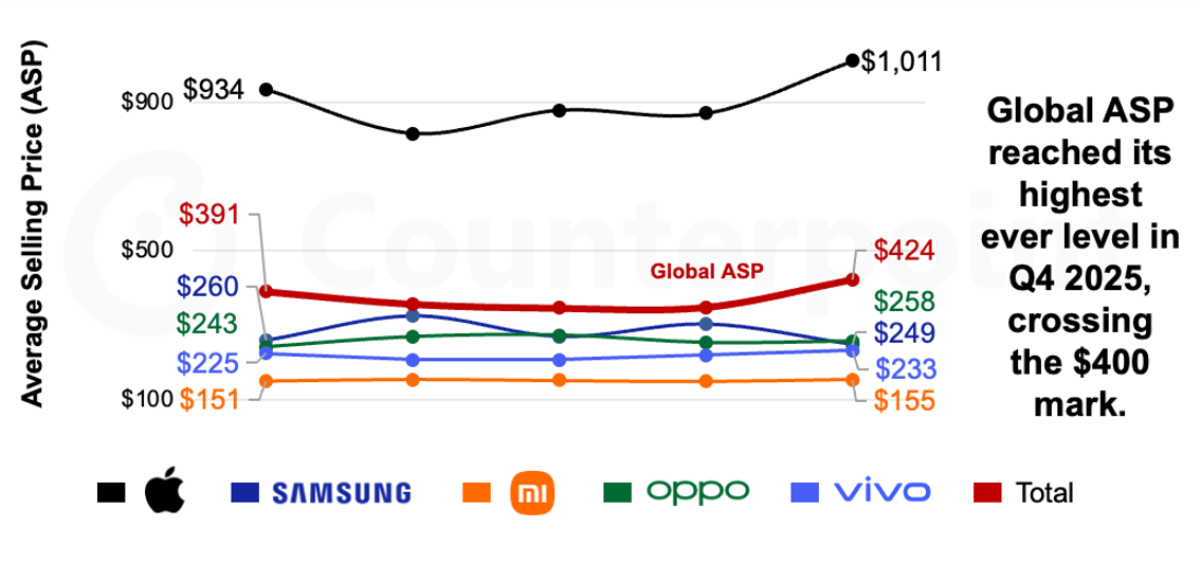
According to Counterpoint Research report, global smartphone ASPs crossed $400 for the first time in Q4 2025. Qualcomm’s Snapdragon 8 Elite and MediaTek’s Dimensity 9500 and Dimensity 8500 emerged as key contributors to the premium segment expansion.
Rising ASPs reflect consumers’ growing willingness to pay for AI features, better cameras, and improved performance. This trend has become a major revenue driver for mobile chipset vendors.
US market shifts challenge MediaTek’s momentum
Despite global growth, MediaTek is facing mounting challenges in the US market. Qualcomm, Samsung, and Google are gaining share, squeezing MediaTek’s presence across both entry-level and premium segments.
Samsung has accelerated its in-house chip strategy, deploying Exynos processors in high-volume Galaxy A16 and Galaxy A17 models. This move is expected to continue, limiting MediaTek’s opportunities in the low-end segment.
At the premium end, Samsung selected its Exynos 2500 3nm processor for the Galaxy Z Flip7, further reducing reliance on third-party suppliers. Qualcomm also felt the impact of Samsung’s design decisions.
Samsung’s SoC sales volumes surged 200 percent year over year in 2025, while Google gained traction with its Pixel 10 series. These developments are eroding Android chipset opportunities for MediaTek in the US.
Motorola design wins remain critical battleground
Competition between Qualcomm and MediaTek for Motorola design wins remains intense. These partnerships are essential for maintaining application processor volumes.
MediaTek’s 2025 design wins helped offset the impact of Samsung’s shift toward in-house chips, acting as a lifeline to sustain shipment volumes.
Memory constraints threaten smartphone growth in 2026
Looking ahead, both companies face a new challenge: rising memory costs. Increasing DRAM prices are expected to pressure smartphone manufacturers, forcing pricing adjustments and design compromises.
Qualcomm is relatively insulated due to its strong foothold in the premium segment, particularly in the US. Carrier subsidies and interest-free instalment plans keep high-end smartphones accessible, allowing price increases to be spread across monthly payments.
MediaTek faces greater exposure to the lower price tiers. In Q4 2025, 69 percent of US smartphones powered by MediaTek chipsets were priced below $600. Rising memory costs are likely to hit these price bands hardest.
K-shaped economy may slow entry-level smartphone sales
The US smartphone market is increasingly shaped by a K-shaped economic recovery. High-income consumers continue spending on premium devices, while budget-conscious buyers are holding onto phones longer.
Price increases could extend replacement cycles and suppress demand in lower price tiers. This trend poses a significant risk for MediaTek as it seeks to regain market share lost to Apple, Samsung, Google, and Qualcomm.
Outlook: premium strength vs structural challenges
Qualcomm and MediaTek enter 2026 with strong momentum in premium smartphones, but the competitive landscape is shifting rapidly. Growing in-house chip development, intensifying competition in the US, and memory price volatility are set to test both companies’ handset businesses in the coming year.
BABURAJAN KIZHAKEDATH