

Wireless evolution is entering a new phase where 6G is expected to move beyond higher data speeds to deliver intelligent, adaptive and energy-efficient connectivity. At Mobile World Congress 2026 in Barcelona, Qualcomm Technologies is demonstrating how foundational 6G research is shaping AI-native networks, sensing-enabled services and system-wide efficiency improvements.

Foundational 6G Evolution
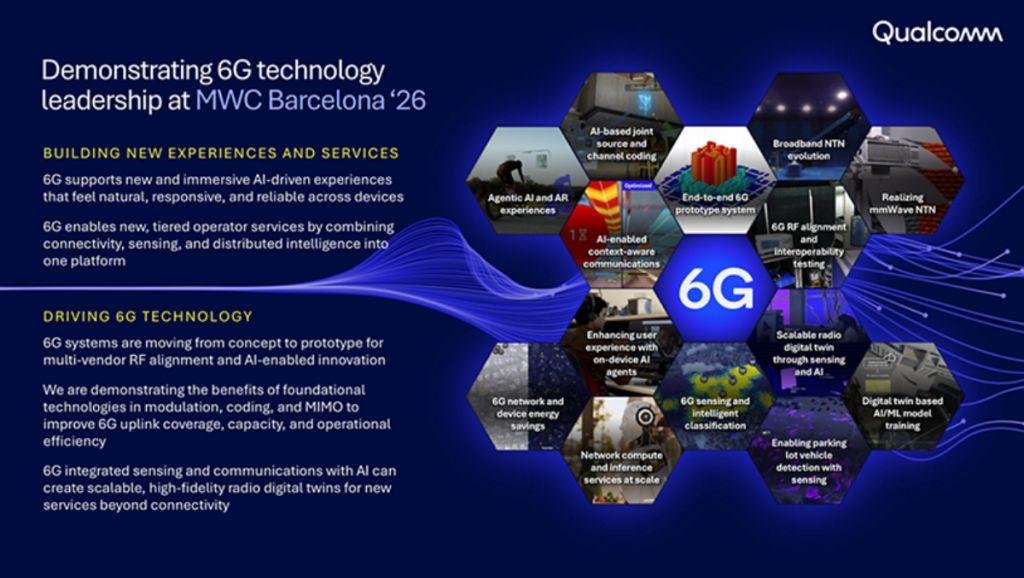
6G development begins with scalable system design choices across spectrum, bandwidth and air interface intelligence. A central end-to-end 6G prototype system on display combines Giga-MIMO, probabilistic shaping and sub-band full duplex to improve spectral efficiency and boost both uplink and downlink throughput. These technologies are designed to support future data-intensive AI applications while optimizing spectrum use.
Qualcomm Technologies is also advancing early ecosystem alignment through 6G RF interoperability testing with infrastructure vendors. These validations focus on new spectrum utilization, wide bandwidth operation and front-end performance targets to ensure readiness for the performance leap expected from 6G.
In collaboration with Nokia Bell Labs, the company is demonstrating AI-based joint source-channel coding for HARQ feedback. By learning real-world network conditions and dynamically adapting signaling, this approach reduces retransmissions, improves reliability and introduces intelligence directly into the air interface, signaling a shift toward AI-native protocol design.
AI-Native Experiences and Context-Aware Connectivity
As AI-driven services expand, networks must sustain consistent experiences rather than simply transport data. Qualcomm’s demonstrations highlight distributed compute models where AI workloads shift between devices and edge infrastructure based on link quality, latency and power constraints.
Agentic AI and augmented reality use cases illustrate how collaborative communications between multiple cellular-connected devices can enhance reliability and reduce latency. AI-enabled context-aware communications further show how on-device intelligence can adapt connectivity to user intent and application requirements, moving beyond traditional QoS mechanisms.
Another key focus is network compute and inference services. 6G is envisioned to enable devices to access more powerful AI models by distributing intelligence across device and edge resources while balancing energy use, latency and privacy considerations. On-device AI agents can proactively adjust performance in real time by analyzing application behavior, environmental context and network conditions.
Integrated Sensing and Digital Twins
6G expands wireless capabilities through Integrated Sensing and Communications. Demonstrations include real-time detection, tracking and classification of drones and vehicles, enabling new applications in safety, smart cities and industrial automation.
Scalable radio digital twins powered by RF sensing and AI are shown to support continuous network tuning and performance optimization. Synthetic data generated from these digital twins can train AI models such as beam prediction algorithms, reducing over-the-air data collection and lowering energy consumption.
Energy efficiency remains a core pillar of 6G research. By combining RF sensing, AI-driven radio modeling and device-level low-power techniques such as wake-up receivers, networks can dynamically allocate resources to reduce energy waste while maintaining user experience.
Expanding Connectivity with Non-Terrestrial Networks
Qualcomm Technologies is also highlighting advancements in non-terrestrial networks. Millimeter-wave satellite connectivity is being explored to extend broadband access beyond traditional terrestrial coverage. Demonstrations include compact broadband access terminals with beam agility and real-time adaptation to moving satellites, as well as satellite-to-device communication supporting high-speed links for phones, vehicles and drones.
6G to Power AI-Driven Robotic Fleets and Physical AI Systems
The evolution of robotics toward coordinated, AI-driven fleets is emerging as a major use case for 6G networks. As robots move from isolated automation systems to collaborative Physical AI platforms, connectivity becomes a core enabler of intelligence sharing, real-time coordination and large-scale deployment.
Future robotic systems will require ultra-low latency, deterministic wireless performance and built-in security to function reliably in safety-critical industrial environments. Unlike traditional automation, next-generation robots must continuously exchange perception data, planning decisions and operational context across machines, infrastructure and edge platforms. This shift places advanced 6G architectures at the center of robotic innovation.
Emerging 6G capabilities extend beyond simple communication. They are designed to support AI-native coordination, enabling distributed intelligence across devices, edge compute and cloud systems. Safety-critical motion control can remain on-device, while long-horizon scheduling and predictive optimization shift to edge or hybrid architectures. This layered intelligence model depends on high reliability, strong uplink performance and secure data exchange.
Robotic fleets also demand power-efficient connectivity and resilient performance in bandwidth-constrained environments. 6G’s focus on low-latency operations, edge-first AI processing and collaborative compute directly addresses these constraints. The ability to securely move intelligence across machines and infrastructure will allow robots to learn continuously, adapt to dynamic environments and scale across large facilities.
Qualcomm Technologies, Inc. and Ericsson have reached a major milestone in 6G development by achieving technical alignment on foundational 6G radio innovations and validating them through collaborative lab prototypes. The breakthrough marks a critical step toward shaping global 6G specifications and accelerating commercialization of next-generation wireless technology.
The companies will showcase their joint progress at Mobile World Congress 2026 from March 2 to 5, featuring live demonstrations of advanced radio capabilities and performance in new spectrum bands.
From Concept to 6G Prototype
Moving beyond theoretical research, the partners have jointly developed and validated essential 6G physical layer capabilities in a prototype environment. This early validation lays the groundwork for influencing future standards under 3GPP 6G Release 20 study items.
Among the highlights is a 400 MHz component carrier operating at 30 kHz subcarrier spacing. The demonstration also explores performance characteristics in the 6 to 8 GHz centimeter-wave spectrum. This cmWave band is expected to play a strategic role in balancing coverage and capacity in 6G deployments, offering improved cell-edge performance and supporting new device capabilities such as four transmit-receive antennas.
By testing these features in real-world lab environments, Qualcomm Technologies and Ericsson are helping define how 6G will deliver both higher performance and broader coverage compared to previous generations.
6G Built for AI-Native Networks
The collaboration extends beyond radio innovation into AI-native, context-aware networking. The companies are prototyping immersive AI and AR experiences across new device form factors supported by resilient infrastructure.
As AI services evolve from app-based sessions to persistent, agentic experiences operating across multiple devices, uplink demand is projected to surge significantly. Enhanced uplink coverage and wide-area reliability are becoming central design priorities for 6G.
Ericsson’s latest ConsumerLab insights indicate that by 2030, 40 percent of consumers may use agentic AI services daily. One in four users are expected to access AI across multiple devices, while 45 percent anticipate using AI outdoors. With uplink data demand forecast to triple every five years, 6G networks must deliver consistent high-performance connectivity beyond traditional hotspot zones.
Device-Network Collaborative Compute
A key pillar of the joint 6G vision is device-network collaborative compute, enabling distributed intelligence across devices, edge infrastructure, and cloud platforms. By integrating AI directly into network architecture, 6G aims to create a fabric that adapts in real time to user context, device capabilities, and application demands.
Durga Malladi of Qualcomm Technologies emphasized that early alignment on radio concepts and user-experience validation accelerates the path from lab innovation to commercial launch. The focus on usable performance, particularly uplink and wide-area reliability, is expected to unlock a new wave of AI-driven devices and services.
Ericsson CTO Erik Ekudden highlighted the need for ecosystem-wide collaboration spanning devices, networks, edge, cloud, and AI platforms. By validating foundational 6G capabilities through working prototypes, the companies aim to translate vision into deployable infrastructure.
With spectrum exploration in the 6 to 8 GHz range, enhanced physical layer design, and AI-native architecture, Qualcomm Technologies and Ericsson are positioning 6G as a transformative platform capable of supporting persistent AI experiences, immersive applications, and large-scale multi-device connectivity.
The 6G Vision
The innovations showcased at MWC 2026 reflect a broader 6G direction: AI-native system design, deterministic performance, integrated sensing and energy efficiency. Rather than focusing solely on peak speeds, 6G aims to create intelligent wireless systems capable of adapting to context, supporting distributed AI workloads and enabling new service models across terrestrial and satellite domains.
BABURAJAN KIZHAKEDATH