

Qualcomm has reported revenue of $12.25 billion for its fiscal first quarter ended December 28, 2025, representing a 5 percent increase, while net income declined 6 percent to $3.0 billion. The results highlight continued diversification across automotive, IoT, AI PCs and industrial technologies, even as the company faces short term headwinds in the smartphone market.

Qualcomm Q1 FY2026 financial highlights
Qualcomm’s chipset division, Qualcomm CDMA Technologies (QCT), generated $10.61 billion in revenue, rising 5 percent. Qualcomm Technology Licensing (QTL) delivered $1.59 billion, up 4 percent.
Segment performance showed mixed trends:
Handset revenue: $7.82 billion, up 3 percent
Automotive revenue: $1.10 billion, up 15 percent
IoT revenue: $1.69 billion, up 9 percent
The automotive and IoT segments continue to be key growth engines as Qualcomm expands beyond smartphones into connected vehicles, industrial computing and edge AI.
Smartphone market faces memory supply constraints
Qualcomm CEO Cristiano Amon said the company’s momentum in personal, industrial and physical AI is strengthening, supported by new product launches and customer adoption. However, the near term outlook for smartphones remains affected by industry wide memory supply constraints.
Despite this, Qualcomm sees strong consumer demand for premium and high tier smartphones and reiterated that it remains on track to meet its fiscal 2029 revenue targets.
For the second quarter of fiscal 2026, Qualcomm expects:
QCT revenue between $8.8 billion and $9.4 billion
QTL revenue between $1.2 billion and $1.4 billion
Snapdragon drives AI smartphone and AI PC expansion
Qualcomm highlighted major milestones in AI powered devices. ByteDance launched the first agentic AI smartphone powered by the Snapdragon 8 Elite platform, marking a shift toward AI native smartphones.
At CES, Qualcomm unveiled 18 Snapdragon powered PCs from partners including Asus, HP, Lenovo and Microsoft. The Asus Zenbook A16 featuring the Snapdragon X2 Elite Extreme platform was introduced as the fastest Snapdragon powered laptop so far. The company expects about 150 Snapdragon X powered PCs to be commercialized this year.
These launches underline Qualcomm’s ambition to expand Snapdragon beyond mobile into the broader personal computing ecosystem.
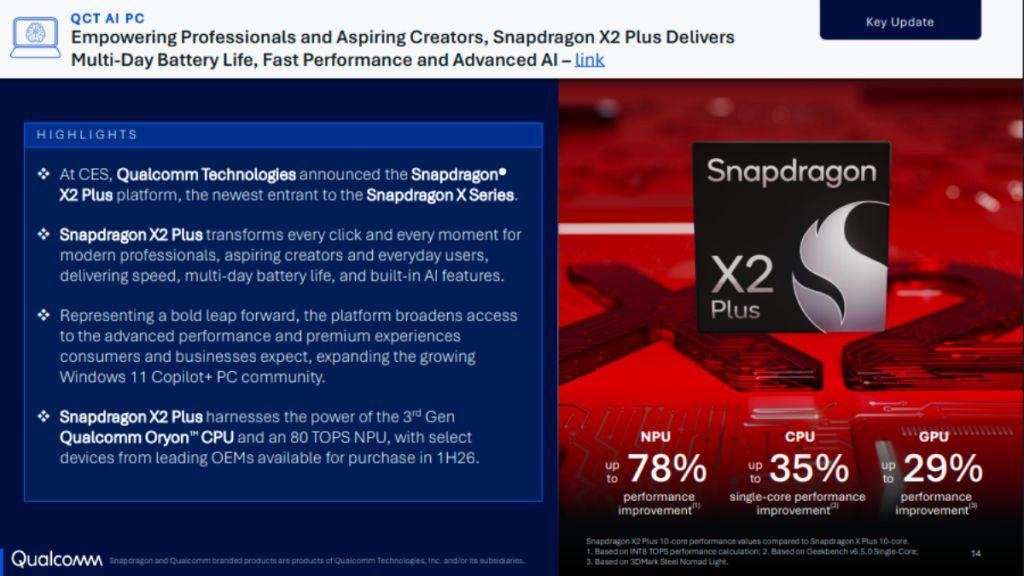
Qualcomm introduced the Snapdragon X2 Plus platform at CES, expanding its Snapdragon X Series for AI powered Windows PCs. The platform is designed to deliver fast performance, multi day battery life and built in AI capabilities for professionals, creators and everyday users.
Snapdragon X2 Plus is powered by the third generation Qualcomm Oryon CPU and an 80 TOPS NPU, enabling advanced on device AI experiences and boosting productivity and creativity. The new platform aims to broaden access to premium PC performance and strengthen the growing Windows 11 Copilot+ PC ecosystem. Qualcomm said devices based on Snapdragon X2 Plus from leading OEM partners are expected to be available in the first half of 2026.
Automotive momentum accelerates with global partnerships
Demand for Snapdragon Digital Chassis solutions continues to grow rapidly. Qualcomm signed a letter of intent for a long term supply agreement with Volkswagen Group and expanded collaborations with Hyundai Mobis, Leapmotor, Li Auto, Zeekr, Great Wall Motor, NIO and Chery.
The automotive segment’s 15 percent revenue growth reflects increasing adoption of connected car, infotainment, telematics and advanced driver assistance technologies.
Qualcomm is strengthening its automotive technology leadership through strong momentum for its Snapdragon Digital Chassis and growing adoption by global automakers. The company highlighted its position as the world’s leading cockpit provider, supported by multiple design wins for its latest Snapdragon Elite automotive platform.
The Snapdragon Elite platform has secured eight design wins and is gaining rapid adoption for premium vehicles, enabling agentic AI capabilities in next generation digital cockpits and in vehicle experiences. Qualcomm also reported ten design wins across key automotive solutions, reflecting increasing demand from global car manufacturers.
A major milestone is the Snapdragon Ride Flex platform, which is now deployed in more than 75 million vehicles worldwide. The platform is accelerating the industry shift toward centralized vehicle computing by combining advanced driver assistance system workloads and in vehicle infotainment on a single chipset. This makes Ride Flex the first commercial automotive platform to support mixed criticality ADAS and infotainment functions together, helping automakers simplify architecture and deliver smarter, AI driven mobility experiences.
Industrial IoT and robotics push strengthens diversification
Qualcomm continues to expand its industrial IoT and robotics portfolio. The company:
Introduced new Qualcomm Dragonwing processors
Acquired Augentix to strengthen its vision and AI portfolio
Launched the Qualcomm Dragonwing IQ Series for industrial PCs
Entered advanced robotics with the Dragonwing IQ10 Series
Qualcomm sees strong growth in physical AI and robotics, driven by edge AI and sensor fusion technologies.
Strategic acquisitions strengthen connectivity and RISC V ecosystem
Qualcomm also completed key acquisitions to strengthen its long term technology roadmap:
Acquisition of Alphawave Semi to enhance high speed wired connectivity
Acquisition of Ventana Micro Systems to expand RISC V ecosystem leadership
These investments reinforce Qualcomm’s strategy to build end to end platforms spanning mobile, automotive, AI PCs, industrial IoT and robotics.
Outlook: Diversification strategy gains traction
Qualcomm’s Q1 results reflect a company transitioning from smartphone dependence toward a broader AI driven platform business. Strong growth in automotive, IoT and AI PCs is helping offset near term smartphone challenges, positioning Qualcomm to capitalize on long term opportunities in edge AI, connected vehicles and intelligent computing.
BABURAJAN KIZHAKEDATH