

South Korea’s smartphone market recorded shipments of 3.78 million units in the first quarter of 2026, representing a 0.5 percent year-on-year decline, according to IDC.

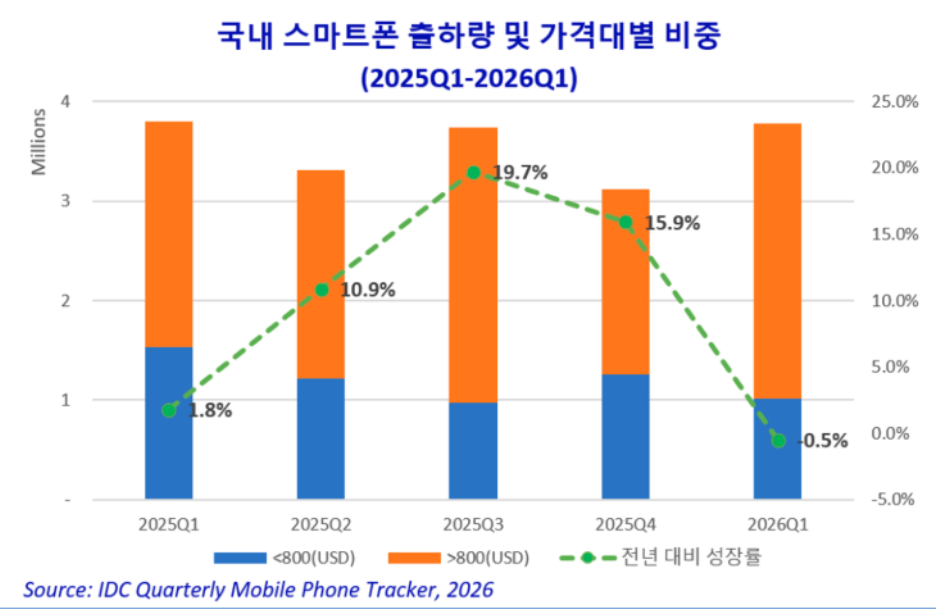
The smartphone market in South Korea remained resilient despite economic uncertainty, with premium smartphones and foldable devices continuing to attract consumers, while competition intensified in the mid-range and budget segments.
5G devices accounted for 95.5 percent of South Korea’s smartphone market in Q1 2026, supported by new flagship launches and wider availability of mid-range 5G smartphones. The premium segment also strengthened sharply, with smartphones priced above $800 capturing 73.2 percent market share, rising by double digits year on year. Foldable smartphone shipments reached 190,000 units, posting a three-digit growth rate, driven by demand for Samsung’s Galaxy Fold series and the limited-volume Galaxy Z TriFold series.
IDC said the Korean smartphone market reflected changing consumer preferences as buyers increasingly favored premium devices offering advanced artificial intelligence (AI) features, high-end cameras, and foldable form factors. Premium smartphones continued to outperform the broader market, supported by strong replacement demand and steady interest from existing flagship users. At the same time, manufacturers faced growing pressure in lower-priced segments due to cautious consumer spending and aggressive competition.
The report highlighted that foldable smartphones maintained positive momentum, reinforcing South Korea’s position as one of the world’s most mature markets for premium mobile devices. Vendors continued expanding their premium portfolios while introducing AI-powered capabilities to differentiate their products and stimulate upgrades.
Although the overall market contracted slightly, IDC expects premiumization to remain a key growth driver throughout 2026. Smartphone vendors are likely to focus on flagship launches, foldable innovations, and AI-enabled user experiences while balancing pricing strategies in an increasingly competitive market. The combination of economic uncertainty and rising competition in the mid-range segment will continue shaping smartphone demand in South Korea over the coming quarters.