

The Philippines smartphone market remains dominated by affordable Android devices, but rising memory prices are forcing vendors to move customers into higher price bands. Transsion leads the Philippines smartphone market with a 33 percent shipment share in the second quarter of 2026, followed by Xiaomi at 22 percent and Samsung at 16 percent, according to Omdia.

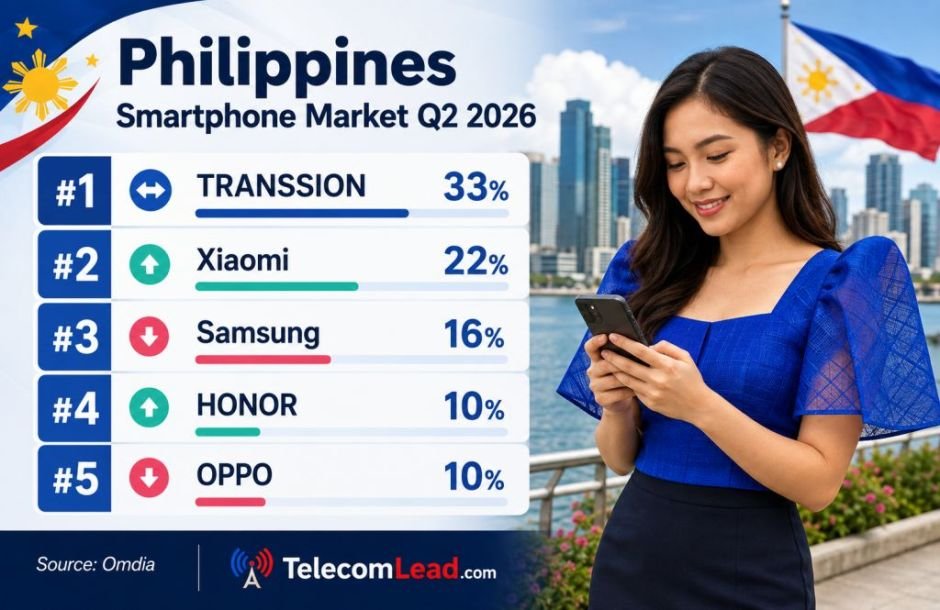
Omdia smartphone market data for Southeast Asia said HONOR and OPPO each captured 10 percent. The five leading vendors collectively controlled 91 percent of Philippine smartphone shipments, leaving only 9 percent for Apple, vivo and other brands.
Transsion’s 11-percentage-point advantage over Xiaomi makes the Philippines less evenly contested than Malaysia, Thailand or Vietnam. However, the leader faces significant risk because its TECNO, Infinix and itel brands remain heavily exposed to price-sensitive consumers.
Also Read: Indonesia Smartphone Market Report Q2 2026
Also Read: Vietnam Smartphone Market Q2 2026
Also Read: Thailand Smartphone Market Q2 2026
Transsion and Xiaomi together accounted for 55 percent of shipments, exceeding Samsung, HONOR and OPPO’s combined 36 percent. Chinese smartphone companies collectively controlled at least 75 percent of the market through Transsion, Xiaomi, HONOR and OPPO.
Transsion Leads with 33 Percent but Faces Entry-Level Pressure
Transsion’s 33 percent share makes it the clear Philippine market leader. Its multi-brand strategy allows it to address different consumer groups through TECNO, Infinix and itel without depending on a single product family.
However, its Southeast Asian performance shows the scale of the affordability challenge. Transsion’s regional shipments fell 25 percent to 3.4 million units in 2Q26, compared with 4.6 million units in 2Q25. Its regional market share remained at 18 percent because the entire market contracted sharply.
Transsion’s shipments below $100 declined 47 percent. Meanwhile, shipments between $100 and $199 increased 12 percent and became the company’s largest price category.
This movement indicates that Transsion is retaining some customers by shifting them into more expensive devices. New models such as the Infinix HOT 70 and TECNO SPARK 50 4G were introduced at higher prices than the devices they replaced.
The TECNO SPARK 50 combines a 120Hz display, 50MP camera and AI features, while its 5G version adds 45W charging. The Infinix HOT 70 offers a 6,000mAh battery and 45W charging, along with promotional access to Google AI and Viu Premium in the Philippines.
Transsion’s challenge is maintaining its 33 percent leadership while component inflation erodes the affordability advantage on which its brands were built.
Xiaomi Captures 22 Percent as ASP Rises 43.5 Percent
Xiaomi ranked second with 22 percent of Philippine smartphone shipments. Its market share was six percentage points higher than Samsung’s and more than double the shares held by HONOR and OPPO.
The company combines Redmi and POCO volume devices with more expensive Xiaomi-branded smartphones. This portfolio gives it wider price coverage than vendors concentrated primarily in either entry-level or premium products.
Across Southeast Asia, Xiaomi shipped 3.7 million smartphones in 2Q26, down 21 percent from 4.7 million a year earlier. Despite this decline, its regional share remained unchanged at 19 percent.
Xiaomi recorded a 43.5 percent increase in average selling price — the second-highest ASP increase among the region’s five largest vendors. Its sub-$100 shipments fell 69 percent, while shipments in the $100–$199 category increased 55 percent.
The contrasting figures show that Xiaomi is successfully moving part of its customer base into higher price bands, although those gains have not fully offset the loss of ultra-affordable shipments.
Xiaomi is supporting Philippine demand through flash sales, online coupons and POCO Carnival promotions. These campaigns are particularly important in an open-market retail environment where consumers can compare prices across multiple brands and e-commerce platforms.
Samsung Holds 16 Percent with Stronger Regional Performance
Samsung captured 16 percent of Philippine smartphone shipments, placing third. Although it trailed Transsion by 17 percentage points and Xiaomi by six points, Samsung recorded stronger regional and global performance than its principal Philippine competitors.
Samsung’s Southeast Asian shipments fell 11 percent to 3.9 million units in 2Q26, compared with declines of 21 percent for Xiaomi, 25 percent for Transsion and 41 percent for OPPO. Consequently, Samsung’s regional market share increased from 17 percent to 20 percent.
Samsung’s share of Southeast Asia’s $200–$299 category jumped from 18 percent in 2Q25 to 32 percent in 2Q26, a gain of 14 percentage points. It also increased its share across the wider sub-$300 market as several competitors reduced their exposure.
Samsung’s Philippine strategy combines affordable Galaxy A devices with premium Galaxy S and foldable models. Discounts, trade-ins, instalment plans and accessory bundles help it compete with lower-priced Chinese vendors without relying exclusively on permanent handset price reductions.
HONOR Reaches 10 Percent and Records Strong Growth
HONOR captured 10 percent of Philippine shipments, matching OPPO but taking fourth place in Omdia’s ranking.
The company’s momentum extends beyond the Philippines. HONOR’s Southeast Asian shipments increased 15 percent during the first half of 2026 even as the regional market contracted. It was also identified as the fastest-growing major smartphone brand in both the Philippines and Malaysia during 2Q26.
HONOR’s shipments across Africa increased 53 percent in the first half, while its global shipments grew 9 percent. In 2025, the company’s Southeast Asian shipments doubled, supported by expansion in the Philippines, Singapore, Thailand and Vietnam.
The company is using mainstream devices to generate volume while premium products strengthen brand recognition. The HONOR Magic V6 was introduced in the Philippines at PHP119,999, with pre-orders including an HONOR Pad X8b valued at PHP12,999.
The tablet bundle was equivalent to approximately 10.8 percent of the smartphone’s launch price. While a PHP119,999 foldable will contribute limited mass-market volume, it can help HONOR improve its premium credentials and compete for higher-value consumers.
The HONOR 600 series gives the company a more accessible platform for increasing its overall Philippine shipment share.
OPPO Holds 10 Percent as Low-Cost Shipments Collapse
OPPO also held 10 percent of the Philippines smartphone market. It trailed Samsung by six percentage points and Transsion by 23 points.
OPPO’s regional results demonstrate why the company is prioritising more expensive Reno devices. Its Southeast Asian shipments — including realme but excluding OnePlus — fell 41 percent to 3.1 million units. Its market share declined from 21 percent to 16 percent.
Shipments of OPPO devices priced below $100 collapsed 96 percent, representing the sharpest contraction among the leading vendors. Shipments in the $100–$199 category also declined 25 percent.
Unlike Xiaomi and Transsion, OPPO did not generate sufficient growth in the next price band to replace the lost entry-level volume. Its strategy is consequently shifting toward imaging, AI, battery performance and higher-value Reno smartphones.
The Reno16 5G is listed at PHP54,999 in the Philippines. OPPO has supported the series with pre-order campaigns, promotional bundles and local launch events.
OPPO’s 10 percent share places it level with HONOR, but their trajectories differ. HONOR is gaining shipments and expanding geographically, while OPPO is attempting to stabilise volume after withdrawing from low-price categories.
Southeast Asia Smartphone Shipments Fall by 5.7 Million
The Philippine rankings form part of a major regional contraction. Southeast Asian smartphone shipments fell 23 percent to 19.3 million units in 2Q26, down from 25 million units in 2Q25. This represents a reduction of approximately 5.7 million smartphones in one quarter.
Market value nevertheless reached $6.6 billion as the average selling price increased 31 percent to $342, according to Omdia.
The $100–$199 category increased its share of regional shipments from 32 percent to 39 percent. Based on Omdia’s rounded figures, this price category represented approximately 7.5 million of the 19.3 million smartphones shipped during the quarter.
Shipments above $100 still declined 2 percent, showing that higher price categories did not absorb all the demand lost below $100. Many consumers appear to be delaying replacements rather than automatically paying more.
Omdia expects Southeast Asian smartphone shipments to fall 25 percent to 75.3 million units in 2026. This forecast implies that the region shipped approximately 100.4 million devices in 2025 and could lose around 25.1 million shipments in 2026.
Philippines Smartphone Competition Shifts Above $100
The Philippines remains a volume-focused market, but the structure of that volume is changing. Transsion retains a commanding lead through TECNO, Infinix and itel, while Xiaomi has established a strong second position by successfully moving customers from sub-$100 phones into the $100–$199 category.
Samsung has the strongest regional and global performance, supported by its growing share of the $200–$299 segment. HONOR is the fastest-growing challenger, while OPPO faces the difficult task of replacing entry-level shipments with higher-priced Reno devices. As memory costs increase, the battle for Philippine consumers will increasingly depend on prices above $100, online promotions, instalment plans, battery capacity, AI features, cameras and long-term software support.
FASNA SHABEER