

Peru’s smartphone market is becoming increasingly competitive as rising component costs put pressure on device prices and consumers become more selective about upgrades. Xiaomi led smartphone shipments in Peru during the second quarter of 2026 with a 28 percent market share, ahead of Samsung at 25 percent, according to Omdia.

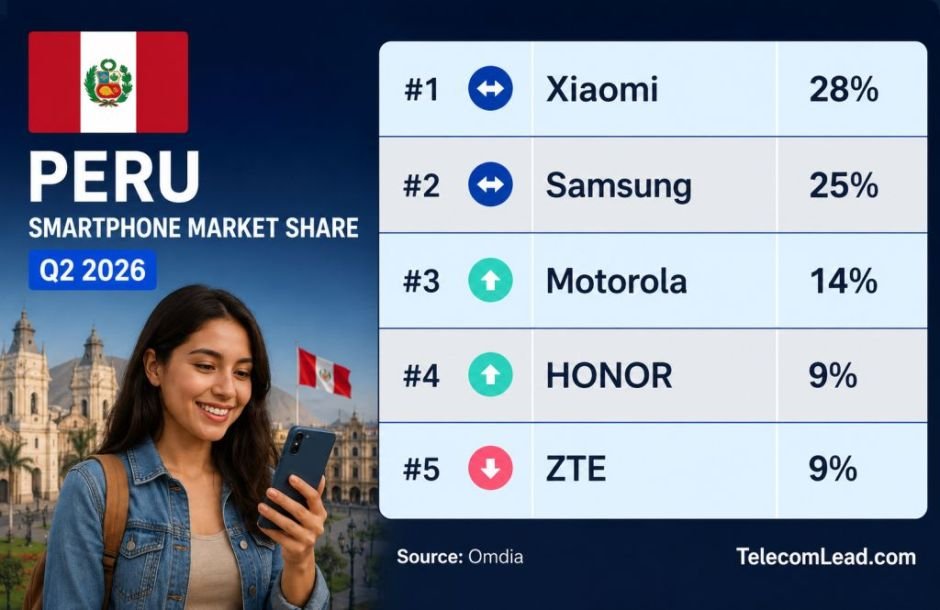
Motorola ranked third with 14 percent, while HONOR and ZTE each captured 9 percent of shipments. Together, the five brands accounted for 85 percent of Peru’s smartphone market during the quarter.
The competitive environment reflects the broader pressure across Latin America, where smartphone shipments fell 12 percent to 30.3 million units in 2Q26 as rising memory costs weighed on demand, according to the Omdia Latin America smartphone market report.
In Peru, price, financing, promotions, camera quality, battery life, storage and 5G capabilities are becoming important factors influencing purchasing decisions.
Xiaomi Leads Peru Smartphone Market with 28 Percent Share
Xiaomi secured first place with 28 percent of Peru smartphone shipments in 2Q26. The company had already recorded double-digit growth in the country during the first quarter, supported by the Redmi Note series and its strong position in price-sensitive segments.
The Redmi Note 15 family illustrates Xiaomi’s strategy. The Redmi Note 15 8GB+256GB was launched at S/949, while the Redmi Note 15 Pro 8GB+256GB was priced at S/1,299 and the Redmi Note 15 Pro 5G 8GB+512GB at S/1,499.
Xiaomi combined these prices with interest-free instalments and bundled accessories. Its devices also emphasize features such as 6000mAh batteries, 108MP cameras, AMOLED displays, AI capabilities and higher storage configurations.
The approach addresses one of the main concerns of Peruvian smartphone customers: obtaining higher specifications without moving into substantially more expensive price bands.
Xiaomi Redmi Note 15 series offers in Peru provides an indication of how promotions and financing are being used to stimulate upgrades.
Samsung Holds 25 Percent with Galaxy A and Galaxy S26
Samsung remained Xiaomi’s closest competitor with a 25 percent shipment share in 2Q26.
Its advantage is a broad product portfolio covering both mainstream and premium customers. Galaxy A smartphones address price-conscious buyers, while the Galaxy S26 family targets consumers looking for premium cameras, AI functionality, privacy and productivity features.
The Galaxy A17 8GB+256GB has been offered by retailers at around S/849 compared with an earlier price of S/1,299, highlighting the level of promotional pressure in Peru.
At the premium end, Samsung introduced the Galaxy S26 series in Peru in February 2026, with local availability beginning in March. The Galaxy S26 has been promoted at around S/4,599 with financing of up to 18 interest-free instalments through selected cards.
Samsung is therefore competing at both ends of the market: discounts and financing help Galaxy A devices defend mainstream share, while Galaxy AI, camera improvements and premium hardware support the significantly higher pricing of the Galaxy S portfolio.
Samsung Galaxy S26 launch in Peru provides additional details on the company’s premium smartphone strategy.
Motorola Captures 14 Percent as Moto G Targets Value Buyers
Motorola ranked third with 14 percent of Peru smartphone shipments.
Its Moto G portfolio remains central to competing for customers who want capable smartphones at relatively affordable prices. The Moto G17 128GB starts at S/599, while the 256GB version is priced from S/649.
The smartphone combines a 50MP Sony LYTIA camera, 5200mAh battery, Full HD+ display and Dolby Atmos with AI features including Gemini and Circle to Search.
Motorola is simultaneously trying to capture customers willing to spend more through its Edge family. The Edge 70 has been promoted at S/1,899, compared with S/2,299 previously, together with up to 18 interest-free instalments.
The combination gives Motorola coverage from affordable Moto G smartphones to higher-value Edge devices without relying exclusively on the premium segment.
HONOR Takes 9 Percent with AI and Camera Strategy
HONOR accounted for 9 percent of smartphone shipments in Peru during 2Q26.
The company is positioning AI photography, battery capacity, displays and design as differentiators in the increasingly crowded mid-range segment.
The HONOR 400 Lite, for example, has been offered at around S/1,349 compared with S/1,399 previously, alongside promotional coupons and interest-free payment options.
Its specifications include a 108MP camera, AI editing features, 5230mAh battery, 35W charging and a 120Hz AMOLED display.
HONOR’s challenge is that lower-priced smartphones increasingly advertise similar headline specifications. Its strategy therefore depends on convincing customers that photography, AI capabilities, display quality, design and durability justify moving into a higher price category.
ZTE Reaches 9 Percent as Nubia Targets Gaming
ZTE also captured 9 percent of Peru smartphone shipments, helped by its Nubia portfolio.
The company is targeting gaming and performance-focused consumers through devices such as the Nubia Neo 5 5G and Neo 5 GT.
The Neo 5 GT 5G 8GB+256GB has been listed at approximately S/1,209, down from S/1,499. It includes a 6.8-inch OLED display, 256GB storage and a 6210mAh battery.
ZTE is also competing aggressively below this level. The Nubia V80 Max 4GB+256GB has been available at around S/499 compared with S/599 previously.
This gives ZTE an opportunity to address customers looking for gaming capabilities or large batteries without paying flagship smartphone prices.
Peru Has 39.4 Million Active Mobile Lines
The smartphone competition is supported by a large and increasingly postpaid-oriented telecom market.
Peru had 39.4 million mobile lines that generated traffic at the end of the first quarter of 2026, up 2.85 percent from 38.3 million a year earlier, according to OSIPTEL data on Peru’s mobile subscriber market.
Claro controlled 33.35 percent of active mobile lines, followed by Bitel with 24.01 percent, Entel with 22.54 percent and Movistar with 19.81 percent. MVNOs collectively represented the remaining 0.29 percent.
Based on the 39.4 million active-line total and these market shares, this translates to approximately 13.1 million active lines for Claro, 9.5 million for Bitel, 8.9 million for Entel and 7.8 million for Movistar. These are approximate calculations from OSIPTEL market-share data rather than operator-reported subscriber totals.
More importantly for smartphone sales, Peru is shifting toward contract customers. Postpaid and control lines reached 20.59 million in 1Q26, rising 12.37 percent from 18.32 million a year earlier and accounting for 52.26 percent of active mobile lines. Prepaid lines totaled 18.80 million.
A larger postpaid customer base potentially supports device financing, instalment plans, bundled smartphones and premium 5G upgrades.
Claro Peru Revenue Reaches S/1.9 Billion in 2Q26
Claro is currently the largest Peruvian mobile operator by active lines and provides one of the clearest indications of the commercial opportunity available to smartphone vendors.
Claro Peru ended June with 13.3 million wireless subscribers, up 3.8 percent . During 2Q26, the operator added 173,000 postpaid subscribers while disconnecting 72,000 prepaid users.
Revenue increased 8.1 percent to S/1.9 billion during the quarter, while service revenue rose 6.5 percent. Mobile service revenue increased 3.4 percent and postpaid revenue expanded 6.5 percent.
The shift toward postpaid is particularly relevant for Xiaomi, Samsung, Motorola, HONOR and ZTE because operator financing can reduce the upfront cost of higher-priced smartphones.
Entel Peru Reaches 10 Million Mobile Customers
Entel is another important smartphone distribution and connectivity player.
The operator reached approximately 10 million mobile customers in Peru during 2Q26. Its Peruvian operation added around 770,000 postpaid customers over the preceding 12 months, representing growth of 14.8 percent.
Entel Peru’s second-quarter revenue increased 9.3 percent . Parent company Entel reported consolidated revenue of CLP781 billion, an increase of 8 percent, supported by an 8.8 percent rise in mobile-service revenue and an 11.6 percent increase in equipment sales.
The growth in equipment revenue demonstrates the continuing importance of operators as smartphone sales channels, particularly when handsets can be combined with postpaid plans and financing.
Claro, Integratel and Entel Lead Telecom Revenue
Peru’s overall telecommunications sector generated S/5.13 billion in revenue during the first quarter of 2026, an increase of 2.3 percent , according to OSIPTEL’s Peru telecom revenue analysis.
Claro accounted for 35 percent of industry revenue, followed by Integratel — which operates the Movistar business — with 23.1 percent and Entel Group with 19.9 percent.
Mobile services generated S/2.654 billion during the quarter, an increase of 4.1 percent. Fixed internet generated another S/874 million from more than 4.1 million connections.
Movistar’s first-half 2026 performance also showed improving monetisation in parts of its customer base. Fiber ARPU increased 7 percent during 2Q26, pay-TV ARPU rose 4 percent and prepaid mobile average revenue per customer increased 9 percent.
Bitel Strengthens Position in Mobile Internet
Bitel has emerged as an important competitive force despite ranking behind Claro in overall mobile connections.
The operator accounted for 24.01 percent of Peru’s active mobile lines in 1Q26. It also recorded the strongest increase in its share of phones accessing mobile internet, gaining 2.48 percentage points to reach 23.01 percent.
Bitel captured 25.06 percent of Peru’s mobile data traffic during the quarter, up 3.18 percentage points . Claro remained first with 34.22 percent, followed by Bitel, Entel at 23.63 percent and Movistar at 17.08 percent.
Increasing mobile-data consumption is important for the smartphone market because it strengthens demand for larger batteries, better displays, 5G connectivity, gaming performance and higher storage capacities.
Smartphone Brands Face a Value-Driven Upgrade Battle
Peru’s smartphone and telecom figures point toward a market where device vendors cannot depend solely on specification upgrades.
Xiaomi’s 28 percent lead demonstrates the strength of aggressive price-to-specification positioning. Samsung’s 25 percent share shows that a broad portfolio spanning affordable Galaxy A devices and premium Galaxy S smartphones can also remain competitive.
Motorola’s 14 percent share gives it a meaningful position through Moto G and Edge, while HONOR and ZTE, with 9 percent each, are challenging established vendors through AI cameras, large batteries, gaming capabilities and competitive pricing.
The telecom market adds another dimension. More than half of Peru’s active mobile lines are now postpaid or control connections, while Claro and Entel continue adding postpaid customers. That creates a larger addressable market for smartphone instalment plans and operator-supported device upgrades.
Competition is also intense. Around 3.1 million mobile lines changed operators during the first half of 2026, with more than 77 percent of porting transactions coming from postpaid customers. Claro recorded a positive net portability balance of 102,058 lines and Entel gained 34,072, while Bitel recorded a negative 33,301 and Movistar a negative 103,221.
For smartphone makers, this means Peru is not simply a battle over hardware. Xiaomi, Samsung, Motorola, HONOR and ZTE are competing inside a mobile ecosystem where device prices, operator promotions, postpaid plans, financing, 5G, data usage and customer switching increasingly influence which smartphone consumers ultimately buy.
FASNA SHABEER