

Samsung has strengthened its leadership in the Middle East smartphone market, excluding Turkey, during the second quarter of 2026, even as total shipments declined sharply.

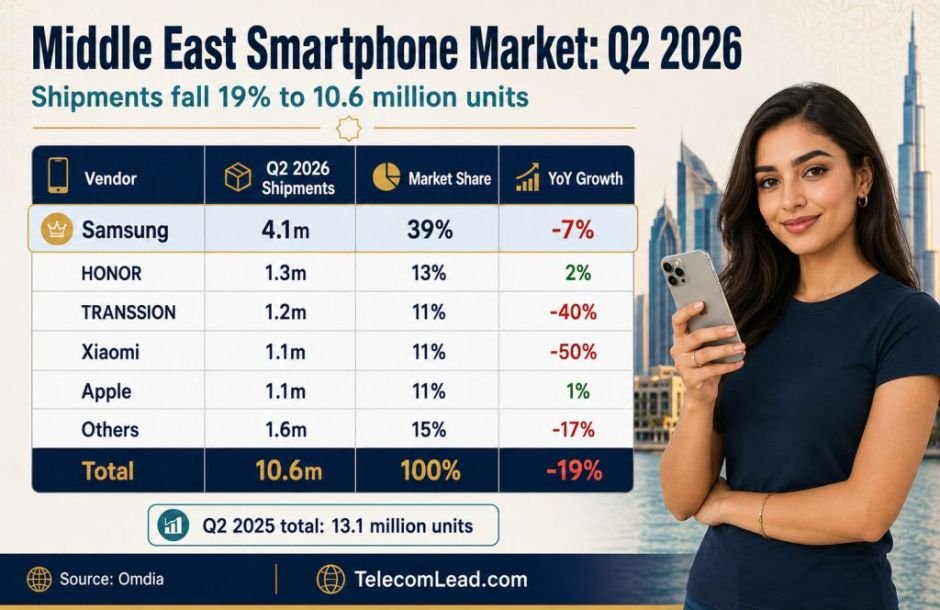
According to Omdia report, regional smartphone shipments fell 19 percent from 13.1 million units in the second quarter of 2025 to 10.6 million units in the second quarter of 2026. Rising prices, declining affordability and component cost pressures particularly affected vendors dependent on entry-level smartphones.
Samsung expands Middle East smartphone market share
Samsung shipped 4.1 million smartphones during the quarter, down 7 percent from 4.5 million units a year earlier. Despite the shipment decline, its market share increased substantially from 34 percent to 39 percent.
The company balanced shipment volumes from its Galaxy A series with Galaxy S26 models designed to support revenue and profitability. Samsung’s diversified portfolio helped it gain share while the broader Middle East smartphone market contracted.
HONOR strengthens second position with 13 percent share
HONOR remained the region’s second-largest smartphone vendor, reporting 2 percent annual shipment growth. The company shipped 1.3 million units in the second quarter of 2026, broadly unchanged from 1.3 million units a year earlier because of rounding.
HONOR increased its market share from 10 percent to 13 percent, benefiting from stronger performance than most leading smartphone brands during the market downturn.
TRANSSION shipments plunge 40 percent
TRANSSION ranked third after its smartphone shipments dropped 40 percent year on year. Shipments declined from 2 million units in the second quarter of 2025 to 1.2 million units in the second quarter of 2026.
Its Middle East market share consequently fell from 15 percent to 11 percent. TRANSSION’s exposure to price-sensitive customers left the company vulnerable to component inflation and weakening demand for entry-level smartphones.
Xiaomi suffers 50 percent shipment decline
Xiaomi recorded the steepest decline among the five leading smartphone vendors. Its shipments plunged 50 percent from 2.3 million units to 1.1 million units.
The company’s market share dropped from 17 percent in the second quarter of 2025 to 11 percent in the second quarter of 2026. Persistent pricing pressure and limited flexibility to absorb higher component costs weakened Xiaomi’s cost-performance proposition among budget-conscious consumers.
Apple gains share as premium smartphone demand remains resilient
Apple shipped 1.1 million iPhones during the quarter, broadly unchanged from 1.1 million units in the previous year. However, unrounded shipments increased 1 percent year on year.
Apple’s market share rose from 8 percent to 11 percent as premium demand, ecosystem strength and access to consumer financing insulated the company from the wider market contraction.
Other smartphone vendors collectively shipped 1.6 million units, down 17 percent from 1.9 million units in the second quarter of 2025. Their combined market share remained unchanged at 15 percent.
The results show that Samsung, HONOR and Apple gained market share even as overall Middle East smartphone demand weakened. TRANSSION and Xiaomi faced the greatest pressure as rising device prices reduced affordability in the entry-level segment.
Middle East Smartphone Shipments Fall 19 Percent
Smartphone shipments in the Middle East, excluding Turkey, declined 19 percent year on year to 10.6 million units in the second quarter of 2026. This was the region’s sharpest contraction since the fourth quarter of 2025, as higher prices, supply constraints, geopolitical uncertainty and weaker consumer confidence affected demand, Manish Pravinkumar, Principal Analyst at Omdia, said.
Despite the steep fall in volumes, the Middle East smartphone market recorded strong growth in mid-range and premium devices. Vendors increasingly prioritised revenue, profitability and brand positioning over shipment growth, while retailers adopted cautious inventory strategies.
Smartphones below $200 face steep decline
Entry-level smartphones experienced the greatest pressure during the quarter. Shipments of devices priced below $200 plunged 42 percent compared with the second quarter of 2025, reflecting rising component costs and limited scope for vendors to absorb price increases.
Markets heavily dependent on affordable smartphones reported some of the region’s largest declines. Smartphone shipments in Iraq dropped 36 percent year on year as pricing pressures and supply limitations weakened entry-level demand.
Instead of reducing specifications to protect sales volumes, smartphone brands maintained competitive memory, storage, camera, battery and artificial intelligence capabilities while moving customers towards higher price segments.
Smartphone shipments above $300 grow 16 percent
Shipments of smartphones priced above $300 increased 16 percent year on year, confirming the mid-range segment as a central growth area for manufacturers.
Devices offering 256GB of storage represented 55 percent of total smartphone shipments in the region. The strong share indicates that higher storage capacity is becoming a standard consumer expectation rather than a feature limited to premium smartphones.
The shift also demonstrates how brands are using improved specifications and AI features to justify higher prices while protecting margins amid escalating component costs.
Premium smartphone shipments reach Q2 record
The premium segment remained resilient despite the overall market downturn. Shipments of smartphones priced above $800 reached 1.9 million units, marking the highest second-quarter volume recorded for the Middle East’s high-end category.
Apple’s popularity was the primary driver of premium smartphone growth, while the UAE and Qatar proved particularly receptive to higher-value devices.
The UAE smartphone market declined only 7 percent, supported by a developed retail ecosystem that includes Sharaf DG, Emax and online sales platforms. Installment financing helped consumers purchase more expensive devices and supported premium upgrade activity.
Qatar recorded 2 percent smartphone shipment growth during the quarter, benefiting from relatively stable economic conditions and sustained demand for premium devices.
Middle East smartphone ASP rises 25 percent
The combination of falling entry-level shipments and resilient mid-to-high-end demand pushed the region’s smartphone average selling price up 25 percent year on year to $448. This was the highest ASP ever recorded in the Middle East during a second quarter.
The figures reveal a major change in market strategy. Smartphone vendors are accepting short-term shipment declines while protecting product competitiveness, revenue and profitability. Retailers are also limiting inventory exposure as uncertain demand and higher prices increase operating risks.
Omdia said the strategy reflects lessons from earlier cost cycles, when aggressive price competition weakened profitability without creating sustainable market growth. The Middle East smartphone market is therefore becoming smaller by volume but more valuable per device, with premiumisation likely to remain central to vendor strategies.
BABURAJAN KIZHAKEDATH