

India’s smartphone market ended 2025 on a relatively flat note, but the competition between MediaTek and Qualcomm became one of the most important stories shaping the industry. New data from the International Data Corporation (IDC) highlights a major shift in chipset dynamics, premiumization trends, and changing consumer behavior that will influence the market heading into 2026.

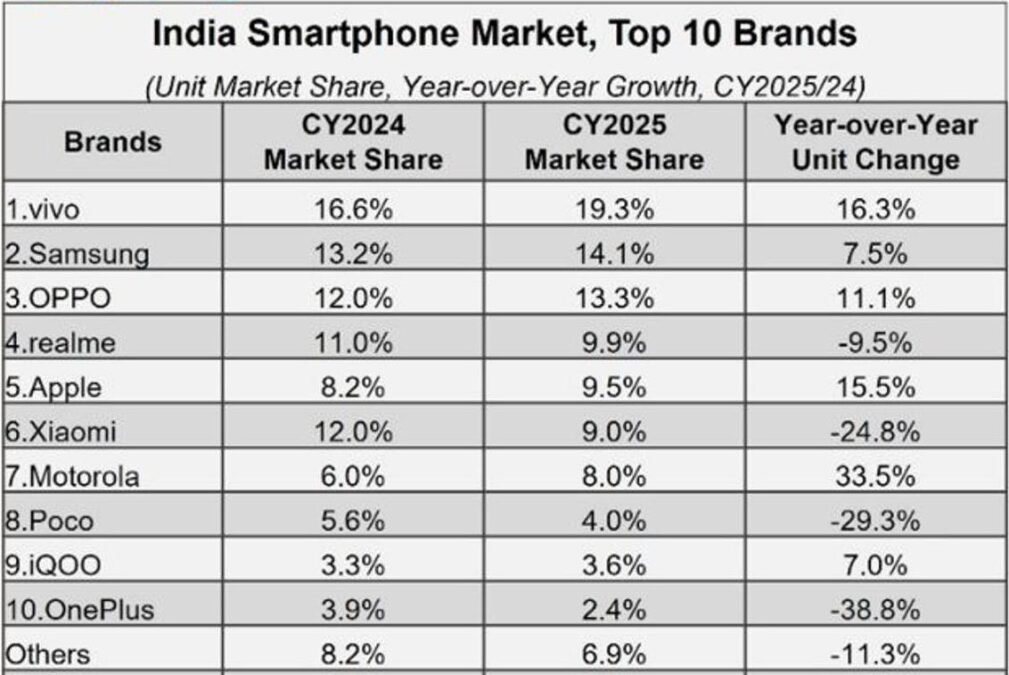
India Smartphone Market Snapshot 2025
India’s smartphone shipments grew just 0.5 percent year-over-year to reach 152 million units in 2025. After a slow start, shipments recovered in mid-2025 before weakening again in the fourth quarter.
Fourth-quarter shipments dropped 5 percent to 34 million units, as post-festive inventory corrections and cautious consumer spending affected demand, IDC report said.
Despite the flat shipment growth, the market delivered 9 percent value growth, signaling strong premiumization and rising smartphone prices.
Apple’s Premium Push Reshapes the Market
India continued to emerge as a major market for Apple, becoming its fourth-largest global market after the US, China, and Japan.
Key Apple milestones in 2025:
Record 14 million shipments, up 16 percent
Ranked 5th in volume share (10 percent)
Captured 29 percent value share, leading the premium segment
iPhone 16 alone contributed 4 percent of India’s total smartphone shipments
Apple’s strong performance is closely tied to the chipset battle because premium phones are dominated by Qualcomm-powered Android devices and Apple’s own silicon.
Rising Prices Driven by Component Costs
Smartphone pricing continued to increase throughout 2025:
Average selling prices rose 4 percent in Q4 to $279
Full-year ASPs increased 8 percent to a record $282
Higher memory costs and a depreciating rupee pushed prices upward, dampening demand in lower price segments.
Segment Performance Shows Premiumization Trend
Entry-Level (Under $100)
Grew 18 percent
Led by Xiaomi and vivo
Motorola recorded fastest growth
Mass-Budget ($100–$200)
Declined 8 percent
Growth led by OPPO and vivo
Entry-Premium ($200–$400)
Fell 5 percent
Growth from vivo, Samsung Electronics, and Motorola
Mid-Premium ($400–$600)
Grew 23 percent
Driven by Apple, Samsung, OPPO
Premium ($600–$800)
Fastest growth at 37 percent
Apple dominated with 74 percent share
Super-Premium ($800+)
Grew 7 percent
Apple led with 63 percent share, Samsung at 34 percent
The premium surge has major implications for chipset vendors, because high-end smartphones heavily depend on advanced processors.
Qualcomm vs MediaTek: Market Share Shift in 2025
The biggest chipset story in India was the shift in market share between Qualcomm and MediaTek.
Qualcomm Gains Momentum
Shipments grew 23 percent
Market share increased to 30 percent
Qualcomm’s growth was driven by strong shipments from Android brands such as Xiaomi, POCO, OPPO, and Nothing, especially in mid-range and premium devices where Snapdragon chipsets dominate.
MediaTek Loses Share
Market share fell to 46 percent, down from 54 percent
Shipments declined 15 percent
MediaTek remains the leader by volume, but the shift reflects rising demand for premium smartphones where Qualcomm has a strong advantage.
Offline Retail Becomes a Growth Engine
Another major trend reshaping the chipset battle was the resurgence of offline retail.
Offline channel shipments grew 12 percent
Market share increased to 57 percent
Online share declined to 43 percent
Premium smartphones received the most aggressive festive promotions, while entry-level Android devices saw weaker upgrade demand.
Vendor Rankings Remain Stable
Top smartphone vendors in India:
vivo – market leader
Samsung – strong premium focus
OPPO – strong offline presence
Meanwhile:
realme, Motorola, and iQOO gained share
Nothing became the fastest-growing brand with 45 percent growth
Scale and omnichannel presence emerged as key success factors.
What This Means for 2026
IDC expects smartphone shipments to decline in 2026 due to a global memory shortage. However, premium demand and finance-led purchasing are expected to sustain value growth.
The Qualcomm vs MediaTek rivalry will likely intensify as:
Premium Android growth favors Qualcomm
Entry-level expansion still supports MediaTek volumes
Rising component costs push vendors toward higher-margin devices
Market consolidation increases the importance of scale and supply chain strength
Conclusion
India’s smartphone market in 2025 revealed a clear shift toward premium devices, rising prices, and stronger offline sales. These trends reshaped the chipset landscape, helping Qualcomm gain ground while MediaTek maintained volume leadership.
BABURAJAN KIZHAKEDATH