

Malaysia’s smartphone market in 2025 and early 2026 is marked by tight vendor competition, rising pricing pressure and shifting buying patterns as consumers balance value, brand trust and security concerns. Chinese smartphone makers dominate shipment volumes, while South Korea’s Samsung remains the strongest non-Chinese competitor.


Smartphone market share: Narrow gaps among top five vendors
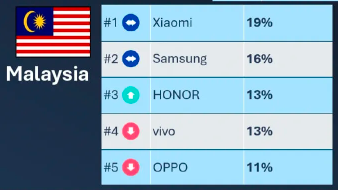
The top five smartphone brands in Malaysia are separated by just 8 percentage points, underlining intense competition, according to the latest Omdia report.
Xiaomi – 19 percent
Xiaomi leads the Malaysian market, driven by competitive pricing, strong online sales and broad appeal in the mid-range segment.
Samsung – 16 percent
Samsung holds second place, benefiting from brand loyalty and a diversified portfolio spanning premium, mid-range and entry-level devices.
HONOR – 13 percent
HONOR continues to gain traction with feature-rich mid-range and upper mid-tier smartphones.
vivo – 13 percent
vivo remains competitive through youth-focused marketing and strong offline retail execution.
OPPO – 11 percent
OPPO rounds out the top five, leveraging camera-focused devices and premium retail experience stores.
While Apple retains strong influence in Malaysia’s premium installed base, shipment growth in 2025 has largely been captured by Chinese vendors offering aggressive specifications at accessible price points.

Vendor strategies: Balancing volume and profitability
Malaysia’s smartphone sector is transitioning from pure volume competition to margin protection and ecosystem differentiation.
Xiaomi’s value-led online strategy
Xiaomi’s leadership is anchored in a value-first portfolio strategy. Its Redmi Note series continues to serve as the volume engine, with devices priced under 1,000 RM appealing to cost-conscious buyers. The brand’s dominance on platforms such as Shopee and Lazada, combined with flash sales and influencer campaigns, has strengthened its online channel advantage. However, rising component costs are gradually pushing up launch prices, especially in the premium tier.
Samsung’s premiumization and retail strength
Samsung is leveraging its Galaxy A series to capture first-time 5G buyers while defending the high-end market with Galaxy S and Ultra models. Trade-in incentives, festive vouchers and installment financing plans remain central to its strategy. Samsung’s extensive physical retail presence provides a key advantage among consumers who prefer in-store purchases for reliability and after-sales assurance.
HONOR’s high-spec differentiation
HONOR has built momentum by focusing on display quality, battery durability and camera performance in the mid-to-upper tiers. Aggressive launch promotions, influencer endorsements and bundled free gifts have helped accelerate brand visibility among younger buyers seeking premium features at lower price points.
vivo’s ASP growth and youth positioning
vivo is shifting toward higher average selling prices by promoting imaging-focused and lifestyle-centric devices. Its strategy blends offline retail strength with e-sports and youth engagement campaigns, helping maintain brand loyalty despite shipment pressure.
OPPO’s retail-led consolidation
OPPO continues to emphasize premium in-store experiences and clearer product segmentation. By simplifying entry-level portfolios and focusing on Reno series upgrades, OPPO aims to defend margins amid cost inflation.
Pricing trends: Memory costs drive inflation
Smartphone pricing in Malaysia is being shaped by higher global memory costs. DRAM and NAND price increases have pushed up bills of materials, particularly for devices below $200 equivalent pricing. Vendors are responding by:
Increasing retail prices for new launches
Reducing hardware specifications to maintain price tiers
Promoting higher-memory variants with financing offers
Enhancing software optimization to offset lower RAM configurations
As a result, average selling prices are gradually rising, even in traditionally price-sensitive segments.
Buying patterns: Omnichannel, financing and festive promotions
Malaysian consumers exhibit hybrid buying behavior:
Strong online purchasing via Shopee, Lazada and TikTok Shop
Continued preference for physical retail stores for premium purchases
High reliance on installment plans and trade-in programs
Purchase spikes during Chinese New Year and Hari Raya campaigns
Festive campaigns such as Samsung’s seasonal rebate programs and HONOR’s bundled gift promotions have become essential tools for stimulating upgrades in a mature market.
AI-driven ecosystem marketing is also gaining traction, with vendors promoting cross-device integration between smartphones, wearables and smart home appliances to increase perceived value.
Customer complaints: Delivery delays, misleading ads and AI scams
As online smartphone sales grow, consumer complaints have reached record levels. Regulatory authorities report rising grievances related to:
Delayed delivery and non-delivery of devices
Misleading promotional claims
Counterfeit products sold via third-party sellers
Warranty and return disputes
Additionally, the rise of AI-generated scams has weakened digital trust. Surveys indicate that a significant majority of Malaysian consumers have altered their online shopping behavior due to fraud concerns. This trend is increasing demand for verified sellers, secure payment systems and built-in device security features.
Outlook: From price wars to ecosystem competition
Malaysia’s smartphone market is entering a new phase where success depends on balancing pricing discipline, margin protection and ecosystem integration. While Xiaomi leads in shipment share, Samsung leverages brand equity and HONOR, vivo and OPPO push aggressive mid-range innovation.
FASNA SHABEER