

Indonesia’s smartphone market is becoming concentrated as higher memory costs weaken demand for entry-level devices. Transsion led the country with a 26 percent shipment share in the second quarter of 2026, followed by Xiaomi at 20 percent, Samsung at 18 percent, OPPO at 17 percent and vivo at 15 percent, according to Omdia.

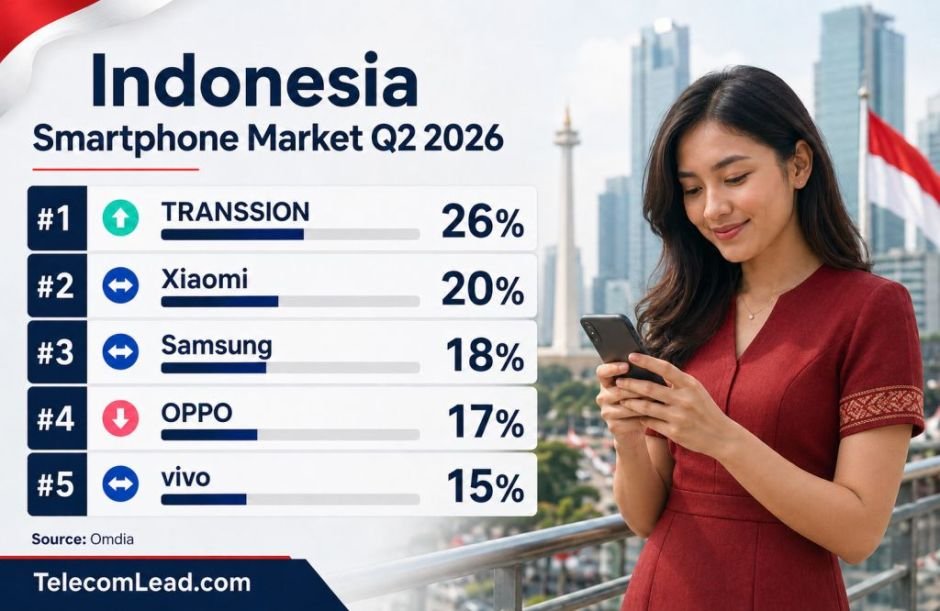
Omdia’s latest Southeast Asia smartphone market research said the five vendors collectively controlled 96 percent of Indonesian smartphone shipments. Other brands — including Apple, HONOR and local vendors — shared the remaining 4 percent, illustrating the dominance of Android brands in Southeast Asia’s largest smartphone market.
Only five percentage points separated Xiaomi, Samsung, OPPO and vivo. However, Transsion maintained a six-percentage-point lead over Xiaomi and an eight-point advantage over Samsung.
Transsion and Xiaomi together controlled 46 percent of the market. Chinese vendors Transsion, Xiaomi, OPPO and vivo accounted for a combined 78 percent, more than four times Samsung’s 18 percent share.
Also Read: Indonesia Smartphone Market Report Q2 2026
Also Read: Vietnam Smartphone Market Q2 2026
Also Read: Thailand Smartphone Market Q2 2026
Also Read: Philippines Smartphone Market Q2 2026
Indonesia Smartphone Shipments Fell 17 Percent in 1Q26
Indonesia entered 2Q26 following a sharp first-quarter contraction. Smartphone shipments fell 17 percent year on year to 7.2 million units in 1Q26.
The country experienced Southeast Asia’s largest absolute shipment decline during that quarter. Based on the reported 17 percent contraction, Indonesia shipped approximately 8.7 million smartphones in 1Q25 — indicating a year-on-year reduction of around 1.5 million devices.
Elevated channel inventory, weaker-than-expected Ramadan demand and recent retail price increases affected replacement purchases. Indonesia’s position as the region’s largest smartphone market means its performance also has a significant impact on Southeast Asia’s overall figures.
Transsion Leads with 26 Percent as Sub-$100 Shipments Fall
Transsion secured 26 percent of Indonesian smartphone shipments through its Infinix, TECNO and itel brands. The multi-brand portfolio gives it extensive coverage across entry-level, affordable 5G and gaming-oriented categories.
However, Transsion’s regional performance shows that the traditional sub-$100 model is becoming harder to sustain. Its Southeast Asian shipments declined 25 percent to 3.4 million units in 2Q26, compared with 4.6 million a year earlier.
Transsion’s shipments below $100 fell 47 percent. Shipments between $100 and $199 increased 12 percent, making this the group’s largest price category.
New devices such as the Infinix HOT 70 and TECNO SPARK 50 4G were introduced at higher prices than their predecessors. The strategy involves offering larger batteries, high-refresh-rate displays, improved cameras and AI features while moving consumers above the traditional entry-level price ceiling.
Transsion’s 26 percent leadership is therefore substantial, but its heavy dependence on price-sensitive customers also makes it particularly exposed to further memory and component inflation.
Xiaomi Captures 20 Percent as ASP Rises 43.5 Percent
Xiaomi ranked second with a 20 percent share, six percentage points behind Transsion and two points ahead of Samsung.
Across Southeast Asia, Xiaomi shipped 3.7 million smartphones in 2Q26, down 21 percent from 4.7 million units a year earlier. Its regional market share nevertheless remained unchanged at 19 percent.
Xiaomi recorded a 43.5 percent increase in average selling price — the second-highest ASP growth among the region’s five leading vendors. Its sub-$100 shipments fell 69 percent, but shipments between $100 and $199 increased 55 percent.
The figures indicate that Xiaomi has been more successful than some competitors in moving affordable buyers into the next price band. Price increases on the Redmi Note 15 and higher launch prices for newer models contributed to the ASP increase.
In Indonesia, the Redmi Note 15 6GB+128GB is priced at Rp2.899 million. The Redmi Note 15 Pro 5G costs Rp5.099 million, while the Redmi Note 15 Pro+ 5G reaches Rp8.999 million.
The Pro+ model costs approximately 3.1 times as much as the standard Redmi Note 15. This wide price range allows Xiaomi to compete with Transsion for affordable customers while challenging Samsung and OPPO in higher-value categories.
Samsung Holds 18 Percent and Gains in $200–$299 Segment
Samsung captured 18 percent of Indonesian smartphone shipments, placing it two percentage points behind Xiaomi and one point ahead of OPPO.
Samsung recorded the strongest regional performance among the five vendors in 2Q26. Its Southeast Asian shipments fell 11 percent to 3.9 million units, a smaller contraction than Xiaomi, Transsion, OPPO or vivo. Samsung’s regional share consequently increased from 17 percent to 20 percent.
Its share of Southeast Asia’s $200–$299 category increased from 18 percent in 2Q25 to 32 percent in 2Q26 — a gain of 14 percentage points. Samsung also expanded across the broader sub-$300 category while several competitors reduced their exposure.
OPPO Holds 17 Percent as Entry-Level Shipments Collapse
OPPO accounted for 17 percent of Indonesia’s smartphone shipments, only one percentage point behind Samsung and three points behind Xiaomi.
Its regional performance was considerably weaker. OPPO’s Southeast Asian shipments—including realme but excluding OnePlus — fell 41 percent to 3.1 million units. Its regional share declined from 21 percent to 16 percent.
OPPO’s shipments below $100 plunged 96 percent, the steepest contraction among the leading vendors. Shipments in the $100–$199 category also fell 25 percent, meaning higher price bands did not replace the lost entry-level volume.
The company is responding by emphasising Reno smartphones, AI, imaging, battery performance and promotions. Its Indonesian Reno16 campaign offered Rp1.6 million off the Reno16 Pro. Discounts of up to Rp700,000 were also available on the Reno16 F Eco Pack.
The Rp1.6 million Reno16 Pro reduction was more than twice the maximum Reno16 F discount. This reflects OPPO’s effort to stimulate demand for higher-value smartphones as it reduces its dependence on the lowest price bands.
vivo Maintains 15 Percent While Moving Above $100
vivo captured 15 percent of Indonesia’s smartphone shipments, putting it two points behind OPPO and three points behind Samsung.
Across Southeast Asia, vivo shipped 2 million smartphones in 2Q26, down 26 percent from 2.8 million units in 2Q25. Its regional market share remained stable at 11 percent.
vivo’s sub-$100 shipments declined 88 percent and accounted for only 5 percent of its regional volume, compared with 32 percent one year earlier. The contribution of sub-$100 devices therefore dropped by 27 percentage points.
The company is using financing to maintain affordability as devices move above $100. Its financing offer for the vivo Y500 includes zero percent interest, zero down payment and instalments starting at approximately Rp500,000.
Financing could become increasingly important in Indonesia because it enables consumers to purchase higher-priced devices without absorbing the full cost at the time of sale.
Omdia expects Southeast Asian smartphone shipments to fall 25 percent to 75.3 million units in 2026. That forecast implies a 2025 market of around 100.4 million devices and an annual reduction of approximately 25.1 million shipments.
The global outlook is also weak. IDC expects worldwide smartphone shipments to decline 13.9 percent to around 1.09 billion units in 2026, which would represent the steepest annual contraction on record. A further 1.1 percent decline is forecast for 2027 before a potential 5.5 percent recovery in 2028 as memory supply normalises, according to IDC.
Indonesia Smartphone Competition Moves into Higher Price Bands
Indonesia’s smartphone rankings show that Transsion remains the volume leader, but Xiaomi, Samsung, OPPO and vivo are separated by only five percentage points.
Transsion must protect its affordable-device leadership as sub-$100 demand contracts. Xiaomi is successfully shifting more shipments into the $100–$199 range, while Samsung is gaining strength in the $200–$299 category. OPPO faces the steepest regional shipment pressure, and vivo is increasingly dependent on financing to support purchases above $100.
The next phase of competition will focus on pricing, instalment plans, 5G, AI features, battery capacity, cameras, software support and promotional value. Vendors that can provide stronger specifications without moving prices beyond consumers’ reach will be best positioned to gain share.
FASNA SHABEER