

India’s wearable device market is undergoing a significant shift from a volume-driven business toward higher-value products, as consumers increasingly opt for premium smartwatches, advanced audio devices and emerging form factors such as smart glasses and wristbands.

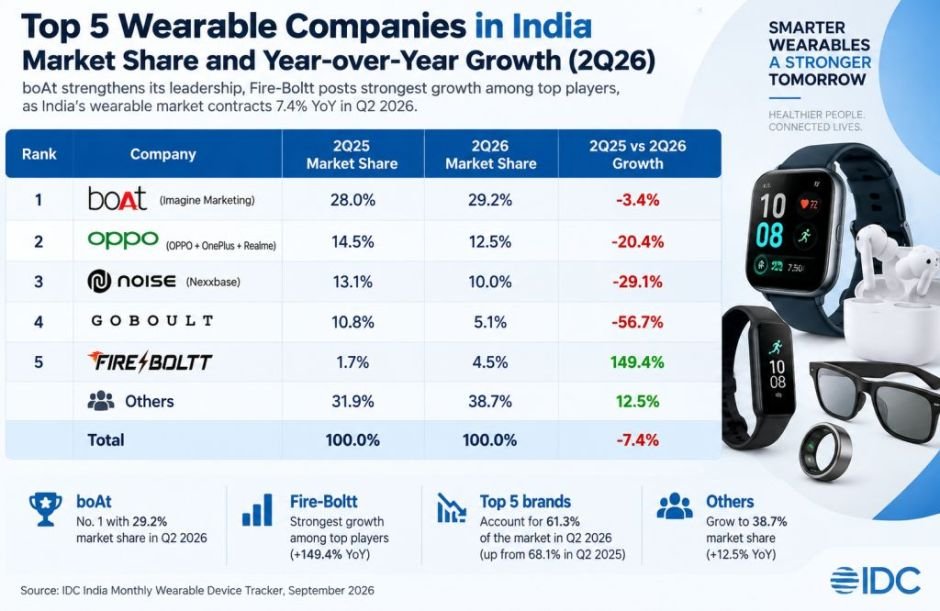
According to IDC’s India Monthly Wearable Device Tracker, wearable shipments in India declined 7.4 percent year over year to 24.7 million units in Q2 2026, compared with a 1.1 percent decline in the first quarter. Fewer product launches and a growing focus on higher-priced devices affected overall shipment volumes.
However, the average selling price (ASP) jumped a record 8.8 percent to $21.0, reversing the 1.1 percent decline recorded in Q1 2026. Despite lower shipments, the overall wearable market value increased 0.7 percent, highlighting the growing impact of premiumization.
For the first half of 2026, India shipped 49.4 million wearable devices, down 4.4 percent, while ASP increased 3.9 percent to $19.5.
Smartwatch ASP Jumps 23.9% as Consumers Trade Up
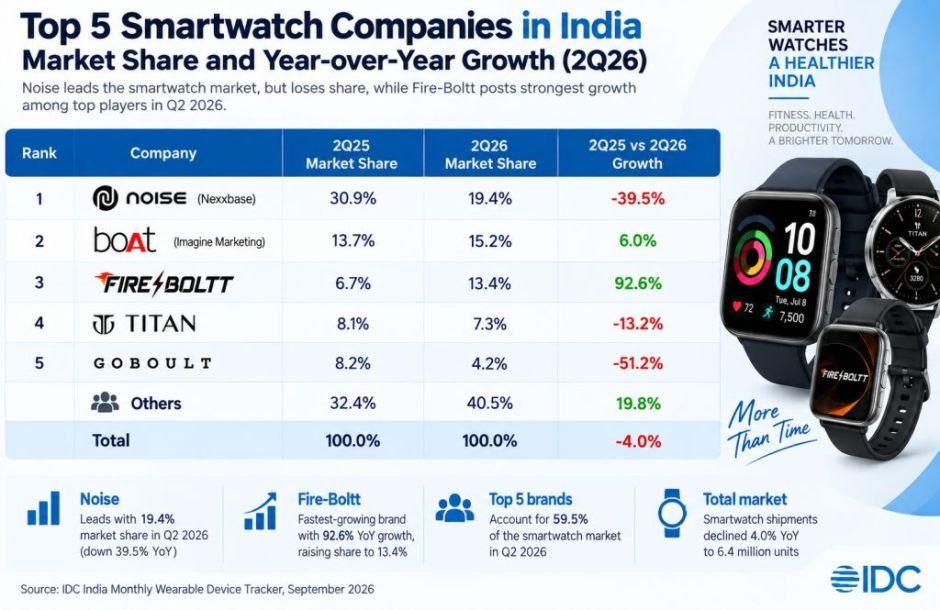
India’s smartwatch market recorded its tenth consecutive quarter of shipment decline, with volumes falling 4 percent to 6.38 million units. Yet smartwatches increased their share of the total wearable market from 24.9 percent to 25.8 percent.
The bigger development was pricing. Smartwatch ASP surged 23.9 percent, from $22.0 to $27.3, indicating that consumers are increasingly willing to pay for better displays, health monitoring, fitness features, build quality and ecosystem integration.
Advanced smartwatches delivered particularly strong growth. Shipments increased 94.8 percent, almost doubling their market share from 2.2 percent to 4.5 percent.

Apple, Samsung and Garmin led the advanced smartwatch segment. Garmin recorded an exceptional 234.2 percent shipment increase, helped by growing consumer interest in running, fitness and sporting events.
The premium trend is visible across price bands. Smartwatches priced below $50 declined 8.3 percent, reducing their market share from 95.9 percent to 91.6 percent. In contrast, the $50-$100 segment expanded its share from 1.9 percent to 4.3 percent.
Earwear Shipments Drop 9.1%, but Premium Audio Gains
Earwear remained India’s largest wearable category with 18.05 million units, although shipments declined 9.1 percent YoY.
The segment’s ASP increased 2.2 percent to $17.8, suggesting that premium audio features are helping brands generate more value despite weaker volumes.
True wireless stereo devices remained dominant with a 71.1 percent share, though TWS shipments dropped 9.3 percent. Neckbands faced considerably greater pressure, with shipments plunging 22.9 percent.
One of the strongest opportunities emerged in over-the-ear devices. Shipments jumped 31.5 percent to 2.0 million units, supported by hybrid working, gaming, entertainment and consumer preference for premium audio experiences.
boAt, Zebronics, JBL and Noise were among the leading brands in this category. Apple recorded 448.6 percent YoY growth, demonstrating the expanding opportunity for premium lifestyle audio.
boAt Expands Wearables Market Leadership
boAt, owned by Imagine Marketing, strengthened its leadership position even as India’s overall wearable market contracted.
The company’s total market share increased from 28.0 percent in Q2 2025 to 29.2 percent in Q2 2026, despite its shipments declining 3.4 percent.
Its strength remains particularly visible in audio. boAt controlled 34.7 percent of India’s earwear market, supported by its presence across TWS, tethered and over-the-ear products.
boAt also strengthened its smartwatch position. Its smartwatch share increased from 13.7 percent to 15.2 percent, while shipments grew 6 percent YoY, placing the company second in the category.
India’s overall top five wearable companies during Q2 2026 were boAt, OPPO — including OPPO, OnePlus and Realme — Noise, GoBoult and Fire-Boltt.
Smart Glasses and Wristbands Emerge as Growth Categories
While smartwatches and earwear still dominate India, smaller wearable categories are showing signs of expansion.
Wristband shipments more than doubled, rising 109.2 percent to 184,400 units, with Pebble and Samsung among the leading players.
Smart glasses shipments increased 38.3 percent to 69,400 units, led by Meta and Fire-Boltt. Although volumes remain small compared with smartwatches and earwear, smart glasses could become an increasingly important wearable category as AI assistants, cameras and hands-free computing capabilities improve.
Smart rings moved in the opposite direction. Shipments declined 23.5 percent to 57,100 units, highlighting the challenge of turning interest in health-focused smart rings into mass-market demand.
Offline Retail Gains Share as Online Wearable Sales Decline
Another important change is taking place in distribution.
Offline wearable shipments increased 2.1 percent, pushing the channel’s market share to 43.8 percent, compared with about 39.8 percent a year earlier.
Online shipments, meanwhile, plunged 13.7 percent, reducing online share to 56.2 percent.
The divergence was particularly pronounced in earwear. Online earwear shipments fell 16.2 percent, while offline shipments grew 2.7 percent. Online smartwatch volumes declined 7.3 percent, whereas offline smartwatch shipments remained broadly stable.
The trend suggests physical retail is becoming increasingly important as wearable products move toward higher prices, where consumers may prefer seeing, testing and comparing devices before purchasing.
AI Could Drive India’s Next Earwear Upgrade Cycle
IDC sees earwear evolving beyond its traditional role as an audio accessory.
Premium sound, active noise cancellation, low latency, longer battery life and improved comfort are increasingly being combined with AI, biometric sensing and health-monitoring capabilities.
Vikas Sharma, senior market analyst for Smart Wearable Devices at IDC India, expects Open Wireless Solution (OWS) and Open Ear Solution (OES) products to gain traction as consumers place greater emphasis on comfort and ear health.
Emerging technologies including camera-enabled earbuds, real-time health monitoring and context-aware AI could eventually transform wireless earbuds into intelligent everyday computing companions.
Such innovation could also help manufacturers justify higher prices and lengthen the value opportunity in a market where traditional TWS replacement cycles are maturing.
India Wearables Market: Q2 2026 Key Figures
India’s wearables market shipped 24.7 million devices, down 7.4 percent, but ASP increased a record 8.8 percent to $21. Earwear accounted for 18.0 million units, while smartwatch shipments reached 6.4 million.
More importantly for the industry’s future, advanced smartwatch shipments surged 94.8 percent, over-the-ear audio grew 31.5 percent, smart glasses expanded 38.3 percent, and wristbands jumped 109.2 percent.
The numbers point to a structural change in India’s wearable technology market. The era when growth depended almost entirely on inexpensive smartwatches and TWS earbuds is weakening. Premium devices, AI-enabled audio, advanced health and fitness features, smart glasses and stronger offline distribution are emerging as the industry’s next growth engines.
BABURAJAN KIZHAKEDATH