

Huawei and Apple emerged as the top performers in China’s smartphone market in Q1-2026, gaining share despite overall market decline, based on separate findings from Counterpoint Research and Omdia.

Omdia: Huawei and Apple Gain Share by Avoiding Price Hikes
Separately, Omdia report indicated that China’s smartphone market declined 1 percent year-on-year in Q1 2026, with total shipments reaching 69.8 million units.
Huawei maintained its leadership with shipments of 13.9 million units and a 20 percent market share, up from 18 percent in Q1 2025. Apple followed closely with 13.1 million units and a 19 percent share, rising significantly from 13 percent a year earlier.
Apple’s shipments increased from 9.2 million units to 13.1 million units, while Huawei’s rose from 13 million to 13.9 million units, reflecting steady and strong growth for both brands.
Omdia noted that several competitors increased smartphone prices by 10 to 30 percent due to rising memory costs, negatively impacting consumer demand. In contrast, Huawei and Apple largely avoided broad price hikes, using pricing discipline to attract consumers and gain market share.
Counterpoint Research: Huawei Leads, Apple Posts Fastest Growth
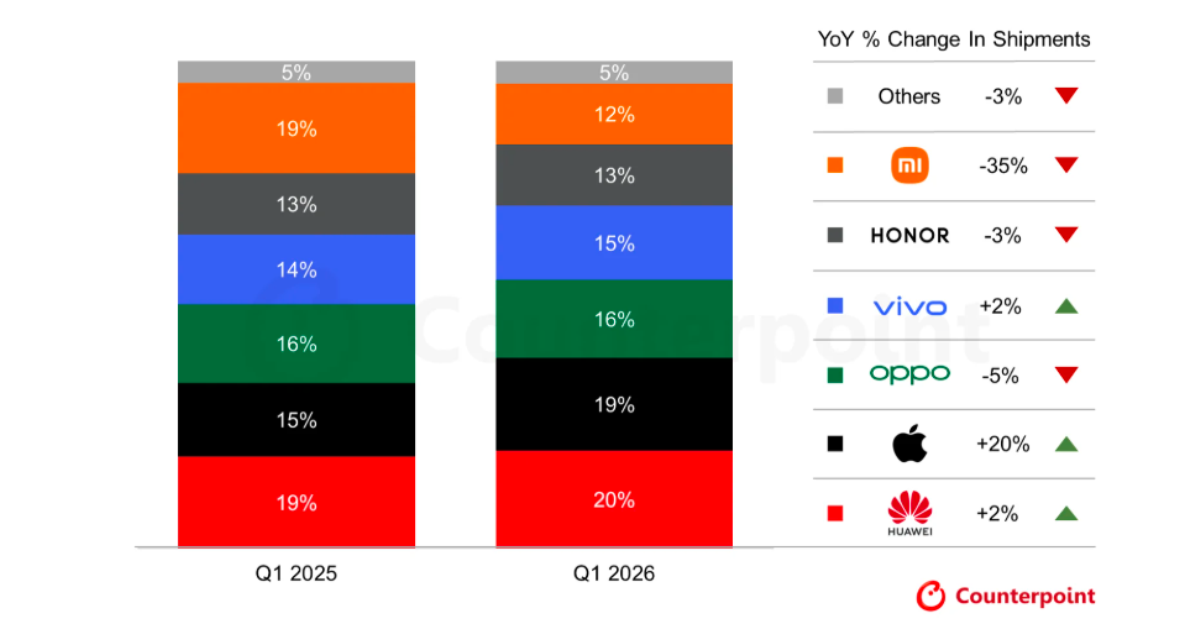
According to Counterpoint Research report, China’s smartphone shipments declined 4 percent year-on-year in Q1 2026 due to a high base from 2025 subsidies and rising component costs.
Huawei led the market with a 20 percent share, the highest since Q4 2020, supported by improved supply of the Mate 80 series, Chinese New Year promotions, and additional shipments from the Enjoy 90 series. Huawei’s shipments increased 2 percent year-on-year, aided by its reliance on domestic suppliers, which helped buffer rising memory costs.
Apple ranked second and recorded the strongest growth among the top six brands, with shipments rising 20 percent year-on-year. Growth was driven by the strong performance of the iPhone 17 series, along with promotional price cuts and government subsidies. Apple’s premium positioning and supply chain strength are expected to help it navigate ongoing cost pressures and expand market share.
Counterpoint also highlighted that rising memory costs are pushing up retail prices and will likely keep the market under pressure through Q2 2026, though premium smartphones remain resilient due to innovations such as AI features, advanced imaging, and foldables.
Strategy Divergence Reshapes Market Dynamics
The contrast in strategy between Huawei and Apple versus other vendors highlights a key shift in China’s smartphone market. While rising costs forced many brands to increase prices, Huawei leveraged domestic supply advantages, and Apple relied on its premium portfolio and supply chain efficiency to absorb costs.
This combination of pricing strategy, product strength, and supply chain resilience enabled both Huawei and Apple to outperform the broader market and strengthen their leadership positions in Q1 2026.
BABURAJAN KIZHAKEDATH