


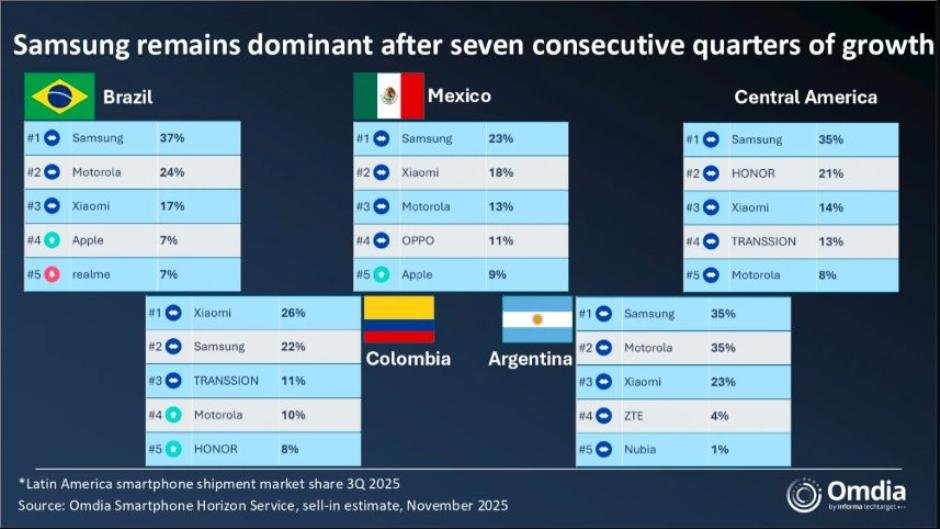
Samsung continues to reinforce its leadership in Latin America’s smartphone market, playing a decisive role in driving the region’s modest recovery and shaping consumer demand across price segments.
Omdia’s latest findings show that the overall market grew by one percent year-over-year in the third quarter of 2025, reaching 35.2 million units — the highest quarterly level since late 2015. This growth came despite economic uncertainty, inventory discipline, and cautious consumer spending. At the center of this momentum is Samsung, which led the market with 11.6 million units and a 33 percent share.


Samsung’s dominance is evident across major Latin American markets. Samsung maintains a 35 percent smartphone market share in Brazil, 23 percent in Mexico, 35 percent in Central America, 22 percent in Colombia, and 35 percent in Argentina. This consistent leadership reflects Samsung’s ability to match its portfolio to the region’s price-sensitive consumers while maintaining brand strength in the mid and high tiers.
A major driver of Samsung’s performance is its A-series lineup. Low-end A-series models accounted for 68 percent of Samsung’s shipments in 3Q25, positioning the brand at the forefront of the sub-three-hundred-dollar category, which still represents more than seventy percent of regional demand. While this low-end segment has declined two percent year-to-date, Samsung’s strong channel presence and broad retail reach have helped stabilize volumes and maintain leadership as competitors face inventory pressures.
At the same time, Samsung has been actively strengthening its midrange and premium offerings in a region where high-value device shipments have risen twenty percent so far this year. The rise in devices priced above five hundred dollars has pushed overall average selling prices up by eight percent. This trend plays to Samsung’s advantage as its premium Galaxy S and foldable lines continue to appeal to aspirational customers and users seeking long-term value. The brand’s dual-positioning — affordability through A-series models and innovation through high-end devices — has allowed it to defend share in both mass-market and premium categories, even as rivals like OPPO, Xiaomi, HONOR, vivo, realme, and Google increase investments in the region.
Samsung’s leadership is also supported by the broader recovery across several Latin American markets. Brazil grew five percent year-over-year, boosted by new entrants expanding through local manufacturing and operator partnerships. Central America and Ecuador continued to post steady growth driven by demand for affordable models. Colombia and Chile showed signs of improvement as inflation eased, investment increased, and consumer spending strengthened. These conditions have supported Samsung’s ability to drive volume while maintaining channel stability.
Omdia Senior Analyst Miguel Ángel Pérez noted that manufacturers are increasing their focus on higher-value segments to maintain share and profitability as the low-end segment becomes saturated. Samsung’s early stocking of premium models in the third quarter ahead of the fourth-quarter peak season aligns with this strategy, reinforcing its competitive position.
The broader outlook for Latin America remains stable for 2025, with the market expected to close the year flat at roughly 137 million units. However, 2026 could bring challenges as rising memory and storage costs may push device prices higher, particularly in entry-level categories. This may impact consumer demand, requiring manufacturers and retailers to consider subsidies, margin adjustments, bundling strategies, and flexible financing plans. Samsung’s well-established ecosystem, strong brand loyalty, and diversified portfolio place it in a favorable position to navigate these challenges while continuing to power smartphone growth across the region.
Baburajan Kizhakedath