

Global XR headwear shipments fell 38.7 percent year on year to 1.9 million units in the first half of 2026, as rapidly growing XR glasses failed to compensate for weakening demand for conventional virtual reality headsets, according to Omdia’s global XR headwear market research.

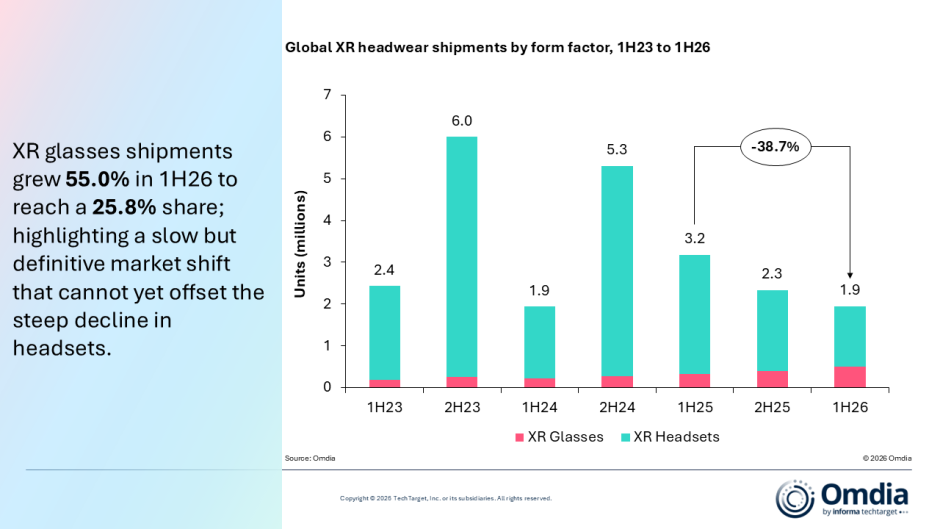
The decline follows the market’s fourth consecutive annual shipment contraction in 2025, highlighting the continuing slowdown in immersive headsets after the pandemic-driven shipment peak in 2021.
However, the headline decline masks an important change in the XR industry: consumers are increasingly shifting from bulky immersive headsets toward lighter glasses designed for video, gaming, artificial intelligence and everyday applications.
XR Glasses Capture 25.8% of Global Shipments
XR glasses increased their share of global XR headwear shipments from 10.2 percent in 1H25 to 25.8 percent in 1H26.
Tethered display glasses accounted for most of the growth. RayNeo, VITURE and XREAL together controlled 93.1 percent of the tethered display-glasses segment.
Demand for products such as the RayNeo Air 4 and VITURE Beast series helped RayNeo and VITURE become the second- and third-largest XR headwear vendors overall. RayNeo captured 9.9 percent of the global market, while VITURE reached 8.6 percent.
The shift suggests consumers are willing to sacrifice some immersive functionality for lighter devices that are easier to use regularly for applications such as entertainment and gaming.
Meta XR Market Share Drops from 71.3% to 48.2%
Meta remained the world’s largest XR headwear supplier, but its dominance weakened significantly.
Meta’s global market share dropped from 71.3 percent in 1H25 to 48.2 percent in 1H26, reflecting softer demand for the Meta Quest 3 and Quest 3S.
Despite improved specifications and more accessible pricing, Omdia said the products have not triggered a major replacement cycle or significantly expanded the audience for VR headsets.
The trend could shift investment toward lighter devices combining AI, cameras, displays and connectivity — technologies that are increasingly intersecting with the broader 5G and telecom technology market.
Intelligent Eyewear Shipments Jump 83%
Other industry research reinforces the shift toward glasses.
According to Counterpoint Research’s intelligent eyewear market analysis, global intelligent eyewear shipments increased 83 percent year on year in Q1 2026.
AR glasses shipments jumped 136 percent, while display-less smart glasses surged 210 percent. In contrast, VR shipments declined 17 percent.
Competition is particularly strong in Birdbath/Flat Prism AR glasses. RayNeo held 41 percent of the segment, while VITURE captured 34 percent after recording 281 percent year-on-year shipment growth.
Competition is also developing in waveguide-based AR. Rokid ranked first, while Meta held 38 percent, followed by Even Realities with 9 percent and Alibaba with 5 percent.
The figures indicate that the XR market is becoming more fragmented as specialist glasses vendors challenge the traditional dominance of VR headset manufacturers.
Google, Samsung and AI Reshape XR Competition
Artificial intelligence is emerging as another important catalyst for XR devices.
Google is developing Android XR with Samsung and Qualcomm while bringing Gemini AI capabilities to XR products. The company has highlighted eyewear partners including Gentle Monster and Warby Parker as part of its Android XR ecosystem.
The combination of Android XR, Gemini, Samsung hardware and Qualcomm chips could create a significant alternative ecosystem to Meta’s vertically integrated XR strategy.
Apple is competing through Vision Pro and spatial computing, while RayNeo, VITURE, XREAL and Rokid are benefiting from growing consumer interest in lighter glasses.
North America Controls 43.9% of XR Market
North America remained the world’s largest XR headwear market in 1H26 with 43.9 percent of global shipments, followed by Western Europe at 23.8 percent.
Greater China recorded a notable increase, with its global shipment share rising from 11.9 percent in 2025 to 16.3 percent in 1H26.
China consequently overtook Rest of Asia-Pacific to become the third-largest XR headwear market, supported by domestic demand for tethered display glasses.
Smart Glasses Could Reach 27.3 Million Units by 2030
Longer-term forecasts indicate that glasses could become one of the primary growth engines for the XR industry.
IDC reported that display-less smart-glasses shipments surged 167 percent year on year to approximately 2.25 million units in Q1 2026.
IDC expects display-less smart-glasses shipments to reach 13.6 million units in 2026 and 27.3 million units by 2030, representing an 18.9 percent CAGR.
Display glasses are expected to expand even faster, rising from 3 million units in 2026 to 12.2 million units in 2030, representing a 41.9 percent CAGR.
These forecasts suggest that XR’s growth opportunity is increasingly moving away from devices designed primarily for lengthy immersive sessions toward glasses intended for more frequent everyday use.
XR Market Shifts from VR Headsets to AI Glasses
The 38.7 percent fall in overall XR headwear shipments to 1.9 million units in 1H26 does not necessarily indicate the disappearance of consumer interest in XR. Instead, the underlying figures point to a fundamental change in device preference.
Meta remains the market leader, but its share has dropped below 50 percent as RayNeo, VITURE and XREAL expand in display glasses. At the same time, Google, Samsung and other technology companies are positioning AI as a central part of the next generation of wearable computing.
With XR glasses already accounting for 25.8 percent of shipments, compared with just 10.2 percent a year earlier, lighter devices are rapidly becoming more important to the industry’s growth story.
The next competitive battle is therefore likely to be driven not simply by better VR experiences, but by the combination of AI, lightweight displays, mobile connectivity and everyday wearable applications.
FASNA SHABEER