

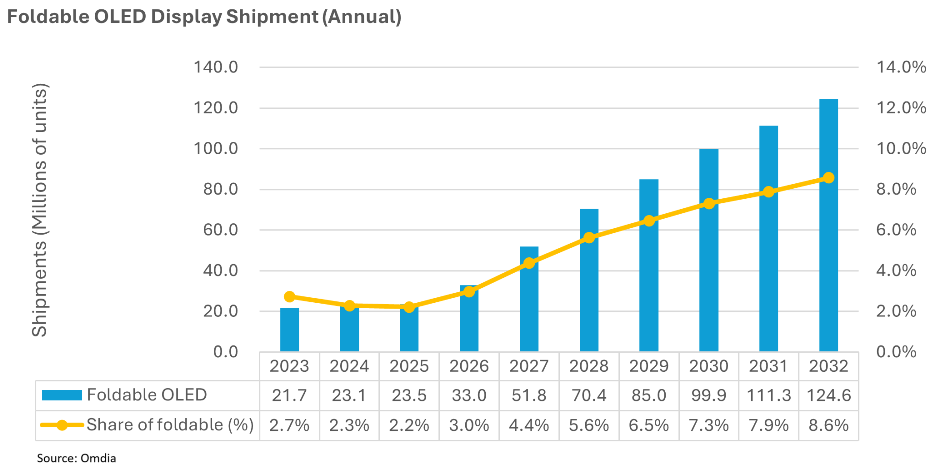
The global foldable OLED display market is set for a major transformation, with shipments projected to reach 124.6 million units by 2032, according to the latest research from Omdia. This would represent 8.6 percent of the total OLED display market, signaling that foldable devices are moving steadily from niche to mainstream adoption.

Current Market Growth and 2025 Outlook
In 2024, foldable OLED shipments grew 6.5 percent year-over-year (YoY) to 23.1 million units, supported by more than 20 new foldable model launches across brands. However, 2025 is expected to see more modest growth of just 1.6 percent YoY, reaching 23.5 million units. Analysts attribute this slowdown to intense competition among smartphone makers, many of whom are pushing engineering limits to design slimmer, more practical devices.
Despite being available since 2019, foldable smartphones have faced adoption hurdles. Two key barriers include:
High pricing, which limits accessibility for mainstream consumers.
Lack of compelling use cases compared to traditional bar-type smartphones.
Additionally, manufacturers have long struggled to balance performance, durability, and thin design, making the foldable experience less appealing for average buyers.
Technology Advancements Driving Adoption
According to Omdia’s Jerry Kang, Practice Leader, the industry is now overcoming these challenges. Display suppliers are reducing the overall thickness of foldable modules by improving ultra-thin glass and support films. These innovations have:
Enabled sleeker and slimmer foldable designs.
Increased durability, addressing one of the biggest consumer concerns.
After more than six years of manufacturing experience, suppliers are reaching maturity in foldable display technology, which could unlock broader adoption in the coming years.
Apple’s Expected Entry: A Game Changer
The biggest inflection point for foldable displays may come with Apple’s anticipated entry in 2026. Omdia believes a foldable iPhone launch could fundamentally reshape the market:
Validating the foldable category in the eyes of global consumers.
Expanding demand beyond the Android ecosystem.
Accelerating post-2026 growth across devices, including smartphones, tablets, and potentially laptops.
“An entry from Apple would fundamentally validate the foldable category and ignite demand far beyond the current Android ecosystem,” Kang noted.
Long-Term Market Potential
By 2032, foldable OLED displays are forecast to account for nearly one-tenth of the entire OLED display market, signaling a long-term growth trajectory. With continuous advancements in slim form factor engineering, durability, and cost reduction, the category is expected to gradually shift from a luxury niche to a mainstream consumer choice.