

Colombia’s smartphone market is becoming an increasingly important battleground for Android brands as consumers become more selective about device upgrades. Xiaomi led smartphone shipments in the country during the second quarter of 2026 with a 27 percent share, followed by Samsung at 22 percent, according to Omdia.

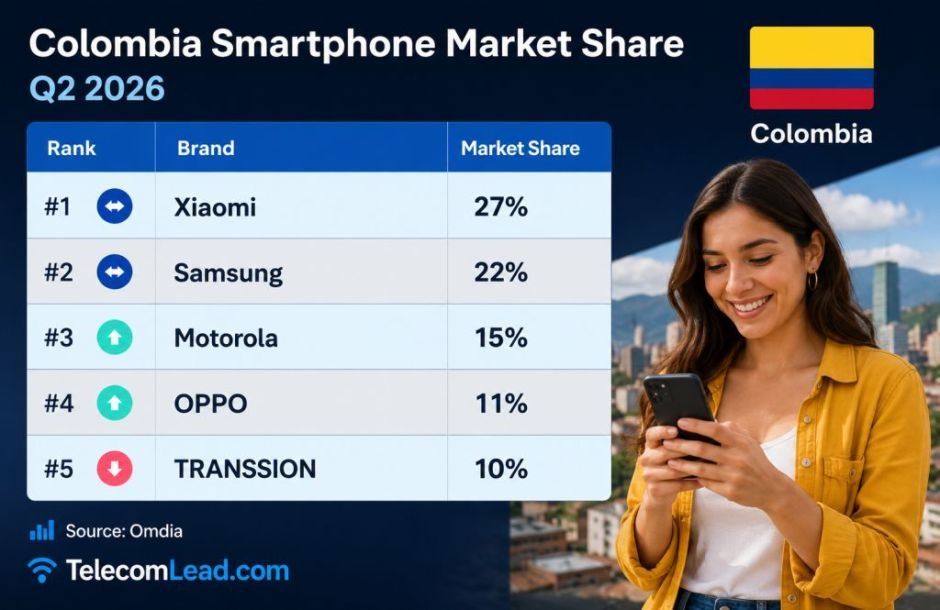
Motorola ranked third with 15 percent, OPPO captured 11 percent and TRANSSION, whose portfolio includes TECNO, Infinix and itel, held 10 percent. Together, the five vendors accounted for 85 percent of Colombia’s smartphone shipments in 2Q26.
The competitive pressure comes as Latin America’s smartphone market faces weaker demand and rising costs. Smartphone shipments across the region fell 12 percent to 30.3 million units in 2Q26 as higher memory costs weighed on demand, according to the Omdia Latin America smartphone market report.
Colombian consumers are therefore paying closer attention to price, storage, cameras, battery capacity, 5G, promotions and financing before replacing existing smartphones.
Xiaomi Leads Colombia Smartphone Market with 27 Percent Share
Xiaomi ranked first with 27 percent of Colombia’s smartphone shipments in 2Q26, underlining the strength of its value-focused Redmi strategy.
The Redmi Note 15 series is an important part of Xiaomi’s 2026 portfolio. The company is positioning the range around higher-resolution cameras, larger batteries, improved durability and competitive storage configurations.
In Colombia, the Redmi Note 15 4G 6GB+128GB has been offered for around COP 699,900, while the 8GB+256GB version has been available for approximately COP 849,900, accompanied by interest-free instalment options through selected channels.
The approach is particularly relevant as consumers try to maximize specifications without moving into substantially higher price bands. Xiaomi is using storage, battery capacity, cameras and aggressive promotions to make upgrading easier to justify.
More information about the product strategy is available through the Xiaomi Redmi Note 15 series launch.
Samsung Holds 22 Percent with Galaxy A and Galaxy S26
Samsung captured 22 percent of Colombia’s smartphone shipments, placing it five percentage points behind Xiaomi.
Unlike Xiaomi’s strong value positioning, Samsung covers a wider price range through its Galaxy A and premium Galaxy S portfolios.
Samsung launched the Galaxy S26 series in Colombia in February 2026. The Galaxy S26 512GB was priced at COP 5.079 million, the Galaxy S26+ at COP 6.049 million and the Galaxy S26 Ultra at COP 6.999 million.
Samsung also used a double-storage launch promotion, effectively offering 512GB for the 256GB price on eligible purchases.
The company is combining Galaxy AI, cameras and premium features with financing. Selected Galaxy S26 purchases have been available with up to 24 interest-free instalments.
The more affordable Galaxy A17, meanwhile, provides a 50MP camera, 5,000mAh battery and Super AMOLED display, allowing Samsung to compete for much larger mainstream volumes.
The Samsung Galaxy S26 launch in Colombia highlights the company’s emphasis on AI and premium smartphone capabilities.
Motorola Takes 15 Percent with Moto G and Edge
Motorola ranked third with 15 percent of Colombia’s smartphone shipments.
Its strategy is built around maintaining a strong presence in affordable and mid-range smartphones through Moto G while using the Edge family to move customers toward higher-value devices.
The Moto G17 starts at COP 899,900, while the Moto G67 starts at COP 1.149 million and Moto G77 at COP 1.499 million.
Motorola is also expanding further upmarket with the Edge 70 Fusion, introduced in Colombia at COP 2.199 million. The device combines the Snapdragon 7s Gen 3 platform with a 5,200mAh battery, 68W charging and moto AI functionality.
The broad portfolio gives Motorola an opportunity to retain price-sensitive customers while encouraging some users to migrate toward higher-priced smartphones.
Additional specifications and pricing are available in the Motorola Moto G launches in Colombia.
OPPO Captures 11 Percent with Cameras and AI
OPPO secured 11 percent of Colombia smartphone shipments in 2Q26.
Rather than competing primarily on the lowest possible price, OPPO is emphasizing photography, AI, battery performance, durability and design.
The Reno14 5G demonstrates that positioning with a 50MP telephoto camera offering 3.5x optical zoom, AI photography tools, IP69 protection and Google Gemini integration.
The Reno14 F 5G 12GB+512GB has been promoted by Colombian retailers at around COP 2.299 million, compared with an earlier listed price of COP 3.599 million, alongside interest-free instalment offers.
Such discounts show the competitive pressure in Colombia’s higher mid-range segment, where consumers can choose between flagship-like features from OPPO and aggressively priced alternatives from Xiaomi, Samsung and Motorola.
The OPPO Reno14 smartphone in Colombia provides further details on the company’s camera and AI proposition.
TRANSSION Reaches 10 Percent as TECNO Pushes Affordable 5G
TRANSSION ranked fifth with a 10 percent shipment share, putting the company only one percentage point behind OPPO.
Its TECNO, Infinix and itel brands primarily target customers looking for strong specifications at accessible prices.
The TECNO Spark 50 5G illustrates the strategy with a 6.78-inch 120Hz display, 50MP camera, 256GB storage and 6,150mAh battery with 45W charging.
The smartphone has been promoted at around COP 849,900 through Colombian online channels, putting 5G and relatively high storage capacity within reach of more price-sensitive consumers.
The strategy directly addresses one of the biggest opportunities in Colombia: customers migrating to 5G without necessarily wanting a premium-priced smartphone.
Details of the device are available through the TECNO Spark 50 5G specifications for Colombia.
Colombia Has 94.6 Million Active Mobile Lines
The smartphone battle is taking place inside one of Latin America’s largest mobile markets.
Colombia reached 94.6 million active mobile telephone lines during the first quarter of 2026, according to the Colombia ICT Ministry’s latest connectivity report. The country also had 49.6 million mobile internet accesses, equivalent to approximately 93 connections for every 100 inhabitants.
More importantly for smartphone vendors, Colombia’s 5G base has expanded rapidly. The country reached 10 million 5G accesses by March 2026, representing quarterly growth of 7.7 percent. However, 5G coverage was still concentrated in around 12 percent of municipalities. 4G remained the dominant technology with 36.5 million mobile internet accesses.
That creates considerable room for additional smartphone upgrades as 5G coverage expands beyond the largest cities.
Claro Colombia Has Nearly 41 Million Mobile Subscribers
Claro remains the biggest individual mobile operator in Colombia and therefore an important sales and distribution channel for smartphone manufacturers.
Claro Colombia ended June 2026 with 40.94 million wireless subscribers. Its postpaid base increased 9.3 percent to 12.27 million, while prepaid subscribers fell 5.8 percent to 28.67 million following a cleanup of 2.5 million inactive prepaid lines. Claro added 250,000 postpaid subscribers during 2Q26.
The operator generated COP 4.367 trillion in total revenue during the second quarter, an increase of 5.8 percent . Service revenue rose 7.5 percent to COP 3.366 trillion, while wireless revenue increased 7.7 percent to COP 3.014 trillion.
Mobile service revenue increased an even stronger 10.5 percent to COP 2.080 trillion, while postpaid revenue grew 10.2 percent. Mobile ARPU increased 6.6 percent to COP 16,218.
The combination of rising postpaid customers and higher mobile revenue is significant for smartphone vendors because postpaid contracts can support device financing and upgrades into higher-priced 5G models.
Claro has also expanded its 5G network to 78 Colombian cities and towns.
Tigo-Movistar Creates a Much Larger Challenger to Claro
One of the biggest structural changes in Colombia’s telecom market in 2026 is the integration of Tigo and Movistar.
Millicom took operational and administrative control of Colombia Telecomunicaciones, or Coltel, in February 2026 after acquiring Telefónica’s 67.5 percent stake. It subsequently acquired the Colombian government’s remaining 32.5 percent stake, giving Millicom full control. The combined operation has emerged as Colombia’s second-largest mobile group, with close to 39 percent of mobile accesses, according to the CRC.
Millicom reported $816 million of service revenue from Colombia in 2Q26, including a $377 million contribution from Coltel. Colombian service revenue increased 11 percent, supported by prepaid and postpaid mobile services, home services and B2B.
Coltel contributed 8.5 million mobile customers at the end of the quarter, including 5.5 million postpaid subscribers. Before the integration, Tigo Colombia had 13.2 million mobile subscribers at the end of 2025.
The combination materially changes the competitive environment facing Claro and also creates a much larger distribution and financing platform for smartphone vendors.
WOM Remains an Important Competitive Force
WOM continues to provide competitive pressure, particularly around mobile pricing and network performance, although comparable Q2 2026 Colombia-specific revenue and subscriber figures are not publicly reported as comprehensively as those from Claro and Millicom.
The operator has nevertheless established itself as part of Colombia’s four-network-operator market alongside Claro, Tigo, Movistar and the continuing integration of the latter two businesses.
Network experience is also becoming increasingly important as consumers buy more capable smartphones. CRC measurements showed WOM delivering the lowest average 4G latency at 26.2 milliseconds, ahead of Tigo at 27.1 milliseconds, Movistar at 29.9 milliseconds and Claro at 30.9 milliseconds. WOM also recorded the best average jitter performance at 8.8 milliseconds.
5G Growth Creates Opportunity for Xiaomi, Samsung and Rivals
Colombia’s 10 million 5G accesses are particularly important for the smartphone market. As operators expand their networks, consumers have a stronger reason to replace older 4G devices.
But the transition does not automatically favour premium phones.
Xiaomi and TRANSSION can address consumers seeking affordable entry points into 5G. Motorola has the opportunity to convert Moto G customers into higher-value 5G models, while Samsung can cover almost every price segment through Galaxy A and Galaxy S. OPPO is positioning AI, photography and design as reasons to pay more.
Operator financing will therefore remain important. Claro’s postpaid base has already exceeded 12 million customers, while the Tigo-Movistar combination creates another substantial postpaid customer pool.
Colombia Smartphone Market Becomes a Value Battle
The 2Q26 rankings show that Colombia is increasingly a value-driven smartphone market.
Xiaomi’s 27 percent share gives it a five-percentage-point advantage over Samsung, but the competitive field remains broad. Samsung holds 22 percent, Motorola 15 percent, OPPO 11 percent and TRANSSION 10 percent.
The wider telecom environment is also changing rapidly. Colombia has 94.6 million active mobile lines, 49.6 million mobile internet accesses and already 10 million 5G connections. Claro has nearly 41 million wireless subscribers, while the Tigo-Movistar integration has created a substantially larger second operator.
For smartphone brands, winning in Colombia will consequently require more than launching new devices. Price, financing, storage, battery life, cameras, AI and 5G will increasingly determine upgrade decisions as consumers compare what they receive for every peso they spend.
FASNA SHABEER