

China’s smartphone market declined 2 percent year-over-year (YoY) in the second quarter of 2026, with total shipments reaching 66.1 million units, according to Omdia.

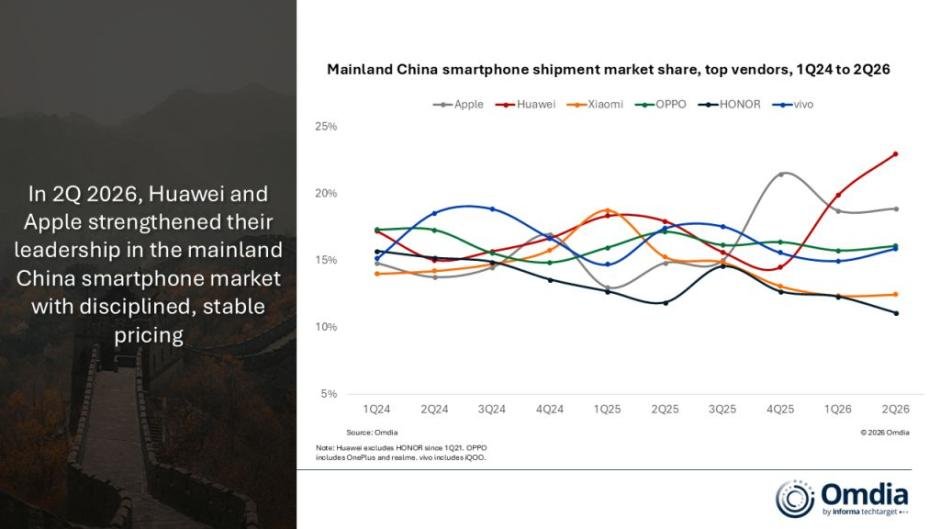
Though the market contracted, its performance remained stronger than the global smartphone market, which recorded a 4 percent decline during the same period. Rising memory costs continued to reshape the competitive landscape, favoring smartphone vendors with stronger premium product portfolios and stable pricing strategies, Omdia report said.
Huawei Extends Leadership in China’s Smartphone Market
Huawei remained the largest smartphone vendor in mainland China during Q2 2026, capturing 23 percent market share as its premium and entry-level product strategy continued to resonate with consumers. Huawei had 18 percent share in Q2 2025.
Hayden Hou, Principal Analyst at Omdia, said Huawei benefited from stable pricing, strong demand for its flagship devices, and successful launches of new smartphones such as the Pura X Max and Enjoy 90 Pro Max.
The company also strengthened its competitive position through sustained investment in research and development (R&D) and close collaboration with domestic supply chains, enabling it to better manage rising component costs than many rivals.
Apple Achieves Record Second-Quarter Performance in China
Apple ranked second in China’s smartphone market after shipping 12.4 million iPhones, accounting for 19 percent market share. Omdia noted that Apple achieved its highest-ever second-quarter shipment volume and market share in mainland China. Apple had 15 percent market share in Q2 2025.
Despite inflationary pressure on memory components and aggressive pricing adjustments by competitors, Apple maintained stable iPhone pricing. This strategy encouraged retail channel restocking while supporting consumer demand for premium iPhones.
OPPO, vivo and Xiaomi Demonstrate Operational Resilience
Chinese smartphone makers continued to navigate component cost inflation while balancing shipment growth and profitability.
OPPO, including OnePlus and realme brands, secured third place after shipping 10.6 million smartphones, representing 16 percent market share. Oppo had 17 percent market share in Q2 2025.
vivo ranked fourth with shipments of 10.5 million smartphones. Vivo has 16 percent market share in Q2 2026 vs 17 percent share in Q2 2025.
Xiaomi completed the top five after shipping 8.2 million smartphones, capturing 12 percent market share. Xiaomi has 12 percent market share in Q2 2026 vs 15 percent share in Q2 2025.
Omdia said leading Android vendors increasingly adjusted pricing, product positioning, channel strategies, and portfolio management to protect margins amid rising manufacturing costs.
AI Smartphones Become the Next Competitive Battleground
Beyond hardware competition, smartphone makers are accelerating investments in artificial intelligence.
Omdia highlighted that HONOR is developing an agentic operating system (OS), while ZTE and ByteDance are expanding collaboration on AI-capable smartphones. AI capabilities are evolving beyond standalone features toward system-level intelligence that enables inter-application collaboration, end-to-end task execution, and deeper integration with third-party ecosystems.
Future smartphone competition will increasingly depend on AI-native operating systems, ecosystem integration, personalization, and intelligent software experiences rather than hardware specifications alone.
China Smartphone Market Outlook for 2026
Omdia forecasts that mainland China’s smartphone shipments will decline 6 percent YoY during 2026 as rising memory prices continue to pressure the industry. However, the Chinese market is still expected to outperform the broader global smartphone market.
The research firm expects smartphone vendors to focus on optimizing product portfolios, redesigning supply chains, refining channel strategies, and carefully balancing market share with profitability. With consumers becoming more cautious about device upgrades, vendors offering clearly differentiated products, meaningful hardware improvements, competitive pricing, and superior user experiences are expected to gain an advantage in China’s increasingly polarized smartphone market.
SHAFANA FAZAL